Hydrogen (H2) is a clean carbon-free fuel with high gravimetric energy density and emerges as an attractive alternative to the unrenewable fossil resource. Photocatalytic water splitting over a semiconductor provides a promising economical and environmentally friendly route to convert unlimited solar energy to H2. The light-driven hydrogen evolution reaction (HER) involves light-harvesting, charge separation and transport, and surface proton reduction. The slow multi-electron interfacial proton reduction usually occurs within milliseconds or longer, while the photoexcited state typically relaxes and returns to the ground state via radiative or irradiative recombination within a few picoseconds. The formation of abundant long-lived electrons with timely transport to reactive sites for the proton reduction is regarded as a key issue for HER but remains one challenge for designing photocatalysts.
Credit: Chinese Journal of Catalysis
Hydrogen (H2) is a clean carbon-free fuel with high gravimetric energy density and emerges as an attractive alternative to the unrenewable fossil resource. Photocatalytic water splitting over a semiconductor provides a promising economical and environmentally friendly route to convert unlimited solar energy to H2. The light-driven hydrogen evolution reaction (HER) involves light-harvesting, charge separation and transport, and surface proton reduction. The slow multi-electron interfacial proton reduction usually occurs within milliseconds or longer, while the photoexcited state typically relaxes and returns to the ground state via radiative or irradiative recombination within a few picoseconds. The formation of abundant long-lived electrons with timely transport to reactive sites for the proton reduction is regarded as a key issue for HER but remains one challenge for designing photocatalysts.
Co-catalysts are typically involved in HER to accelerate electron-to-proton transfer. COFs offer a versatile affinity to modulate and stabilize co-catalysts and maximize their efficiency, particularly for noble metal co-catalysts like Pt single atom. Strategies such as pre-designation, post-modification, and hybridization with other materials have been employed to develop COFs-based photocatalysts for HER. However, the function of COFs is strongly dependent on the building blocks, making the synthesis and structure modulation via monomer designation crucial. Although COFs have been typically synthesized from highly symmetric and rigid building blocks, the use of asymmetric monomers may greatly enrich the variety, physicochemical properties, and functions of COFs. Nonetheless, the intrinsic mismatch between the isotropy of crystal and the anisotropy of asymmetric building blocks poses a challenge in synthesis. While COFs containing asymmetric monomers have been used in the field of gas adsorption and fuel cells, they have not yet been applied in the field of photocatalysis and metal-supported catalysts, particularly monoatomic catalysts.
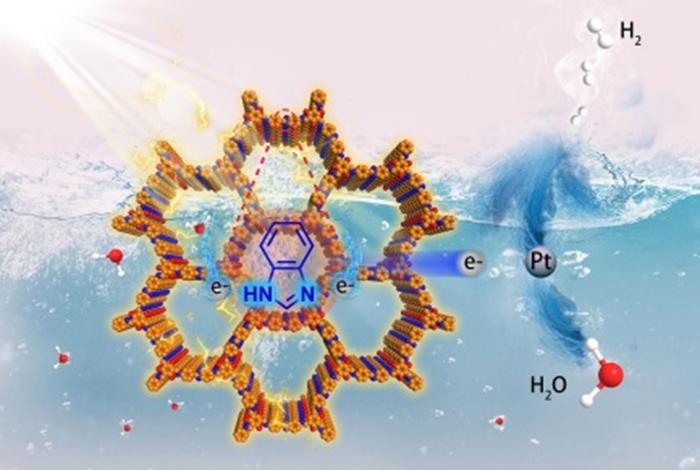
Recently, a research team led by Prof. Yu Zhou and Prof. Jun Wang from Nanjing Tech University, China, reported the construction of highly active covalent organic framework (COF) from the unusual benzimidazole monomer in a microwave-assisted solvothermal pathway. With single-atom Pt sites as the cocatalyst, the benzimidazole-based COF exhibited a high HER rate up to 115 mmol g–1 h–1 and turnover frequency of 4475.1 h–1 under visible-light irradiation. The above performance relied on the combinational effect of benzimidazole moieties and COF framework, which, on the one hand, stabilized photogenerated electrons to prolong the electron lifetime, and on the other hand, provided a strong host-guest interaction that resulted in the creation of single-atom Pt sites and the acceleration of the electron-transfer to the Pt active sites for proton reduction. This work demonstrates the perspective in the construction of electron stabilization and interfacial charge transfer avenue for the HER process, which can be reached by a molecular-level design of COF-based organic semiconductors by using structural and functional diverse asymmetric building blocks. The results were published in Chinese Journal of Catalysis (https://doi.org/10.1016/S1872-2067(23)64422-5).
###
About the Journal
Chinese Journal of Catalysis is co-sponsored by Dalian Institute of Chemical Physics, Chinese Academy of Sciences and Chinese Chemical Society, and it is currently published by Elsevier group. This monthly journal publishes in English timely contributions of original and rigorously reviewed manuscripts covering all areas of catalysis. The journal publishes Reviews, Accounts, Communications, Articles, Highlights, Perspectives, and Viewpoints of highly scientific values that help understanding and defining of new concepts in both fundamental issues and practical applications of catalysis. Chinese Journal of Catalysis ranks among the top two journals in Applied Chemistry with a current SCI impact factor of 12.92. The Editors-in-Chief are Profs. Can Li and Tao Zhang.
At Elsevier http://www.journals.elsevier.com/chinese-journal-of-catalysis
Manuscript submission https://mc03.manuscriptcentral.com/cjcatal