A key challenge in neuroscience is to understand how the brain can adapt to a changing world, even with a relatively static anatomy. The way the brain’s areas are structurally and functionally related to each other – its connectivity – is a key component. In order to explain its dynamics and functions, we also need to add another piece to the puzzle: receptors. Now, a new mapping by Human Brain Project (HBP) researchers from the Forschungszentrum Jülich (Germany) and Heinrich-Heine-University Düsseldorf (Germany), in collaboration with scientists from the University of Bristol (UK), New York University (USA), Child Mind Institute (USA), and University of Paris Cité (France) made advances on our understanding of the distribution of receptors across the brain.
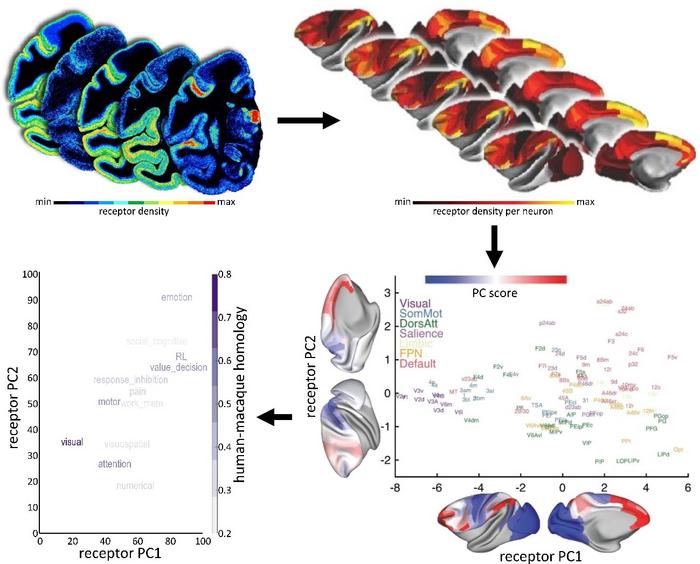
Credit: Sean Froudist-Walsh, Nicola Palomero-Gallagher
A key challenge in neuroscience is to understand how the brain can adapt to a changing world, even with a relatively static anatomy. The way the brain’s areas are structurally and functionally related to each other – its connectivity – is a key component. In order to explain its dynamics and functions, we also need to add another piece to the puzzle: receptors. Now, a new mapping by Human Brain Project (HBP) researchers from the Forschungszentrum Jülich (Germany) and Heinrich-Heine-University Düsseldorf (Germany), in collaboration with scientists from the University of Bristol (UK), New York University (USA), Child Mind Institute (USA), and University of Paris Cité (France) made advances on our understanding of the distribution of receptors across the brain.
The findings were published in Nature Neuroscience, and the data is now freely available to the neuroscientific community via the HBP’s EBRAINS infrastructure.
The HBP team used autoradiography to analyse the density of receptors for neurotransmitters on very thin in vitro brain sections. They measured the density of 14 neurotransmitter receptor types in 109 areas of the macaque cortex and this data was integrated with multiple structural parameters into neuroimaging templates.
Neurotransmitter receptors
Receptors are key molecules in signal transmission in the brain. Within a neuron, information transmission occurs via electric signals along the axon. But transfer of information between neurons usually requires the release of molecules called neurotransmitters into the extracellular space and their binding to receptors on the target neuron.
The HBP researchers have uncovered a primary and a secondary gradient of receptor expression per neuron. In other words, they mapped receptor densities across the cortex and were able to identify two main arrangements, shedding light on the links between molecular and neuron organization of the cortex. “These two major axes of receptor organisation in the macaque cortex align with two different functional systems, namely the sensory-cognitive and the external-internal cognition networks. This is the first time that such an association has been described,” explains Nicola Palomero-Gallagher, researcher at the Forschungszentrum Jülich and senior author of the paper.
Integrating maps
In their study, the researchers integrated the new neurotransmitter receptor data with multiple layers of anatomical and functional data onto a common cortical space within the cortical surface of Yerkes19, a frequently used non-human primate template. Few studies so far had integrated in vitro anatomy and in vivo imaging of the macaque brain. Creating openly-accessible maps of receptor expression across the cortex that integrate neuroimaging data, such as what was done by the HBP team, could speed up translation across species.
“It is being made freely available to the neuroscientific community so that they can be used by other computational neuroscientists aiming to create other biologically informed models,” Palomero-Gallagher says. Part of the data generated for this study has already been implemented in a computational model of how dopamine gates information into the frontoparietal working-memory network.
Text by Helen Mendes
Journal
Nature Neuroscience
DOI
10.1038/s41593-023-01351-2
Article Title
Gradients of neurotransmitter receptor expression in the macaque cortex
Article Publication Date
19-Jun-2023