Researchers led by Christi Gendron at the University of Michigan, US, have found the link between death perception and reduced aging in flies. Their new study, published June 13th in the open access journal PLOS Biology shows that a specific group of brain cells in the fly, called R2 and R4 neurons, are activated when flies encounter other dead flies, and that this increased activity leads to more rapid aging.
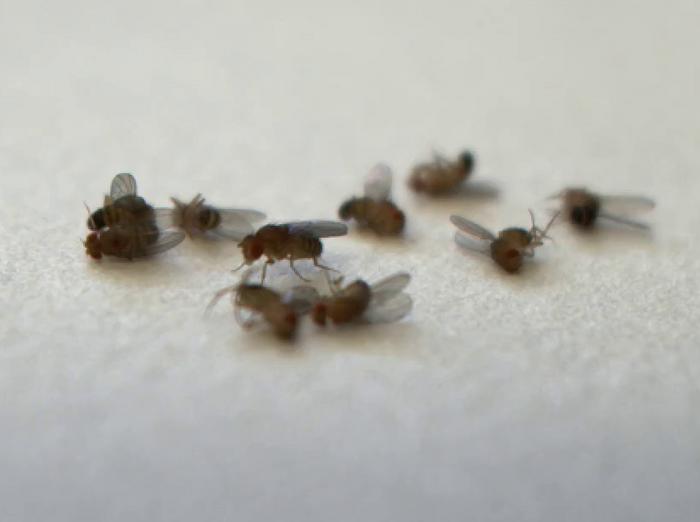
Credit: Christi Gendron (CC-BY 4.0, https://creativecommons.org/licenses/by/4.0/)
Researchers led by Christi Gendron at the University of Michigan, US, have found the link between death perception and reduced aging in flies. Their new study, published June 13th in the open access journal PLOS Biology shows that a specific group of brain cells in the fly, called R2 and R4 neurons, are activated when flies encounter other dead flies, and that this increased activity leads to more rapid aging.
Aging is a complex process that can be affected by both genetics and the environment. While we know that perceptual experiences can affect aging, how this happens is still mostly a mystery. One example is the effect of “death perception” in fruit flies. Previously, the group at the University of Michigan reported that when fruit flies see other dead fruit flies, they experience advanced aging, and that this depends on a type of serotonin receptor. In their new follow-up study, the researchers report the details of this process.
A series of experiments in fruit flies showed that a specific group of neurons is responsible. Fluorescent tagging showed that exposure to dead flies led to increased activity in a region of the fly brain called the ellipsoid body. Silencing different ring neurons in this region revealed that two types of ring neurons, R2 and R4, are necessary for the effect, and other tests showed that the key is the serotonin receptor 5-HT2A located on these neurons. Finally, the researchers showed that when these neurons were artificially activated, fruit fly lifespans decreased, even when flies did not actually experience any death perception. Understanding how neural circuits like this regulate aging could eventually lead to targeted drug therapies in humans that slow the aging process.
Coauthor Scott Pletcher adds, “We identified specific neurons and evolutionarily conserved molecules in the fly brain that help tune rates of aging in response to environmental conditions and experiences.”
#####
In your coverage, please use this URL to provide access to the freely available paper in PLOS Biology: http://journals.plos.org/plosbiology/article?id=10.1371/journal.pbio.3002149
Citation: Gendron CM, Chakraborty TS, Duran C, Dono T, Pletcher SD (2023) Ring neurons in the Drosophila central complex act as a rheostat for sensory modulation of aging. PLoS Biol 21(6): e3002149. https://doi.org/10.1371/journal.pbio.3002149
Author Countries: United States
Funding: This work is supported by National Institutes of Health, National Institute on Aging RO1AG051649 (to SDP), National Institutes of Health, National Institute on Aging RO1AG030593 (to SDP), National Institutes of Health, National Institute on Aging RO1AG063371 (to SDP), and the Glenn Medical Foundation (to SDP). The funders had no role in study design, data collection and analysis, decision to publish, or preparation of the manuscript.
Journal
PLoS Biology
DOI
10.1371/journal.pbio.3002149
Method of Research
Experimental study
Subject of Research
Animals
COI Statement
Competing interests: The authors have declared that no competing interests exist.