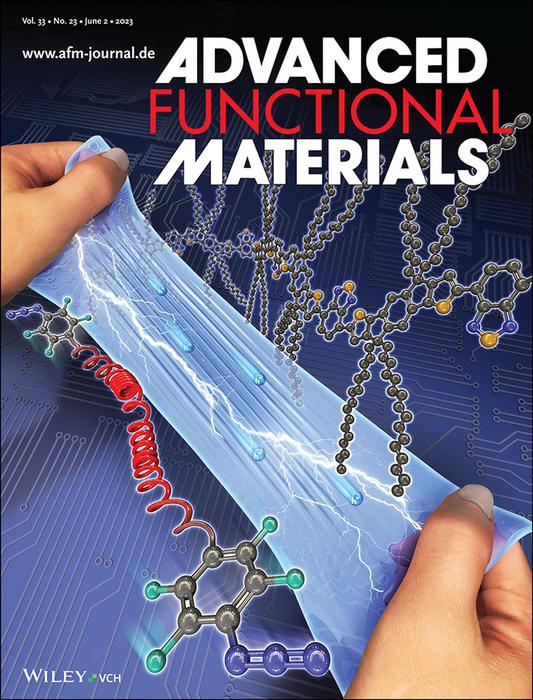
Like the brakes that stop cars, a molecular brake exists that can prevent semiconductor chains from slipping, enabling the creation of more groundbreaking devices. Recently, a joint research team led by Professor Kilwon Cho and PhD candidates Seung Hyun Kim and Sein Chung from the Department of Chemical Engineering at POSTECH, and Professor Boseok Kang from the Department of Nano Engineering at Sungkyunkwan University (SKKU) has developed a technology for high-performance organic polymer semiconductors that exhibit both stretchability and electrical functionality. This study was recently featured on the inside back cover of Advanced Functional Materials.
Credit: POSTECH
Like the brakes that stop cars, a molecular brake exists that can prevent semiconductor chains from slipping, enabling the creation of more groundbreaking devices. Recently, a joint research team led by Professor Kilwon Cho and PhD candidates Seung Hyun Kim and Sein Chung from the Department of Chemical Engineering at POSTECH, and Professor Boseok Kang from the Department of Nano Engineering at Sungkyunkwan University (SKKU) has developed a technology for high-performance organic polymer semiconductors that exhibit both stretchability and electrical functionality. This study was recently featured on the inside back cover of Advanced Functional Materials.
For semiconductors to find applications in diverse flexible devices like flexible displays and skin-attachable medical devices, it is necessary to use stretchable materials instead of rigid ones. However, the force exerted during the stretching of semiconductors can be up to ten times greater than that experienced during simple bending, leading to the breakdown of the semiconductor layers and a decline in their electrical performance. Researchers have been diligently exploring methods to preserve semiconductor performance even under deformation, but a definitive solution to this challenge remains elusive.
The research team successfully created a flexible molecular photocrosslinker1 featuring azide-reactive groups at both ends. When exposed to ultraviolet light, this photocrosslinker forms a network structure with the polymer semiconductor, acting as a brake that prevents slipping even under stretching conditions. In contrast to conventional semiconductor materials, where polymer chains become intertwined and irreversibly slip and fracture when stretched, the presence of this “brake” allows the polymer chains to retain their stretchability and performance without any slipping.
Using this approach, the research team successfully preserved up to 96 percent of the electrical performance of the polymer semiconductor, even when it was stretched to 80 percent. Moreover, the semiconductor exhibited significantly enhanced stretchability and durability compared to conventional semiconductors, clearly demonstrating the effectiveness of the developed technology.
Professor Kilwon Cho explained, “By incorporating azide photocrosslinkers into the films, we have successfully preserved the excellent electrical properties of polymer semiconductors for organic thin-film transistors even under significant mechanical deformation. This simple approach significantly enhances the stretchability and UV-patternability of organic semiconducting polymers, making it highly valuable for industries requiring large-area production and photolithography for the development of next-generation flexible electronics.”
This study was conducted with the support of the Mid-career Researcher Program of the National Research Foundation of Korea and the Strategic Reinforcement of International Cooperation Network of the Ministry of Science and ICT of Korea.
Journal
Advanced Functional Materials
DOI
10.1002/adfm.202370142
Article Title
Designing a Length-Modulated Azide Photocrosslinker to Improve the Stretchability of Semiconducting Polymers
Article Publication Date
2-Jun-2023