Driven by a lifelong curiosity about the natural world and the diversity of life, Elizabeth King, associate professor in the Division of Biological Sciences at the University of Missouri, found inspiration to spend her formative years studying science — and along the way she discovered her passion for biology. That foundation has led her to pursue an ongoing career working to develop a better understanding of genetic traits from a biological perspective.
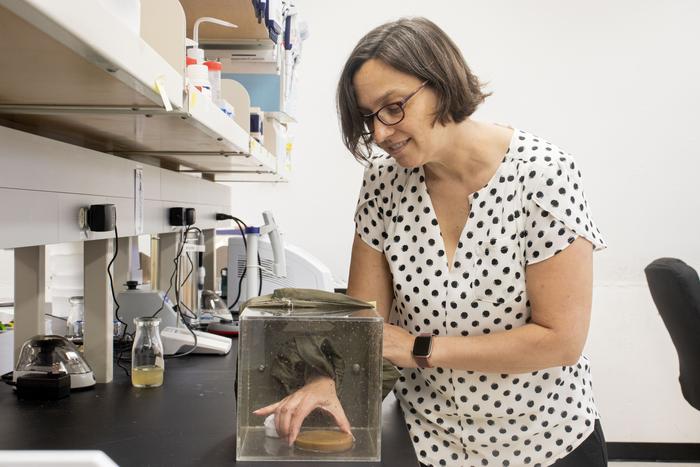
Credit: Pate McCuien/University of Missouri
Driven by a lifelong curiosity about the natural world and the diversity of life, Elizabeth King, associate professor in the Division of Biological Sciences at the University of Missouri, found inspiration to spend her formative years studying science — and along the way she discovered her passion for biology. That foundation has led her to pursue an ongoing career working to develop a better understanding of genetic traits from a biological perspective.
Recently, the National Institutes of Health (NIH) awarded King a five-year, $1.9 million grant to expand her lab’s research focused on experimental biology using a fruit fly model. The goal of the project is to develop a knowledge base surrounding complex traits or characteristics — like a fruit fly’s flight performance and endurance — that are determined by the interconnectedness among many factors, including multiple genes and the environment. King said the research will help address a scientific knowledge gap found in this field of study.
“Science hasn’t fully grappled with the ‘complex’ part of complex traits, and that’s left a significant knowledge gap in our understanding of the genetic basis of these traits,” King said. “Our work embraces this complexity by focusing explicitly on the interconnectedness between multiple high-order traits and the sub-phenotypes that come together to shape them. Overall, this research will provide generalizable lessons about how genomes are connected to physiology to produce the interconnected set of traits that affect health across the lifespan.”
While King’s research is focused on basic science knowledge, she hopes the data gathered over the span of the five-year project can one day be applied by other scientists studying human genetics. For instance, one aspect of the research will focus on trait hierarchies, or how traits are organized into different groups called phenotypes and sub-phenotypes. She said many human traits are organized in comparable ways.
“For instance, a person’s risk of a heart attack results from a combination of a lot of different phenotypes and sub-phenotypes found at different levels,” King said. “So, with this project we’re looking at traits structured in similar ways in flies, such as flight performance, and dissect the genetics across the genotype-to-phenotype map to see if we can come up with some general lessons about what these traits are really like because they’re so complex we haven’t really figured them out yet. We’ve developed hypotheses for why that might be the case, and we’re hoping to harness the power of the fly model to figure that out.”
Using fruit flies as a model to understand the general principles across the diversity of life can also be highly relevant to understanding how traits function in humans.
“Like we do with other species, fruit flies share common ancestry with humans,” King said. “In a lot of cases once we figure out a gene’s function, we can then connect that trait to something similar in humans. It’s estimated that around 75% of genes in the Drosophila genome have a relationship to disease-related genes found in humans.”
The grant, “Genome evolution across complex trait hierarchies” is funded by NIH.