
Credit: American Chemical Society
Grease-proof packaging has helped make pizzas, burgers and tacos on-the-go a less messy proposition. However, a new study in the ACS journal Environmental Science & Technology Letters has found that some fast-food packaging from across the U.S. contains a variety of fluorinated compounds — a few of which have been linked to potential health effects.
According to the Agency for Toxic Substances and Disease Registry, some studies in humans have suggested that long-chain, per- and polyfluoroalkyl substances, or PFASs, are associated with developmental problems in children, decreased fertility and an increased cancer risk. In 2000, the U.S. started phasing out some long-chain PFASs, which had commonly been used in a wide range of products to make them stain-resistant or waterproof, for example. But other countries still produce them, and some manufacturers have replaced them with shorter-chain PFASs or variations of long-chain PFASs. The potential health effects of these smaller compounds are unclear, although preliminary studies have raised concerns. Previous research has shown that substances in food packaging can migrate into food and, when discarded in landfills, could contribute to elevated levels of PFASs in the environment. How much depends on type of PFAS, temperature and other factors.
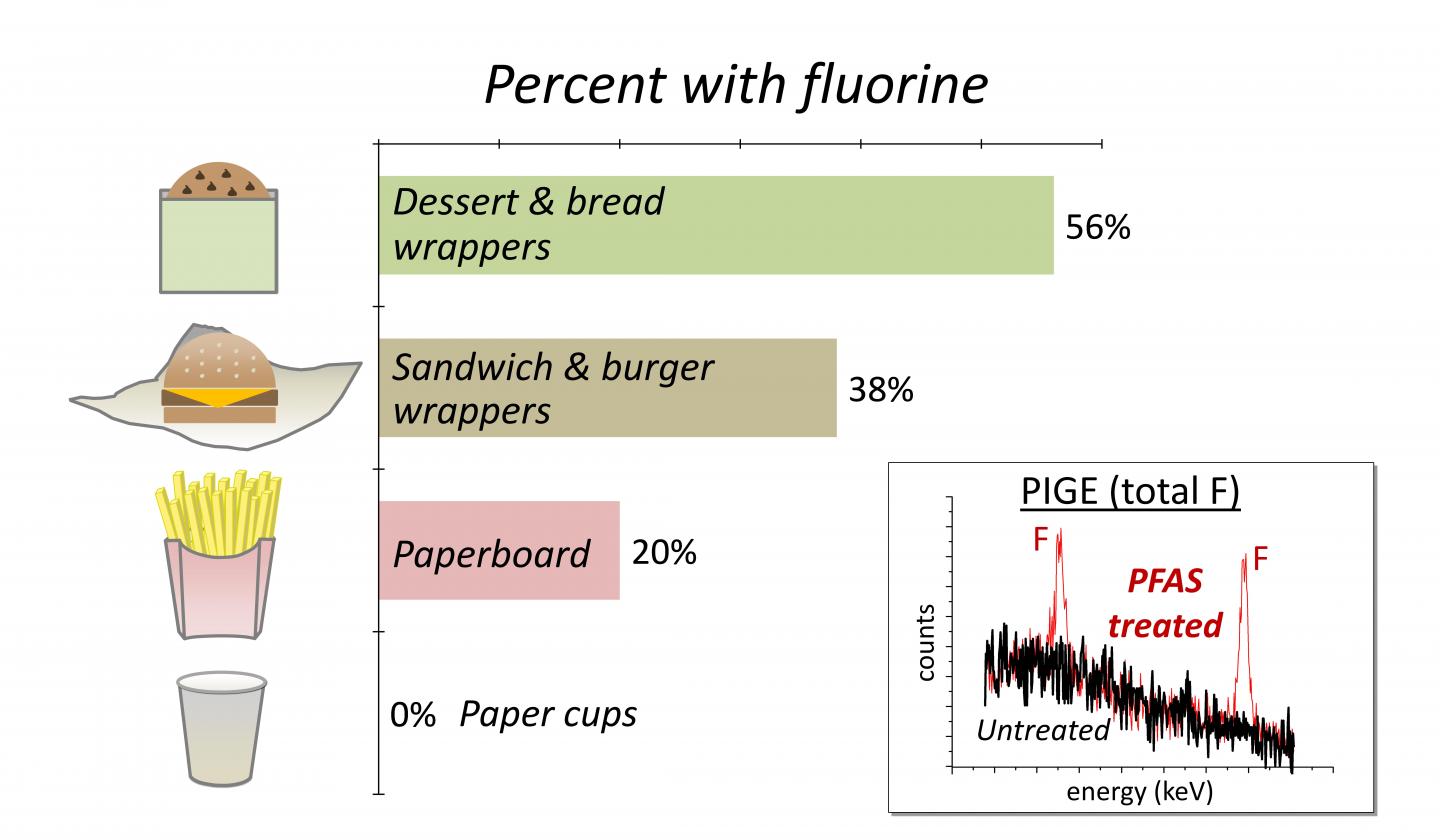
To find out how widely used PFASs are in fast-food packaging, Laurel Schaider of the Silent Spring Institute and her colleagues tested more than 400 paper wrappers, paperboard containers and cups from fast-food restaurants across the U.S. They detected fluorine — an indication of fluorinated compounds — in nearly half of the food contact papers overall and 20 percent of the paperboard containers. Wrappers for Tex-Mex food, desserts and breads were the most likely to contain fluorine. A more detailed analysis of a subset of 20 samples found that perfluorooctanoic acid (PFOA), a long-chain PFAS currently being phased out in the U.S., was among the packaging compounds. Determining what the findings mean for consumers is difficult, however. The PFASs occurred at a wide range of concentrations, suggesting that some of them were not specifically added to the packaging but came from older, recycled materials or other undetermined sources. The researchers say this could lead to the persistence of some of the compounds, even if phased out, for many years to come.
###
The authors acknowledge funding from the National Science Foundation and the Silent Spring Institute.
The paper's abstract will be available on Feb. 1 at this link: http://pubs.acs.org/doi/abs/10.1021/acs.estlett.6b00435
The American Chemical Society is a nonprofit organization chartered by the U.S. Congress. With nearly 157,000 members, ACS is the world's largest scientific society and a global leader in providing access to chemistry-related research through its multiple databases, peer-reviewed journals and scientific conferences. ACS does not conduct research, but publishes and publicizes peer-reviewed scientific studies. Its main offices are in Washington, D.C., and Columbus, Ohio.
To automatically receive news releases from the American Chemical Society, contact [email protected].
Follow us: Twitter | Facebook
Media Contact
Katie Cottingham
[email protected]
301-775-8455
@ACSpressroom
http://www.acs.org
############
Story Source: Materials provided by Scienmag