Fertilized chicken eggs can be sexed by “sniffing” volatile chemicals emitted through the shell, according to new work by researchers at the University of California, Davis, and Sensit Ventures Inc., a startup company in Davis. The work is published May 22 in PLOS ONE.
Credit: Sensit Ventures, Inc.
Fertilized chicken eggs can be sexed by “sniffing” volatile chemicals emitted through the shell, according to new work by researchers at the University of California, Davis, and Sensit Ventures Inc., a startup company in Davis. The work is published May 22 in PLOS ONE.
The study shows that it is feasible to sort eggs by sex, early in incubation, based on volatile organic chemicals, said Professor Cristina Davis, associate vice chancellor for interdisciplinary research and strategic initiatives at UC Davis and co-author on the paper.
Hatcheries for laying hens sort chicks by sex a day after hatching, with male chicks being culled immediately. If hatcheries could instead identify the sex of an egg early in incubation, billions of male eggs could be humanely diverted to other uses, reducing waste and environmental impact. Some European countries have already banned culling of male chicks or plan to phase it out.
Technology already on the market depends either on sampling the egg through a tiny hole in the shell, or imaging through the shell. Imaging technology is more accurate with older eggs.
The UC Davis/Sensit approach relies on detecting volatile organic compounds given off by the developing embryo that diffuse through the shell. The first step was to find out if there is a reliably detectable difference in the chemicals given off by male and female embryos.
Davis’ lab at the UC Davis Department of Mechanical and Aerospace Engineering has developed sensing chip technology that can be used to collect and analyze organic chemicals in the air. The patented technology has been licensed by Sensit, which aims to commercialize it for a range of applications including agriculture and medicine.
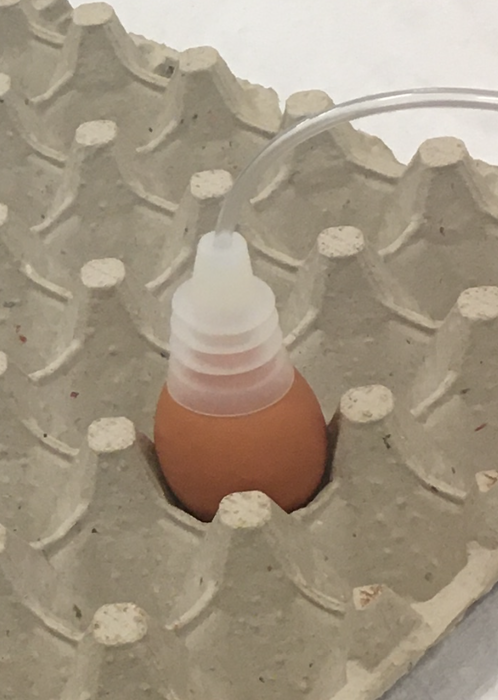
Suction cup sniffer
The researchers adapted suction cups used for industrial handling of eggs to “sniff” air from the eggs without opening them. The air samples were analyzed in Davis’ lab with gas chromatography/mass spectrometry. Sex of the eggs was confirmed by DNA analysis in Professor Huajin Zhou’s lab at the UC Davis Department of Animal Science.
“We found that there are volatile chemicals from the egg, a scent that you can capture and sort statistically,” said Tom Turpen, president and CEO of Sensit Ventures and senior author on the paper. Using this method, the researchers were able to identify male and female embryos at 8 days of incubation with 80% accuracy, based on two minutes of sampling.
Rapid suction-cup sampling could be carried out in rows to test a lot of eggs at the same time.
“We think that the hardware platform invented at UC Davis could be integrated into hatcheries,” Turpen said.
Sensit was founded in 2015 with support from the Venture Catalyst unit of the UC Davis Office of Research.
“It’s been essential for a small startup like us to be able to access resources on campus,” Turpen said.
Additional authors on the paper are: at UC Davis, Eva Borras, Ying Wang, Kevin Bellido, Katherine Hamera, Mitchell McCartney and Kristy Portillo; Priyanka Shah and Robert Arlen, Sensit Ventures.
The work was partly supported by a grant from the Foundation for Food & Agricultural Research, or FFAR.
Journal
PLoS ONE
DOI
10.1371/journal.pone.0285726
Method of Research
Experimental study
Subject of Research
Animals
Article Title
Active sampling of volatile chemicals for non-invasive classification of chicken eggs by sex early in incubation
Article Publication Date
22-May-2023
COI Statement
The authors have declared that no competing interests exist.