COLUMBIA, Mo. – For more than 10 years, Guoliang Huang, the Huber and Helen Croft Chair in Engineering at the University of Missouri, has been investigating the unconventional properties of “metamaterials” — an artificial material that exhibits properties not commonly found in nature as defined by Newton’s laws of motion — in his long-term pursuit of designing an ideal metamaterial.
Credit: University of Missouri
COLUMBIA, Mo. – For more than 10 years, Guoliang Huang, the Huber and Helen Croft Chair in Engineering at the University of Missouri, has been investigating the unconventional properties of “metamaterials” — an artificial material that exhibits properties not commonly found in nature as defined by Newton’s laws of motion — in his long-term pursuit of designing an ideal metamaterial.
Huang’s goal is to help control the “elastic” energy waves traveling through larger structures — such as an aircraft — without light and small “metastructures.”
“For many years I’ve been working on the challenge of how to use mathematical mechanics to solve engineering problems,” Huang said. “Conventional methods have many limitations, including size and weight. So, I’ve been exploring how we can find an alternative solution using a lightweight material that’s small but can still control the low-frequency vibration coming from a larger structure, like an aircraft.”
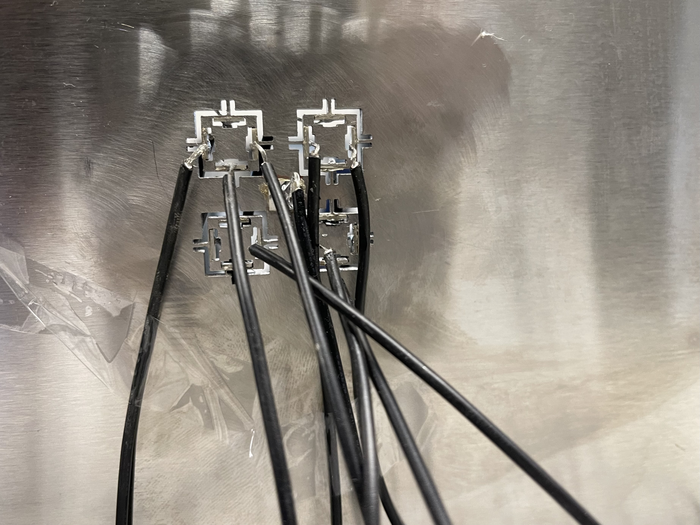
Now, Huang’s one step closer to his goal. In a new study published in the Proceedings of the National Academy of Sciences (PNAS), Huang and colleagues have developed a prototype metamaterial that uses electrical signals to control both the direction and intensity of energy waves passing through a solid material.
Potential applications of his innovative design include military and commercial uses, such as controlling radar waves by directing them to scan a specific area for objects or managing vibration created by air turbulence from an aircraft in flight.
“This metamaterial has odd mass density,” Huang said. “So, the force and acceleration are not going in the same direction, thereby providing us with an unconventional way to customize the design of an object’s structural dynamics, or properties to challenge Newton’s second law.”
This is the first physical realization of odd mass density, Huang said.
“For instance, this metamaterial could be beneficial to monitor the health of civil structures such as bridges and pipelines as active transducers by helping identify any potential damage that might be hard to see with the human eye.”
“Active metamaterials for realizing odd mass density,” was published in the Proceedings of the National Academy of Sciences (PNAS). Other MU contributors include Qian Wu, Xianchen Xu, Honghua Qian, Shaoyun Wang, Zheng Yan and Hongbin Ma. Grants from the Air Force Office of Scientific Research and the Army Research Office funded the research.
Editor’s Note: For more on the story, please see:
- Creating an artificial material that can sense, adapt to its environment
- Designing a flexible material to protect buildings, military personnel
- Aviation Enhancements, Better Biosensors Could Result from New Sensor Technology
- Scientists ‘bend’ acoustic and elastic waves with new metamaterials that could have commercial applications
Journal
Proceedings of the National Academy of Sciences
DOI
10.1073/pnas.2209829120
Article Title
Active metamaterials for realizing odd mass density
Article Publication Date
18-May-2023