As we age, our muscles start to waste. Called sarcopenia, it happens to us all, yet no one has ever understood why and how it happens. Now new research from the Australian Regenerative Medicine Institute (ARMI) at Monash University has used a surprising animal model – the African killifish – to reveal that towards the end of life, our muscles actually reverse to an “early-life” state, slowing mortality. This finding may provide a clue to slowing, halting or even reversing age-related loss of muscle mass and strength.
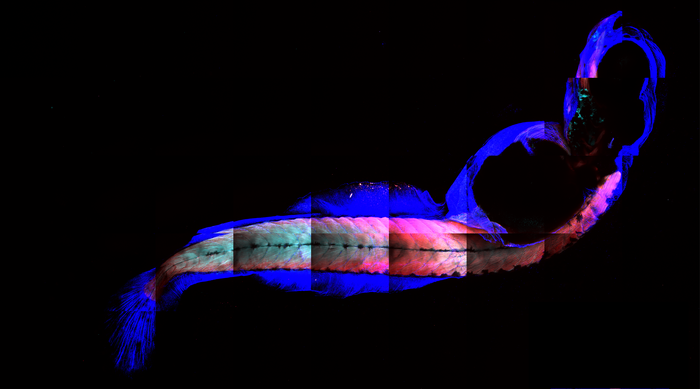
Credit: Dr Avnika Ruparelia
As we age, our muscles start to waste. Called sarcopenia, it happens to us all, yet no one has ever understood why and how it happens. Now new research from the Australian Regenerative Medicine Institute (ARMI) at Monash University has used a surprising animal model – the African killifish – to reveal that towards the end of life, our muscles actually reverse to an “early-life” state, slowing mortality. This finding may provide a clue to slowing, halting or even reversing age-related loss of muscle mass and strength.
The research, published in the Aging Cell and led by Professor Peter Currie and Dr Avnika Ruparelia, who is from ARMI and the University of Melbourne, is important because of the expected dramatic increase in the prevalence and severity of sarcopenia throughout the global population.
According to Professor Currie, “…there is a pressing need to understand the mechanisms that drive sarcopenia, so that we can identify and implement suitable medical interventions to promote healthy muscle ageing,” he said.
The African turquoise killifish, Nothobranchius furzeri has recently emerged as a new model for the study of ageing. Killifish have the shortest known life span of any vertebrate species that can be bred in captivity. Life for a killifish begins with the African rains, creating seasonal rain pools in which fish hatch, grow rapidly and mature in as few as two weeks, and then reproduce daily until the pool dries out.
Importantly, their short life span is accompanied with symptoms of ageing we see in humans – including the appearance of cancerous lesions in the liver and gonads, reduced regenerative capacity of the limbs, in this case the fin, and genetic characteristics that are the hallmark of human ageing such as a reduction in mitochondrial DNA copy number and function and shortening of telomeres.
According to Dr Ruparelia, this study is the first to use the killifish to study sarcopenia.
“In this study, we performed a thorough cellular and molecular characterization of skeletal muscle from early life, aged and extremely old late-life stages, revealing many similarities to sarcopenia in humans and other mammals,” she said.
Surprisingly the researchers also found these same metabolic hallmarks of ageing are reversed during the late-life stage, “suggesting that in extremely old animals, there may be
mechanisms in place that prevent further deterioration of skeletal muscle health, which may ultimately contribute to an extension of their life span,” Dr Ruparelia said.
“Importantly, the late-life stage during which we observed improved muscle health perfectly coincides with a stage when mortality rates decline. We therefore postulate that the improvement in muscle health may be a critical factor contributing to the extension of life span in extremely old individuals.”
To better understand the mechanisms behind this, the research team surveyed the metabolism of fish at different stages of the ageing process. This experiment surprisingly revealed that certain features of the metabolism of the very oldest fish actually were rejuvenated to resemble those of young fish. It highlighted the critical role of lipid metabolism in this process of rejuvenation. By using drugs that regulate the formation of certain lipids a similar rejuvenation of ageing muscle could be achieved.
“During extreme old age, there is a striking depletion of lipids, which are the main energy reserves in our cells,” explains senior author Prof Currie.
“We believe that this mimics a state of calorie restriction, a process known to extend life span in other organsims, which results in activation of downstream mechanisms ultimately enabling the animal to maintain nutrient balance and live longer. A similar process is seen in the muscle of highly trained athletes.”
Dr Ruparelia went on to say, “The idea that muscle ageing may be reversible, and potentially treatable by drugs that can manipulate a cell’s metabolism, is an exciting prospect especially given the social, economic and healthcare costs associated with the ever-growing aged population around the world. We are excited by the potential of the killifish model, and very grateful to the Winston Churchill Trust for funding, and to Hon Dr Kay Patterson for her assistance with establishing the import regulations to establish first and only killifish facility in Australia. We now have a unique opportunity to study biological processes regulating ageing and age-related diseases, and to investigate strategies to promote heathy ageing.”
The publication was the cumulation of a collaboration between researchers from:
- Australian Regenerative Medicine Institute (Australia)
- Monash Biomedicine Discovery Institute (Australia)
- The University of Melbourne (Australia)
- Centre for Muscle Research (Australia)
- Peter MacCallum Cancer Centre (Australia)
- Leibniz Institute on Aging – Fritz Lipmann Institute (Germany)
More information
The Currie group is curious about the biological mechanisms of the zebrafish, a freshwater fish that is native to South-East Asia. Zebrafish are used in scientific research to understand human genetics and the biological processes of human diseases. For more information on Professor Peter Currie and his group at ARMI, please visit the Currie Group page. You can contact Dr Avnika Ruparelia or Professor Peter Currie via [email protected] and [email protected] respectively.
Journal
Aging Cell
DOI
10.1111/acel.13862
Method of Research
Observational study
Subject of Research
Animals
Article Title
The African killifish: A short-lived vertebrate model to study the biology of sarcopenia and longevity
Article Publication Date
16-May-2023