Scientists have discovered a new species of mosasaur, a sea-dwelling lizard from the age of the dinosaurs, with strange, ridged teeth unlike those of any known reptile. Along with other recent finds from Africa, it suggests that mosasaurs and other marine reptiles were evolving rapidly up until 66 million years ago, when they were wiped out by an asteroid along with the dinosaurs and around 90% of all species on Earth.
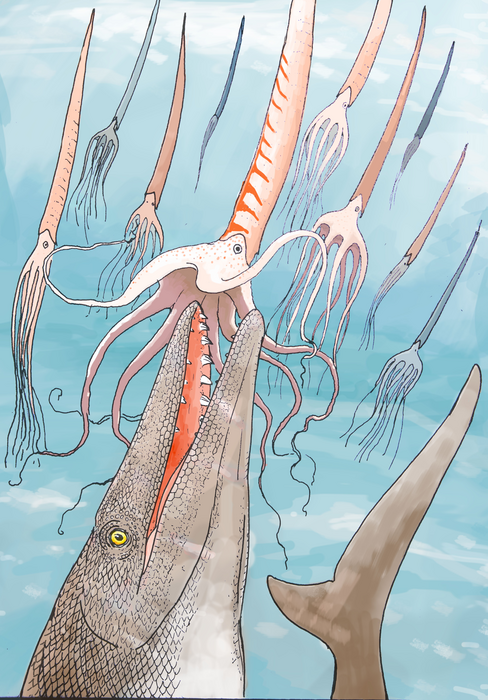
Credit: Dr Nick Longrich
Scientists have discovered a new species of mosasaur, a sea-dwelling lizard from the age of the dinosaurs, with strange, ridged teeth unlike those of any known reptile. Along with other recent finds from Africa, it suggests that mosasaurs and other marine reptiles were evolving rapidly up until 66 million years ago, when they were wiped out by an asteroid along with the dinosaurs and around 90% of all species on Earth.
The new species, Stelladens mysteriosus, comes from the Late Cretaceous of Morocco and was around twice the size of a dolphin.
It had a unique tooth arrangement with blade-like ridges running down the teeth, arranged in a star-shaped pattern, reminiscent of a cross-head screwdriver.
Most mosasaurs had two bladelike, serrated ridges on the front and back of the tooth to help cut prey, however Stelladens had anywhere from four to six of these blades running down the tooth.
“It’s a surprise,” said Dr Nick Longrich from the Milner Centre for Evolution at the University of Bath, who led the study. “It’s not like any mosasaur, or any reptile, even any vertebrate we’ve seen before.”
Dr Nathalie Bardet, a marine reptile specialist from the Museum of Natural History in Paris, said: “I’ve worked on the mosasaurs of Morocco for more than 20 years, and I’d never seen anything like this before – I was both perplexed and amazed!”
That several teeth were found with the same shape suggests their strange shape was not the result of a pathology or a mutation.
The unique teeth suggest a specialised feeding strategy, or a specialised diet, but it remains unclear just what Stelladens ate.
Dr Longrich said: “We have no idea what this animal was eating, because we don’t know of anything similar either alive today, or from the fossil record.
“It’s possible it found a unique way to feed, or maybe it was filling an ecological niche that simply doesn’t exist today. The teeth look like the tip of a Phillips-head screwdriver, or maybe a hex wrench.
“So what’s it eating? Phillips head screws? IKEA furniture? Who knows.”
The teeth were small, but stout and with wear on the tips, which seemed to rule out soft-bodied prey. The teeth weren’t strong enough to crush heavily armoured animals like clams or sea urchins, however.
“That might seem to suggest it’s eating something small, and lightly armoured— thin-shelled ammonites, crustaceans, or bony fish— but it’s hard to know,” said Longrich. “There were weird animals living in the Cretaceous- ammonites, belemnites, baculites – that no longer exist. It’s possible this mosasaur ate something, and occupied a niche, that simply doesn’t exist anymore, and that might explain why nothing like this is ever seen again.
“Evolution isn’t always predictable. Sometimes it goes off in a unique direction, and something evolves that’s never been seen before, and then it never evolves again.”
The mosasaurs lived alongside dinosaurs but weren’t dinosaurs. Instead, they were giant lizards, relatives of Komodo dragons, snakes, and iguanas, adapted for a life at sea.
Mosasaurs evolved around 100 million years ago, and diversified up to 66 million years ago, when a giant asteroid hit the Yucatan Peninsula in Mexico, plunging the world into darkness.
Although scientists have debated the role of environmental changes towards the end of the Cretaceous in the extinction, Stelladens, along with recent discoveries from of Morocco, suggests that mosasaurs were evolving rapidly up to the very end—they went out at their peak, rather than fading away.
The new study shows that even after years of work in the Cretaceous of Morocco, new species are continuing to be discovered. The reason may be that most species are rare.
The authors of the study predict that in a very diverse ecosystem, it may take decades to find all of the rare species.
“We’re not even close to finding everything in these beds,” said Longrich, “This is the third new species to appear, just this year. The amount of diversity at the end of the Cretaceous is just staggering.”
Nour-Eddine Jalil, a professor at the Natural History Museum and a researcher at Univers Cadi Ayyad in Morocco, said: “The fauna has produced an incredible number of surprises – mosasaurs with teeth arranged like a saw, a turtle with a snout in the form of snorkel, a multitude of vertebrates of various shapes and sizes, and now a mosasaur with star-shaped teeth.
“We would say the works of an artist with an overflowing imagination.
“Morocco’s sites offer an unparalleled picture of the amazing biodiversity just before the great crisis of the end of the Cretaceous.”
The new paper is published in the journal Fossils (DOI: 10.3390/fossils1010002).
Dr Longrich has also written a blog on these findings: A strange new mosasaur with screwdriver teeth from the Maastrichtian of Morocco
Journal
Fossils
DOI
10.3390/fossils1010002
Method of Research
Observational study
Subject of Research
Not applicable
Article Title
Stelladens mysteriosus: A Strange New Mosasaurid (Squamata) from the Maastrichtian (Late Cretaceous) of Morocco
Article Publication Date
17-May-2023