Soon, you’ll be able to get a box of freshly picked, sweet strawberries from the grocery store or local farm stand. But it’s disappointing when you get them home and find that the ones at the bottom have started to rot. To increase the berries’ shelf life, researchers reporting in ACS Applied Materials & Interfaces have incorporated cannabidiol — a non-hallucinogenic compound from cannabis known as CBD — and sodium alginate into an edible antimicrobial coating.
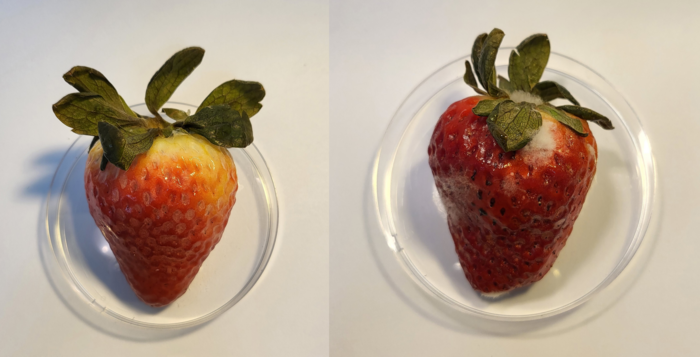
Credit: Adapted from ACS Applied Materials & Interfaces 2023, DOI: 10.1021/acsami.3c04036
Soon, you’ll be able to get a box of freshly picked, sweet strawberries from the grocery store or local farm stand. But it’s disappointing when you get them home and find that the ones at the bottom have started to rot. To increase the berries’ shelf life, researchers reporting in ACS Applied Materials & Interfaces have incorporated cannabidiol — a non-hallucinogenic compound from cannabis known as CBD — and sodium alginate into an edible antimicrobial coating.
CBD is popular because of its potential therapeutic effects. But this cannabinoid has also been shown to have antioxidant and antimicrobial properties. In previous studies, CBD limited the growth of some bacteria and pathogenic fungi, such as the ones that cause fresh fruits and vegetables to rot. However, the oily compound needs to be evenly distributed in water before it can be widely incorporated into foods or used for food preservation. One possible way to do this is to encapsulate the CBD molecules in edible polymers. So, Pongpat Sukhavattanakul, Sarute Ummartyotin and colleagues wanted to see if a food coating made using CBD-filled nanoparticles could promote antimicrobial activity and extend the freshness of strawberries.
The researchers encapsulated CBD in poly(D,L-lactide-co-glycolide), a biodegradable polymer used in drug delivery, producing 400-nm-wide particles. They mixed the most stable nanoparticles, containing 20% by weight CBD, with sodium alginate in water. Strawberries were then submerged into solutions containing different amounts of nanoparticles before a second dip into a mixture of ascorbic acid and calcium chloride to turn the colorless coating into a gel.
Untreated and treated strawberries were then placed in open plastic containers at refrigerator temperatures. After 15 days, CBD-treated samples ripened and decayed much more slowly than untreated ones, possibly because of reduced microbial growth. The coating with the most CBD-loaded nanoparticles preserved the berries’ dark red appearance, enhanced their antioxidant activity the most and exhibited the largest antimicrobial protection over the storage period, suggesting that this version would lead to the longest shelf life. The researchers say that their results demonstrate how encapsulated CBD could be used to create a colorless antimicrobial coating for active food packaging.
The authors acknowledge funding from the Thammasat University Research Unit in Textile and Polymer Chemistry and a Thammasat Postdoctoral Fellowship.
The American Chemical Society (ACS) is a nonprofit organization chartered by the U.S. Congress. ACS’ mission is to advance the broader chemistry enterprise and its practitioners for the benefit of Earth and all its people. The Society is a global leader in promoting excellence in science education and providing access to chemistry-related information and research through its multiple research solutions, peer-reviewed journals, scientific conferences, eBooks and weekly news periodical Chemical & Engineering News. ACS journals are among the most cited, most trusted and most read within the scientific literature; however, ACS itself does not conduct chemical research. As a leader in scientific information solutions, its CAS division partners with global innovators to accelerate breakthroughs by curating, connecting and analyzing the world’s scientific knowledge. ACS’ main offices are in Washington, D.C., and Columbus, Ohio.
To automatically receive news releases from the American Chemical Society, contact [email protected].
Follow us: Twitter | Facebook | LinkedIn | Instagram
Journal
ACS Applied Materials & Interfaces
DOI
10.1021/acsami.3c04036
Article Title
“Influence of a Transparent and Edible Coating of Encapsulated Cannabidiol Nanoparticles on the Quality and Shelf Life of Strawberries”
Article Publication Date
4-May-2023