Coral reef fish larvae undergo major physiological changes during their short development as they transition from long-distance dispersal in the open ocean to settling on a reef, according to a study by Adam Downie at James Cook University in Australia and colleagues, publishing May 11th in the open access journal PLOS Biology.
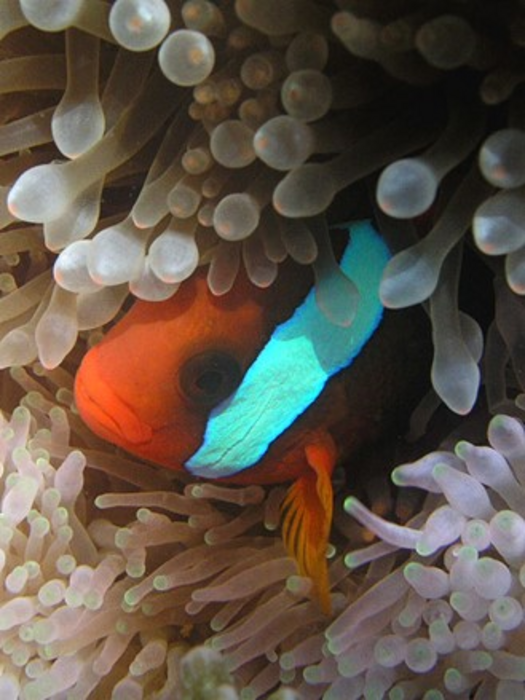
Credit: Prof. Mark McCormick (CC-BY 4.0, https://creativecommons.org/licenses/by/4.0/)
Coral reef fish larvae undergo major physiological changes during their short development as they transition from long-distance dispersal in the open ocean to settling on a reef, according to a study by Adam Downie at James Cook University in Australia and colleagues, publishing May 11th in the open access journal PLOS Biology.
Coral reef fish tend to stay in the reef as adults, but when they spawn their eggs are washed into the open ocean. After hatching, the larvae swim against strong currents to settle on a reef, an energetically demanding task. Once settled on the reef floor, they must survive low-oxygen (hypoxic) environments at night. To understand how fish larvae cope with these two opposing challenges, the researchers collected daily measurements of swimming speed, oxygen uptake, and hypoxia tolerance in cinnamon anemonefish (Amphiprion melanopus) larvae in the laboratory from hatching until day nine, when they usually settle.
They found swimming speed increased from three body-lengths per second at hatching to ten body-lengths per second by day nine. Oxygen uptake rates decreased, and hypoxia tolerance increased around day five. The team sequenced mRNA from larvae of different ages to investigate changes in gene activity changes during development. Physiological changes were correlated with the production of different hemoglobin subunits. Activity of 2,470 genes changed during development, with the biggest shift between four and nine after hatching. This included increased expression of the oxygen-carrying molecules myoglobin, cytoglobin, and neuroglobin.
Relative to their body size, cinnamon anemonefish larvae have the highest oxygen uptake rate of any bony fish measured to date, which underpins their exceptional swimming performance. The authors suggest that changes in gene activity allow the larvae to switch from hemoglobin subunits that deliver large amounts of oxygen to tissues for swimming, to different subunits that help them cope with hypoxic conditions on the reef floor.
Downie adds, “Anemonefishes are miniature athletes as larvae so they are able to swim against ocean currents and find a home coral reef to settle on. When they are close to finding a reef, they lower their oxygen uptake rates and their haemoglobin changes to be able to tolerate the low oxygen levels that characterise their new coral reef homes at night.”
#####
In your coverage, please use this URL to provide access to the freely available paper in PLOS Biology: http://journals.plos.org/plosbiology/article?id=10.1371/journal.pbio.3002102
Citation: Downie AT, Lefevre S, Illing B, Harris J, Jarrold MD, McCormick MI, et al. (2023) Rapid physiological and transcriptomic changes associated with oxygen delivery in larval anemonefish suggest a role in adaptation to life on hypoxic coral reefs. PLoS Biol 21(5): e3002102. https://doi.org/10.1371/journal.pbio.3002102
Author Countries: Australia, Norway, Germany, New Zealand
Funding: see manuscript
Journal
PLoS Biology
DOI
10.1371/journal.pbio.3002102
Method of Research
Observational study
Subject of Research
People
COI Statement
Competing interests: The authors have declared that no competing interests exist.