Much of what is now considered modern medicine originated as folk remedies or traditional, Indigenous practices. These customs are still alive today, and they could help address a variety of conditions. Now reporting in ACS Omega, a team of researchers have identified compounds in the leaves of a particular medicinal Labrador tea plant used throughout the First Nations of Nunavik, Canada, and demonstrated that one of them has activity against the parasite responsible for malaria.
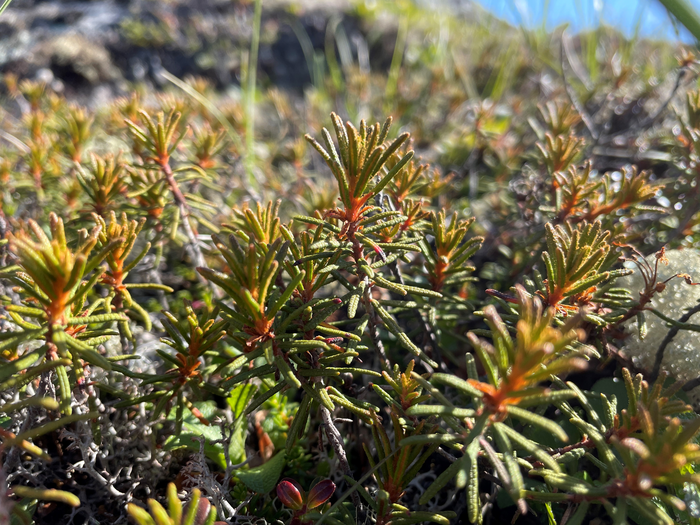
Credit: Adapted from ACS Omega, 2023, DOI: 10.1021/acsomega.3c00235
Much of what is now considered modern medicine originated as folk remedies or traditional, Indigenous practices. These customs are still alive today, and they could help address a variety of conditions. Now reporting in ACS Omega, a team of researchers have identified compounds in the leaves of a particular medicinal Labrador tea plant used throughout the First Nations of Nunavik, Canada, and demonstrated that one of them has activity against the parasite responsible for malaria.
“Labrador tea” refers to multiple, closely related plants — all members of the genus Rhododendron. These are small, evergreen shrubs with fuzzy leaves that, as their name suggests, are steeped to make herbal teas commonly used by the Inuit and Indigenous nations in the U.S. and Canada. Reportedly, drinks made from the leaves or roots can aid in treating colds or the flu, headaches or stomach aches, nasal congestion and many other ailments. Past studies have shown that essential oils extracted from the plants have antimicrobial properties, which could help fight antibiotic-resistant microbes. Dwarf Labrador tea, or Rhododendron subarcticum, produces a particularly aromatic brew and grows in the harsher conditions of the subarctic, found from Alaska to Siberia just south of the Arctic Circle. Despite its common use as a traditional medicine, its chemical composition and potential antimicrobial applications remain relatively unstudied. So, Normand Voyer and colleagues wanted to characterize the makeup of R. subarcticum for the first time and test its antiparasitic activity.
The team gathered R. subarcticum leaves from Nunavik, a region in northern Quebec. The researchers extracted the essential oil from the leaves and analyzed it with gas chromatography, mass spectrometry and flame ionization detection, to identify 53 compounds. It turns out that 64.7% of the oil was comprised of ascaridole, followed by p-cymene at 21.1%. This combination of compounds has not previously been reported in closely related North American Labrador tea varieties, though it has been found in subspecies originating in Europe and Asia.
To see whether this essential oil had antimalarial properties, the team exposed two strains of Plasmodium falciparum, a malaria-causing parasite, to the oil or to just ascaridole. In the experiment, one of the strains was resistant to known antimalaria drugs. The data showed that ascaridole was the primarily component that acted against both strains of the parasite, which is consistent with other, antiparasitic traditional medicines also rich in the compound. The researchers say that this work bolsters the importance of investigating and protecting plants used in traditional medicines, especially those from harsher climates impacted by climate change.
The authors thank the Whapmagoostui Cree Nation Council and Kuujjuarapik Inuit Community Council for sharing their knowledge, and acknowledge funding from the Natural Science and Engineering Research Council of Canada, Fonds de Recherche du Québec—Nature et Technologies, Sentinel North and IDEX UCAjedi.
The American Chemical Society (ACS) is a nonprofit organization chartered by the U.S. Congress. ACS’ mission is to advance the broader chemistry enterprise and its practitioners for the benefit of Earth and all its people. The Society is a global leader in promoting excellence in science education and providing access to chemistry-related information and research through its multiple research solutions, peer-reviewed journals, scientific conferences, eBooks and weekly news periodical Chemical & Engineering News. ACS journals are among the most cited, most trusted and most read within the scientific literature; however, ACS itself does not conduct chemical research. As a leader in scientific information solutions, its CAS division partners with global innovators to accelerate breakthroughs by curating, connecting and analyzing the world’s scientific knowledge. ACS’ main offices are in Washington, D.C., and Columbus, Ohio.
To automatically receive news releases from the American Chemical Society, contact [email protected].
Follow us: Twitter | Facebook | LinkedIn | Instagram
Journal
ACS Omega
DOI
10.1021/acsomega.3c00235
Article Title
“Chemical Composition and Antiplasmodial Activity of the Essential Oil of Rhododendron subarcticum Leaves from Nunavik, Québec, Canada”
Article Publication Date
1-May-2023