Cattle worldwide face major health threats from a highly infectious viral disease that decades of vaccinations and other precautions have failed to contain. Federal, private-sector and Husker scientists are collaborating on a new line of defense, by producing a gene-edited calf resistant to the virus.
Credit: Craig Chandler|University Communication|University of Nebraska-Lincoln
Cattle worldwide face major health threats from a highly infectious viral disease that decades of vaccinations and other precautions have failed to contain. Federal, private-sector and Husker scientists are collaborating on a new line of defense, by producing a gene-edited calf resistant to the virus.
If follow-up research confirms its efficacy, the gene-editing approach offers long-term potential to reduce antimicrobial and antibiotic use in the cattle industry.
The bovine viral diarrhea virus (BVDV) devastates the bovine immune system and can cause severe respiratory and intestinal harm to infected beef and dairy cattle, said veterinary epidemiologist Brian Vander Ley, an associate professor in the University of Nebraska-Lincoln’s School of Veterinary Medicine and Biomedical Sciences.
In utero calves are especially vulnerable to infection. If they survive, they can remain infected for life, repeatedly spreading the virus to other cattle.
“They show up as normal cattle but really, they’re shedding a tremendous amount of virus. They’re the ‘Typhoid Marys’ of BVDV spread,” said Vander Ley, assistant director of UNL’s Great Plains Veterinary Educational Center in Clay Center.
The cattle industry has vaccinated against the disease since the 1960s, but “the highly mutable nature of BVDV and the emergence of highly virulent strains of BVDV contribute to limited success of present control programs,” the Academy of Veterinary Consultants has stated.
Scientists identified the specific genetic structure associated with the disease earlier this century. A collaborative project involving scientists with the USDA’s Agricultural Research Service and Acceligen, a Minnesota-based private company, used gene editing to change the small number of amino acids that lead to BVDV vulnerability, while keeping the rest of the protein, CD46, unchanged.
“Our objective was to use gene-editing technology to slightly alter CD46 so it wouldn’t bind the virus yet would retain all its normal bovine functions,” said Aspen Workman, a scientist with ARS’ U.S. Meat Animal Research Center (USMARC) in Clay Center, Nebraska.
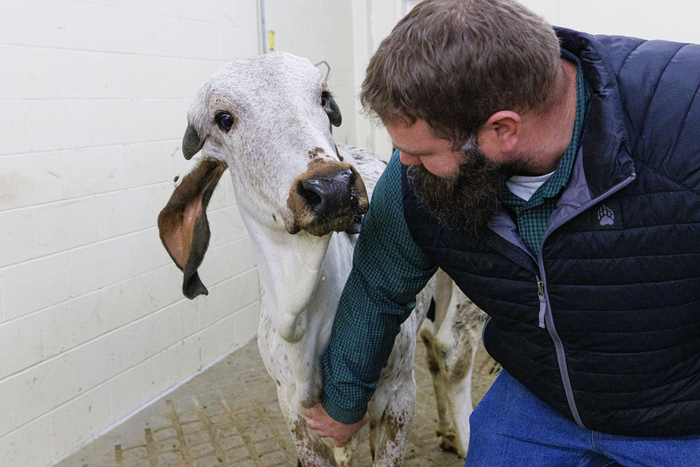
A gene-edited calf, named Ginger, was born on July 19, 2021, and was transported to UNL a week later for close monitoring by Vander Ley. Throughout, Ginger has remained a “bright, healthy calf,” normal both physically and behaviorally, which included a week with a BVDV-infected dairy calf that was shedding the virus in great volume.
The research findings will be published online May 9, by the PNAS Nexus open-access journal, a sibling publication to the Proceedings of the National Academy of Sciences. Workman is lead author.
Ginger is a Gir, a tropically adapted cattle breed used to develop Brahman cattle in North America. Follow-up research will require experimental replication in other cattle breeds. Ginger also will be monitored through pregnancy, if it occurs.
If the gene-editing approach proves viable, it could potentially reduce the cattle sector’s use of antimicrobials, Vander Ley said.
“The most successful version of the future that I can see is one where we don’t have to deal with antimicrobial resistance because we just don’t use that many antimicrobials,” he said. “That’s better for everyone. That means that we have eliminated the cause of a lot of the antimicrobial use and we’ve eliminated that expense for livestock producers.”
Michael Heaton, a USMARC researcher for the BVDV project, concurred. This line of research “represents another opportunity to lessen the need for antibiotics in agriculture,” he said.
In addition to Vander Ley, Workman and Heaton, other study coauthors are Erin E. Jobman (Great Plains Veterinary Educational Center); Gregory P. Harhay (USMARC); private-sector scientists Tad S. Sonstegard, Dennis A. Webster, Luke Sherry, Sabreena Larson, Daniel F. Carlson and Jonathan Bostrom; and Theodore S. Kalbfleisch with the University of Kentucky.
Journal
PNAS Nexus
DOI
10.1093/pnasnexus/pgad110
Method of Research
Experimental study
Subject of Research
Animals
Article Title
First gene-edited calf with reduced susceptibility to a major viral pathogen
Article Publication Date
9-May-2023
COI Statement
Co-authors D.W., J.B. and D.C. are full-time employees of Recombinetics, Inc. S.L. and T.S. are employees of Acceligen, a wholly owned subsidiary of Recombinetics, Inc. Recombinetics, Inc., is a company that commercializes animal gene editing and associated applied technologies for biomedical research, regenerative medicine and animal agriculture. There are no patents to declare, and the interests do not alter the authors’ adherence to all the journal’s policies on sharing data and materials published herein.