WASHINGTON, May 9, 2023 – Espresso coffee is brewed by first grinding roasted coffee beans into grains. Hot water then forces its way through a bed of coffee grains at high pressure, and the soluble content of the coffee grains dissolves into the water (extraction) to produce espresso.
Credit: W.T. Lee, A. Smith, and A. Arshad
WASHINGTON, May 9, 2023 – Espresso coffee is brewed by first grinding roasted coffee beans into grains. Hot water then forces its way through a bed of coffee grains at high pressure, and the soluble content of the coffee grains dissolves into the water (extraction) to produce espresso.
In 2020, researchers found that more finely ground coffee beans brew a weaker espresso. This counterintuitive experimental result makes sense if, for some reason, regions exist within the coffee bed where less or even no coffee is extracted. This uneven extraction becomes more pronounced when coffee is ground more finely.
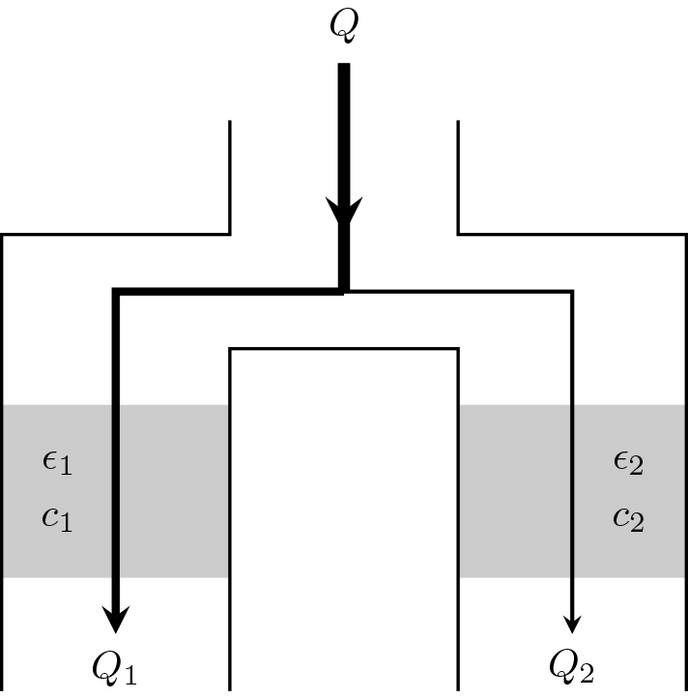
In Physics of Fluids, from AIP Publishing, University of Huddersfield researchers explored the role of uneven coffee extraction using a simple mathematical model. They split the coffee into two regions to examine whether uneven flow does in fact make weaker espresso.
One of the regions in the model system hosted more tightly packed coffee than the other, which caused an initial disparity in flow resistance because water flows more quickly through more tightly packed grains. The extraction of coffee decreased the flow resistance further, as coffee grains lose about 20% to 25% of their mass during the process.
“Our model shows that flow and extraction widened the initial disparity in flow between the two regions due to a positive feedback loop, in which more flow leads to more extraction, which in turn reduces resistance and leads to more flow,” said co-author William Lee. “This effect appears to always be active, and it isn’t until one of the regions has all of its soluble coffee extracted that we see the experimentally observed decrease in extraction with decreasing grind size.”
The researchers were surprised to find the model always predicts uneven flow across different parts of the coffee bed.
“This is important because the taste of the coffee depends on the level of extraction,” said Lee. “Too little extraction and the taste of the coffee is what experts call ‘underdeveloped,’ or as I describe it: smoky water. Too much extraction and the coffee tastes very bitter. These results suggest that even if it looks like the overall extraction is at the right level, it might be due to a mixture of underdeveloped and bitter coffee.”
Understanding the origin of uneven extraction and avoiding or preventing it could enable better brews and substantial financial savings by using coffee more efficiently.
“Our next step is to make the model more realistic to see if we can obtain more detailed insights into this confusing phenomenon,” said Lee. “Once this is achieved, we can start to think about whether it is possible to make changes to the way espresso coffee is brewed to reduce the amount of uneven extraction.”
###
The article “Uneven extraction in coffee brewing” is authored by W.T. Lee, A. Smith, and A. Arshad. It will appear in Physics of Fluids on May 9, 2023 (DOI: 10.1063/5.0138998). After that date, it can be accessed at https://doi.org/10.1063/5.0138998.
ABOUT THE JOURNAL
Physics of Fluids is devoted to the publication of original theoretical, computational, and experimental contributions to the dynamics of gases, liquids, and complex fluids. See https://aip.scitation.org/journal/phf.
###
Journal
Physics of Fluids
DOI
10.1063/5.0138998
Article Title
Uneven extraction in coffee brewing
Article Publication Date
9-May-2023