CHICAGO, May 8, 2023 – The coqui frog is one of Puerto Rico’s most iconic animals. It gets its name from its distinctive two-note call, “co-qui,” which can be heard throughout the island every night. The males of the species produce these calls to mark their territory and ward away rivals, but scientists can also use them to study the changing climate.
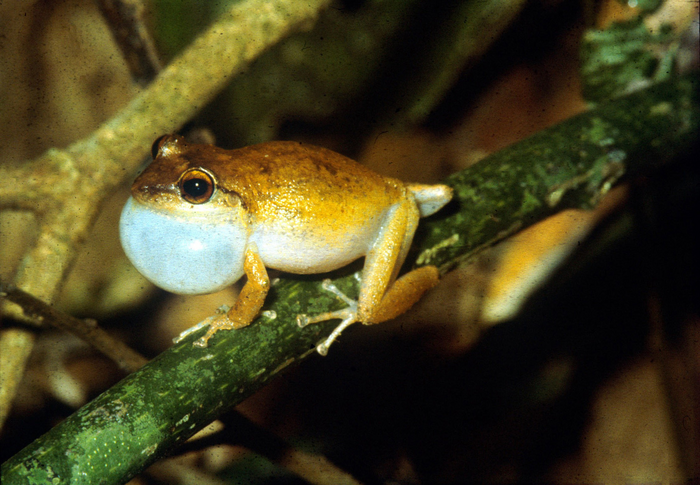
Credit: K. Wells
CHICAGO, May 8, 2023 – The coqui frog is one of Puerto Rico’s most iconic animals. It gets its name from its distinctive two-note call, “co-qui,” which can be heard throughout the island every night. The males of the species produce these calls to mark their territory and ward away rivals, but scientists can also use them to study the changing climate.
Peter Narins of the University of California, Los Angeles will describe changes in the calls of the coqui frog over a 23-year period in his talk, “Climate change drives frog call change in Puerto Rico: Predictions and implications.” The presentation will take place Monday, May 8, at 2:40 p.m. Eastern U.S. in room Chicago F/G, as part of the 184th Meeting of the Acoustical Society of America running May 8-12 at the Chicago Marriott Downtown Magnificent Mile Hotel.
Over two decades ago, Narins recorded the sounds of the coqui frog along the slopes of Puerto Rico’s El Yunque Peak. His team discovered the calls changed based on elevation. Like all amphibians, coqui frogs are highly sensitive to changes in temperature. On cold mountain peaks, the frogs grow larger than in warmer valleys, and this size discrepancy is reflected in their calls.
“Coqui that produced short, high-pitched calls at high rates lived near the base of the mountain, while the calls of animals living near the mountain’s peak were longer, lower-pitched, and repeated less frequently,” said Narins.
Upon returning to the mountain two decades later, Narins and a team including colleague Sebastiaan Meenderink discovered that every frog call had grown higher in pitch.
“In order to record a call with certain characteristics we had to move to a slightly higher altitude,” said Meenderink. “It was as if all the animals had moved up the mountain.”
This mini-migration corresponds with the temperature shift induced by climate change and foreshadows a dire future for the coqui. As temperatures continue to rise, the frogs will continue to retreat up the mountain until they run out of room.
“For now, the consequences are not dire,” said Meenderink. “A barely perceptible change in frog body size and call has little impact on the environment. However, if left unabated, the temperature increase will eventually cause a collapse of the coqui population, which will be catastrophic for the Puerto Rican ecosystem.”
###
———————– MORE MEETING INFORMATION ———————–
Main meeting website: https://acousticalsociety.org/asa-meetings/
Technical program: https://eppro02.ativ.me/web/planner.php?id=ASASPRING23&proof=true
ASA PRESS ROOM
In the coming weeks, ASA’s Press Room will be updated with newsworthy stories and the press conference schedule at https://acoustics.org/asa-press-room/.
LAY LANGUAGE PAPERS
ASA will also share dozens of lay language papers about topics covered at the conference. Lay language papers are summaries (300-500 words) of presentations written by scientists for a general audience. They will be accompanied by photos, audio, and video. Learn more at https://acoustics.org/lay-language-papers/.
PRESS REGISTRATION
ASA will grant free registration to credentialed and professional freelance journalists. If you are a reporter and would like to attend the meeting or virtual press conferences, contact AIP Media Services at [email protected]. For urgent requests, AIP staff can also help with setting up interviews and obtaining images, sound clips, or background information.
ABOUT THE ACOUSTICAL SOCIETY OF AMERICA
The Acoustical Society of America (ASA) is the premier international scientific society in acoustics devoted to the science and technology of sound. Its 7,000 members worldwide represent a broad spectrum of the study of acoustics. ASA publications include The Journal of the Acoustical Society of America (the world’s leading journal on acoustics), JASA Express Letters, Proceedings of Meetings on Acoustics, Acoustics Today magazine, books, and standards on acoustics. The society also holds two major scientific meetings each year. See https://acousticalsociety.org/.
###