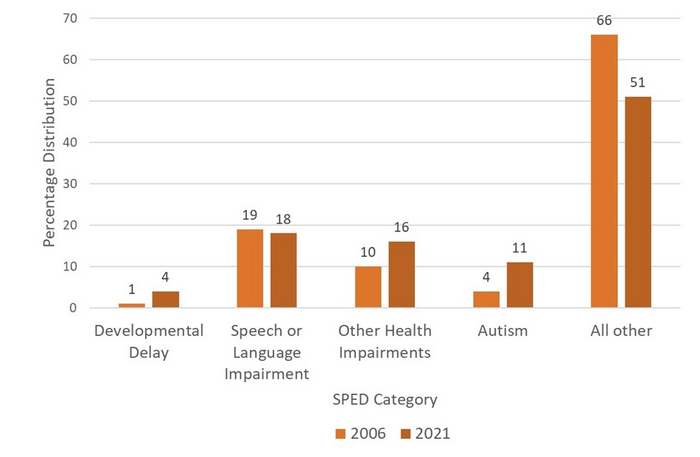
In a recent publication released by PubMed, American scientists led by Dr. Dufault at the Food Ingredient and Health Research Institute, reported alarming increases in the numbers of children requiring special education services. While student enrollment in US schools remained stable from 2006-2021, the percentage of children receiving special education services increased 10.4%. Of the three disability categories under which children with autism may receive services, autism caseload percentages tripled jumping from 4% to 11% while developmental delay caseload percentages quadrupled jumping from 1% to 4%. Children qualifying for special education (SPED) services under the other health impairments category, which includes ADHD, jumped from 10% to 16%.
Credit: Dr. Raquel Crider
In a recent publication released by PubMed, American scientists led by Dr. Dufault at the Food Ingredient and Health Research Institute, reported alarming increases in the numbers of children requiring special education services. While student enrollment in US schools remained stable from 2006-2021, the percentage of children receiving special education services increased 10.4%. Of the three disability categories under which children with autism may receive services, autism caseload percentages tripled jumping from 4% to 11% while developmental delay caseload percentages quadrupled jumping from 1% to 4%. Children qualifying for special education (SPED) services under the other health impairments category, which includes ADHD, jumped from 10% to 16%.
Dr. Dufault’s research team also conducted a literature review to determine the epigenetic factors involved in the development of autism and ADHD. Over the last ten years, numerous clinical trial data indicate dietary heavy metal exposures and poor nutrition are the primary epigenetic factors impacting gene behavior and the inheritance of autism and/or ADHD in children. Prenatal consumption of ultra-processed foods results in poor nutrition and exposures to heavy metals which adversely impact infant gene behavior before and after birth.
The line of research that focuses on the effect of dietary factors on gene expression is known as nutritional epigenetics. Dr. Dufault’s has led research efforts in this field of study since 2005 when she first identified the problem of inorganic mercury residues in high fructose corn syrup while still working at the Food and Drug Administration.
Heavy metal residues continue to be a problem in the food supply. The US Congress released two reports in 2021 on the problem of heavy metals in baby foods. The first report issued on February 4, 2021, revealed baby foods are tainted with dangerous levels of arsenic, lead, cadmium, and mercury. The second report, issued on September 29, 2021, confirmed new disclosures from manufacturers show dangerous levels of heavy metals in even more baby foods. These heavy metal exposures may further exacerbate the development of autism and ADHD.
Journal
World Journal of Clinical Pediatrics
DOI
10.5409/wjcp.v12.i2.25
Method of Research
Literature review
Subject of Research
People
Article Title
Higher rates of autism and attention deficit/hyperactivity disorder: Are food quality issues impacting epigenetic inheritance?
Article Publication Date
9-Mar-2023
COI Statement
The authors declare no conflicts of interest.