• HOME
  • NEWS
  • EXPLORE
    • CAREER
      • Companies
      • Jobs
    • EVENTS
    • iGEM
      • News
      • Team
    • PHOTOS
    • VIDEO
    • WIKI
  • BLOG
  • COMMUNITY
    • FACEBOOK
    • INSTAGRAM
    • TWITTER
Saturday, May 2, 2026
BIOENGINEER.ORG
No Result
View All Result
  • Login
  • HOME
  • NEWS
  • EXPLORE
    • CAREER
      • Companies
      • Jobs
        • Lecturer
        • PhD Studentship
        • Postdoc
        • Research Assistant
    • EVENTS
    • iGEM
      • News
      • Team
    • PHOTOS
    • VIDEO
    • WIKI
  • BLOG
  • COMMUNITY
    • FACEBOOK
    • INSTAGRAM
    • TWITTER
  • HOME
  • NEWS
  • EXPLORE
    • CAREER
      • Companies
      • Jobs
        • Lecturer
        • PhD Studentship
        • Postdoc
        • Research Assistant
    • EVENTS
    • iGEM
      • News
      • Team
    • PHOTOS
    • VIDEO
    • WIKI
  • BLOG
  • COMMUNITY
    • FACEBOOK
    • INSTAGRAM
    • TWITTER
No Result
View All Result
Bioengineer.org
No Result
View All Result
Home NEWS Science News Chemistry

Want to make better materials? Read between the lines. Or the “grain boundaries,” as they’re known in materials science.

Bioengineer by Bioengineer
April 21, 2023
in Chemistry
Reading Time: 3 mins read
0
Grain Boundaries 1
Share on FacebookShare on TwitterShare on LinkedinShare on RedditShare on Telegram

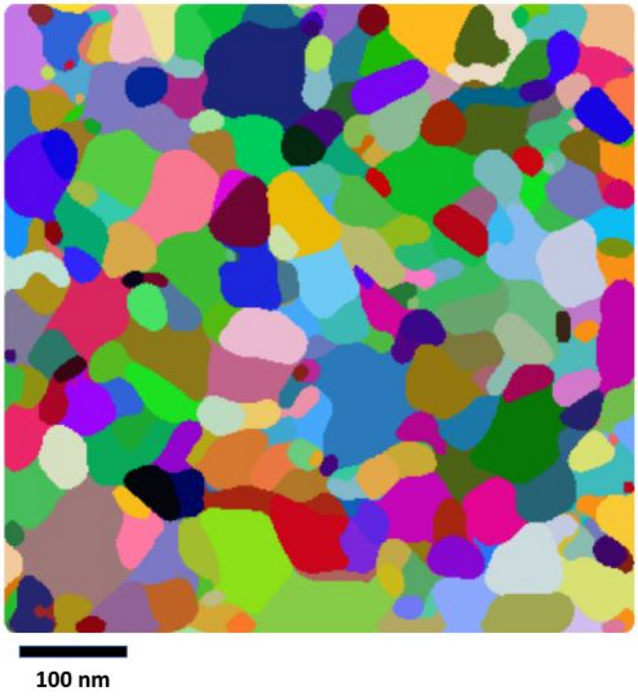
The orientations of these infinitesimally small separations between individual “grains” of a polycrystalline material have big effects. In a material such as aluminum, these collections of grains (called microstructures) determine properties such as hardness. 
Grain Boundaries 1

Credit: Courtesy of Lehigh University

The orientations of these infinitesimally small separations between individual “grains” of a polycrystalline material have big effects. In a material such as aluminum, these collections of grains (called microstructures) determine properties such as hardness. 

New research is helping scientists better understand how microstructures change, or undergo “grain growth,” at high temperatures.

A team of materials scientists and applied mathematicians developed a mathematical model that more accurately describes such microstructures by integrating data that can be identified from highly magnified images taken during experiments. Their findings are published in Nature: Computational Materials. 

The research team included Jeffrey M. Rickman, Class of ’61 Professor of Materials Science & Engineering at Lehigh University; Katayun Barmak, Philips Electronics Professor of Applied Physics and Applied Mathematics at Columbia University; Yekaterina Epshteyn, Professor of Mathematics at the University of Utah; and Chun Liu, Professor of Applied Mathematics at the Illinois Institute of Technology.

“Our model is novel because it is given in terms of features that can be identified from experimental micrographs, or photos that reveal the details of microstructures at a length scale of nanometers to microns,” Rickman said. “Because our model can be related to these experimental features, it is a more faithful representation of the actual grain growth process.”

The researchers conducted crystal orientation mapping on thin films of aluminum with columnar grains and used a stochastic, marked point process to represent triple junctions, points where three grains and grain boundaries meet in the structure. Their model is the first to integrate data on the interactions and disorientations of these triple junctions to predict grain growth.

Predicting grain growth is key to the creation of new materials and is a pivotal area of study in materials science. As a result, many models of grain growth have been developed. However, the project’s direct link between the mathematical model and the experimental micrographs is highly distinctive. 

According to Rickman, linking the model directly to features that can be tracked during experiments will benefit computational materials scientists who model the kinetics of grain growth.

“Ultimately, this research provides a way to better understand how grain growth works and how it can be used to inform the development of new materials,” Rickman said.

The research was funded by the National Science Foundation under the prestigious Designing Materials to Revolutionize and Engineer Our Future (DMREF) program. Rickman is lead author of the research article, “Point process microstructural model of metallic thin films with implications for coarsening,” with Barmak, Epshteyn and Liu as co-authors.


Journal

npj Computational Materials

DOI

10.1038/s41524-023-00986-w

Method of Research

Computational simulation/modeling

Subject of Research

Not applicable

Article Title

Point process microstructural model of metallic thin films with implications for coarsening

Article Publication Date

25-Feb-2023

Share12Tweet8Share2ShareShareShare2

Related Posts

Using Epigenetics to Monitor Environmental Arsenic Exposure — Chemistry

Using Epigenetics to Monitor Environmental Arsenic Exposure

May 1, 2026
Innovative Nanoreactor Design Enhances Catalysis by Optimizing Transport and Reaction Kinetics — Chemistry

Innovative Nanoreactor Design Enhances Catalysis by Optimizing Transport and Reaction Kinetics

May 1, 2026

Swift Creation of Conductive Organic Compounds via Mechanochemistry

May 1, 2026

Scientists Reveal Atomic Mechanism Behind Water-Induced Hydroxylation in CoOx Nanostructures

May 1, 2026

POPULAR NEWS

  • Research Indicates Potential Connection Between Prenatal Medication Exposure and Elevated Autism Risk

    831 shares
    Share 332 Tweet 208
  • New Study Reveals Plants Can Detect the Sound of Rain

    714 shares
    Share 285 Tweet 178
  • Scientists Investigate Possible Connection Between COVID-19 and Increased Lung Cancer Risk

    67 shares
    Share 27 Tweet 17
  • Salmonella Haem Blocks Macrophages, Boosts Infection

    61 shares
    Share 24 Tweet 15

About

We bring you the latest biotechnology news from best research centers and universities around the world. Check our website.

Follow us

Recent News

Paul and Shelia Schlosberg Family Foundation Advances Military Brain Health with Pioneering $3 Million Grant

Early Detection of Keratoconus Enhanced by Light Polarization and AI

Improving Hip Fracture Care in Frail Elders

Subscribe to Blog via Email

Success! An email was just sent to confirm your subscription. Please find the email now and click 'Confirm' to start subscribing.

Join 82 other subscribers
  • Contact Us

Bioengineer.org © Copyright 2023 All Rights Reserved.

Welcome Back!

Login to your account below

Forgotten Password?

Retrieve your password

Please enter your username or email address to reset your password.

Log In
No Result
View All Result
  • Homepages
    • Home Page 1
    • Home Page 2
  • News
  • National
  • Business
  • Health
  • Lifestyle
  • Science

Bioengineer.org © Copyright 2023 All Rights Reserved.