• HOME
  • NEWS
  • EXPLORE
    • CAREER
      • Companies
      • Jobs
    • EVENTS
    • iGEM
      • News
      • Team
    • PHOTOS
    • VIDEO
    • WIKI
  • BLOG
  • COMMUNITY
    • FACEBOOK
    • INSTAGRAM
    • TWITTER
Saturday, February 7, 2026
BIOENGINEER.ORG
No Result
View All Result
  • Login
  • HOME
  • NEWS
  • EXPLORE
    • CAREER
      • Companies
      • Jobs
        • Lecturer
        • PhD Studentship
        • Postdoc
        • Research Assistant
    • EVENTS
    • iGEM
      • News
      • Team
    • PHOTOS
    • VIDEO
    • WIKI
  • BLOG
  • COMMUNITY
    • FACEBOOK
    • INSTAGRAM
    • TWITTER
  • HOME
  • NEWS
  • EXPLORE
    • CAREER
      • Companies
      • Jobs
        • Lecturer
        • PhD Studentship
        • Postdoc
        • Research Assistant
    • EVENTS
    • iGEM
      • News
      • Team
    • PHOTOS
    • VIDEO
    • WIKI
  • BLOG
  • COMMUNITY
    • FACEBOOK
    • INSTAGRAM
    • TWITTER
No Result
View All Result
Bioengineer.org
No Result
View All Result
Home NEWS Science News Chemistry

Co-thermal in-situ reduction of inorganic carbonates to reduce carbon-dioxide emission

Bioengineer by Bioengineer
April 20, 2023
in Chemistry
Reading Time: 2 mins read
0
Co-thermal in-situ reduction of inorganic carbonates to reduce carbon-dioxide emission
Share on FacebookShare on TwitterShare on LinkedinShare on RedditShare on Telegram

This study is led by Prof. Mingfei Shao and Prof. Xue Duan (College of Chemistry, Beijing University of Chemical Technology). Interestingly, the beginning decomposition temperature of CaCO3 in hydrogen atmosphere is clearly reduced (as low as 600 °C) and the emission of CO2 was largely inhibited. Instead, gaseous CO was produced with a high selectivity of 95.8% and the reaction rate could be up to 0.756 mmol min−1. Meanwhile, the high-purity and porous solid CaO was produced, which has the great application potentials. This study demonstrated that the CO results from the selective cleavage of Ca–O bonds at the surface of CaCO3 via the direct hydrogenation mechanism at relatively low temperature. However, it undergoes the reverse water-gas shift (RWGS) reaction path at high temperature, i.e., CO being produced by the reduction of CO2 released by the decomposition of carbonates.
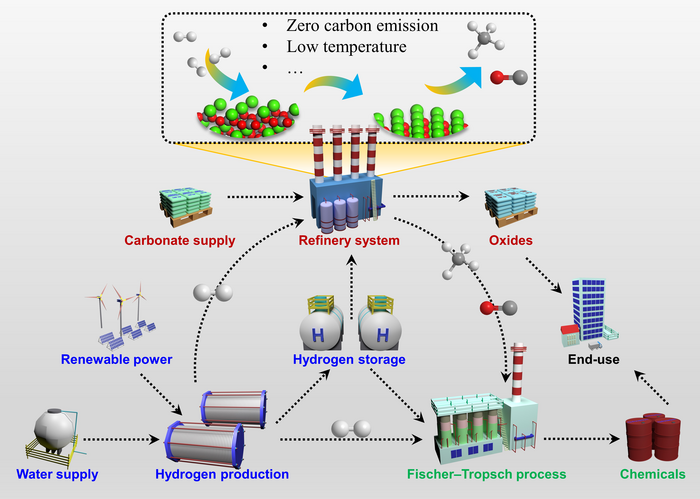
Co-thermal in-situ reduction of inorganic carbonates to reduce carbon-dioxide emission

Credit: ©Science China Press

This study is led by Prof. Mingfei Shao and Prof. Xue Duan (College of Chemistry, Beijing University of Chemical Technology). Interestingly, the beginning decomposition temperature of CaCO3 in hydrogen atmosphere is clearly reduced (as low as 600 °C) and the emission of CO2 was largely inhibited. Instead, gaseous CO was produced with a high selectivity of 95.8% and the reaction rate could be up to 0.756 mmol min−1. Meanwhile, the high-purity and porous solid CaO was produced, which has the great application potentials. This study demonstrated that the CO results from the selective cleavage of Ca–O bonds at the surface of CaCO3 via the direct hydrogenation mechanism at relatively low temperature. However, it undergoes the reverse water-gas shift (RWGS) reaction path at high temperature, i.e., CO being produced by the reduction of CO2 released by the decomposition of carbonates.

“The hydrogenation of metal carbonates gives a potential chance to change the carbon transfer pathway in order to inhibit CO2 emission and obtain high value-added gaseous products (such as CO). Co-thermal via residual heats generated by carbonate decomposition, coupling the thermal decomposition of carbonate and reduction process will make a huge breakthrough. we are surprised that in-situ hydrogenation of carbonates coupled with a green hydrogen system not only makes full use of energy, but also solves the storage, transport, and safety problems of hydrogen.” Shao says.

A few implications thus emerge for designing the system for Co-thermal in-situ reduction of inorganic carbonates: 1) Hydrogenation mechanism and carbon transfer path are of great significance for emission reduction and efficiency enhancement; 2) Through the design and development of the co-thermal in-situ reduction process toward high value-added products will produce huge social and environmental benefits.

See the article:

Co-thermal in-situ reduction of inorganic carbonates to reduce carbon-dioxide emission

https://doi.org/10.1007/s11426-022-1537-6


Journal

Science China Chemistry

DOI

10.1007/s11426-022-1537-6

Share12Tweet8Share2ShareShareShare2

Related Posts

blank

Breakthrough in Environmental Cleanup: Scientists Develop Solar-Activated Biochar for Faster Remediation

February 7, 2026
blank

Cutting Costs: Making Hydrogen Fuel Cells More Affordable

February 6, 2026

Scientists Develop Hand-Held “Levitating” Time Crystals

February 6, 2026

Observing a Key Green-Energy Catalyst Dissolve Atom by Atom

February 6, 2026

POPULAR NEWS

  • Robotic Ureteral Reconstruction: A Novel Approach

    Robotic Ureteral Reconstruction: A Novel Approach

    82 shares
    Share 33 Tweet 21
  • Digital Privacy: Health Data Control in Incarceration

    63 shares
    Share 25 Tweet 16
  • Study Reveals Lipid Accumulation in ME/CFS Cells

    57 shares
    Share 23 Tweet 14
  • Breakthrough in RNA Research Accelerates Medical Innovations Timeline

    53 shares
    Share 21 Tweet 13

About

We bring you the latest biotechnology news from best research centers and universities around the world. Check our website.

Follow us

Recent News

Digital Health Perspectives from Baltic Sea Experts

Florida Cane Toad: Complex Spread and Selective Evolution

Exploring Decision-Making in Dementia Caregivers’ Mobility

Subscribe to Blog via Email

Enter your email address to subscribe to this blog and receive notifications of new posts by email.

Join 73 other subscribers
  • Contact Us

Bioengineer.org © Copyright 2023 All Rights Reserved.

Welcome Back!

Login to your account below

Forgotten Password?

Retrieve your password

Please enter your username or email address to reset your password.

Log In
No Result
View All Result
  • Homepages
    • Home Page 1
    • Home Page 2
  • News
  • National
  • Business
  • Health
  • Lifestyle
  • Science

Bioengineer.org © Copyright 2023 All Rights Reserved.