Some of the most extraordinary body transformations in evolution have occurred in animals that adapted to life in water from land-living ancestors, such as modern whales, turtles and seals. During the Mesozoic, from 252 to 66 million years ago, while the dinosaurs stomped about on land, many groups of reptiles took to the seas, such as the iconic ichthyosaurs, plesiosaurs, crocodiles and mosasaurs.
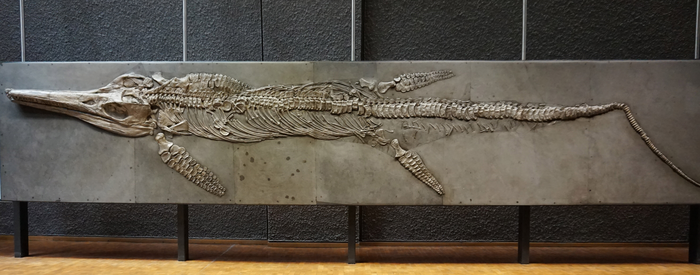
Credit: Dr Susana Gutarra
Some of the most extraordinary body transformations in evolution have occurred in animals that adapted to life in water from land-living ancestors, such as modern whales, turtles and seals. During the Mesozoic, from 252 to 66 million years ago, while the dinosaurs stomped about on land, many groups of reptiles took to the seas, such as the iconic ichthyosaurs, plesiosaurs, crocodiles and mosasaurs.
In a new paper, published in the journal Palaeontology, a Bristol team of palaeobiologists used state-of-the-art statistical methods to perform a large-scale quantitative study, the first of its kind, on the locomotion of Mesozoic marine reptiles.
The researchers collected measurements from 125 fossilised skeletons, and used these to explore changes in swimming styles within lineages and through time, discovering that there was no explosive radiation at the beginning of the Mesozoic, but a gradual diversification of locomotory modes, which peaked in the Cretaceous period.
Lead author Dr Susana Gutarra of Bristol’s School of Earth Sciences said: “Changes in anatomy in land-to-sea transitions are intimately linked to the evolution of swimming. For example, sea lions’ flippers have relatively short forearm and large hands, very different from the walking legs of their ancestors. The rich fossil record of Mesozoic marine reptiles provided great opportunity to study these transitions at a large scale.”
Co-author Beatrice Heighton, said: “We included measurements from living aquatic animals, such as otters, seals and turtles, of which we know their swimming behaviour. This is very important to provide a functional reference for the ancient species, with unknown swimming modes.”
In the aftermath of the end-Permian extinction, about 250 million years ago, various groups of reptiles became aquatic hunters, populating the early Mesozoic seas.
Co-author Dr Tom Stubbs said: “After this devastating event, there was a gradual diversification of locomotory modes, which contrasts with the rapid radiation described previously for feeding strategies. This is fascinating because it suggests a ‘head-first’ pattern of evolution in certain lineages.”
This paper sheds light into the swimming of specific groups. Dr Ben Moon explained: “Ichthyosaurs were highly specialised for aquatic locomotion from very early in their evolution. This includes their close relatives, the hupehsuchians, which had a morphology unlike any other known aquatic tetrapod. Further, we see overlap between mosasaurs and ichthyosaurs, which is indicative that mosasaurs evolved a swimming mode by oscillating flukes, different from the eel-like body undulation suggested in the past.
“In contrast, we don’t find evidence of convergence between ichthyosaurs and metriorhynchids (the highly aquatic crocodyliform thalattosuchians). This group retained quite primitive-looking hindlimbs, which seems incompatible with swimming by fluke oscillation.”
This study also delves into the evolution of size, a feature related to locomotion, animal physiology and ocean productivity. Professor Mike Benton said: “We know that transition to life in water is usually accompanied by an increase in body mass, as seen in cetaceans, and one of our previous studies shows that large sizes benefit aquatic animals in reducing the mass-specific costs of drag. Thus, it was essential to explore this trait in the wider ensemble of Mesozoic marine reptiles.”
Dr Gutarra added: “Body size follows a similar trend to the diversification of locomotory modes, and the widest spread of body size also occurred in the Cretaceous, confirming a strong connection between the two. The rate of increase and the maximum limits to body size seems to vary a lot between groups. This is a fascinating observation. We need to explore further what factors influence and limit the increase in body mass in each group.”
This research was funded by the Natural Environment Research Council (NERC) and the European Research Council (ERC).
Journal
Palaeontology
DOI
10.1111/pala.12645
Method of Research
Data/statistical analysis
Subject of Research
Animals
Article Title
The locomotor ecomorphology of Mesozoic marine reptiles
Article Publication Date
17-Apr-2023