CORVALLIS, Ore. – Oregon State University researchers have discovered a new class of compounds that contributes to the ashy or smokey flavors in wine made with grapes exposed to wildfire smoke.
Credit: Sean Nealon, Oregon State University
CORVALLIS, Ore. – Oregon State University researchers have discovered a new class of compounds that contributes to the ashy or smokey flavors in wine made with grapes exposed to wildfire smoke.
This development is significant for winemakers who have struggled to combat the impact of smoke on grapes at a time when climate change is leading to an increase in the number and severity of wildfires, the researchers said.
“These findings provide new avenues for research to understand and prevent smoke taint in grapes,” said Elizabeth Tomasino, an associate professor of enology at Oregon State. “They also will help provide tools for the grape and wine industries to quickly make decisions about whether to harvest grapes or make wine following a smoke event.”
The findings, made in conjunction with researchers at Washington State University, were just published in the journal Food Chemistry Advances. Tomasino also discussed the findings in June at the American Society for Enology and Viticulture national conference in San Diego.
Wildfires are a significant threat to wineries because persistent exposure to smoke compromises the quality and value of wine grapes and adversely affects wines. That threat is particularly pronounced on the West Coast of the United States, where California, Oregon and Washington are three of the nation’s top four wine-producing states.
Using smoke tainted grapes to make wine can affect the aroma and flavor of the wine. The changes in flavor and aroma have traditionally been attributed to a class of compounds known as volatile phenols. However, volatile phenols weren’t considered good predictors of smoke taint issues, Tomasino said. For example, wines with high levels of these compounds often didn’t taste smoke tainted, and wines with low levels could taste smoke tainted, she said.
This led Tomasino and her team to search for other compounds that could be causing smoke taint in wine.
Last year, Tomasino and Jenna Fryer, a doctoral student in Tomasino’s lab, published a paper that outlined a new standard for tasting the smoky/ashy component of smoke taint in wine. As part of that work, they discovered the new class of sulfur-containing compounds, thiophenols. Thiophenols are not normally found in wines and alcoholic beverages. They are found in meat and fish, and past sensory research has used the terms meaty and burnt to describe them.
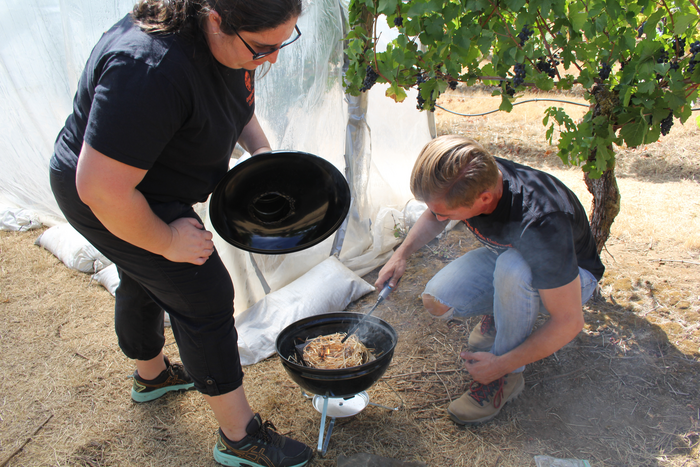
To better understand what impact thiophenols might have on wine, Cole Cerrato, an Oregon State researcher who works closely with Tomasino, set up an experiment at the university’s vineyard. Cerrato and others in the lab built a greenhouse-like structure, placed it over a row of grapes and exposed the grapes to smoke. They harvested those grapes and made wine with them.
The wines the researchers made were sent to Tom Collins, an assistant professor at Washington State’s Wine Science Center. He confirmed that thiophenols were found in the wines that had been exposed to smoke in Oregon State’s vineyard, and that the thiophenols were not found in control samples that had no smoke exposure.
During sensory analysis in Tomasino’s lab, the wines exposed to smoke in Oregon State’s vineyard – which has both thiophenols and volatile phenols in them – were described as ashy and smoky.
“To date, volatile phenol concentrations and frequent tasting of potentially impacted wines are the only predictors winemakers can use to determine the level of smoke they might have in their wines,” Tomasino said. “The discovery of thiophenols provides a new chemical marker for smoke taint that could provide a reliable way to identify smoke taint and ways to potentially eliminate it during the winemaking process.”
The research is funded by a $7.65 million grant Oregon State researchers and a team of West Coast university collaborators received in 2021 to study the impact of smoke exposure on grapes. Oregon State researchers are working with scientists at Washington State and the University of California, Davis, on the four-year project, which is funded by the U.S. Department of Agriculture’s National Institute of Food and Agriculture and through the USDA Agricultural Research Service.
Co-authors of the paper also include Lindsay Garcia of Oregon State and Mackenzie Aragon and Layton Ashmore of Washington State.
Journal
Food Chemistry Advances