• HOME
  • NEWS
  • EXPLORE
    • CAREER
      • Companies
      • Jobs
    • EVENTS
    • iGEM
      • News
      • Team
    • PHOTOS
    • VIDEO
    • WIKI
  • BLOG
  • COMMUNITY
    • FACEBOOK
    • INSTAGRAM
    • TWITTER
Saturday, May 2, 2026
BIOENGINEER.ORG
No Result
View All Result
  • Login
  • HOME
  • NEWS
  • EXPLORE
    • CAREER
      • Companies
      • Jobs
        • Lecturer
        • PhD Studentship
        • Postdoc
        • Research Assistant
    • EVENTS
    • iGEM
      • News
      • Team
    • PHOTOS
    • VIDEO
    • WIKI
  • BLOG
  • COMMUNITY
    • FACEBOOK
    • INSTAGRAM
    • TWITTER
  • HOME
  • NEWS
  • EXPLORE
    • CAREER
      • Companies
      • Jobs
        • Lecturer
        • PhD Studentship
        • Postdoc
        • Research Assistant
    • EVENTS
    • iGEM
      • News
      • Team
    • PHOTOS
    • VIDEO
    • WIKI
  • BLOG
  • COMMUNITY
    • FACEBOOK
    • INSTAGRAM
    • TWITTER
No Result
View All Result
Bioengineer.org
No Result
View All Result
Home NEWS Science News Chemistry

Visualizing differences in nuclear structure

Bioengineer by Bioengineer
April 13, 2023
in Chemistry
Reading Time: 2 mins read
0
Angular distribution of elastic scattering differential cross sections of an oxygen nucleus by a high energy proton
Share on FacebookShare on TwitterShare on LinkedinShare on RedditShare on Telegram

Helium usually has two protons and two neutrons strongly bound to each other, often forming a substructure within the nucleus. A nucleus composed of several such substructures is called a cluster structure. In the standard picture, nuclei are difficult to understand in terms of so-called shell structure; because there was no way to clearly distinguish whether each nucleus has a cluster or a shell structure.
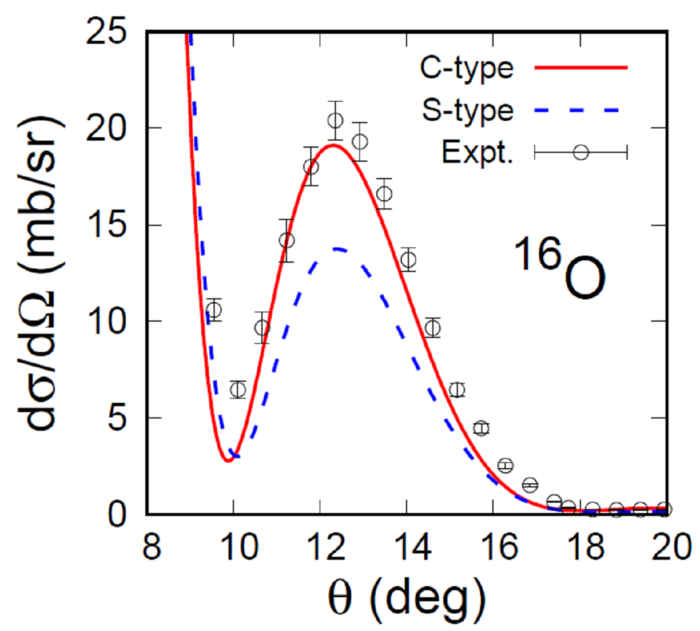
Angular distribution of elastic scattering differential cross sections of an oxygen nucleus by a high energy proton

Credit: Wataru Horiuchi, OMU

Helium usually has two protons and two neutrons strongly bound to each other, often forming a substructure within the nucleus. A nucleus composed of several such substructures is called a cluster structure. In the standard picture, nuclei are difficult to understand in terms of so-called shell structure; because there was no way to clearly distinguish whether each nucleus has a cluster or a shell structure.

Associate Professor Wataru Horiuchi and Professor Naoyuki Itagaki from the Osaka Metropolitan University Graduate School of Science, have developed an “antisymmetrized quasicluster model” that can represent cluster and shell structure in a single framework, which they applied to carbon and oxygen. The density distributions they obtained were significantly different under the assumption of cluster and shell structure. Furthermore, these differences were visualized as data by performing scattering experiments with protons accelerated to high energies for each nucleus.

Theoretical calculations from this study and existing experimental data* reveal that in carbon and oxygen nuclei, there are many components with a clustered structure.
* G. D. Alkhazov et al., Yad. Fiz. 42, 8 (1985)

“The method is simple and powerful, allowing visualization of nuclear structures without the need for extensive numerical calculations,” said Professor Horiuchi. “In the future, we will consider applying this method to heavier nuclei such as neon, magnesium, and silicon isotopes, so that we can continue to answer that ultimate question: where did the elements we see around us come from?”

Their findings were published in Physical Review C (Letter).


###

About OMU 

Osaka Metropolitan University is a new public university established by a merger between Osaka City University and Osaka Prefecture University in April 2022. For more science news, see https://www.omu.ac.jp/en/, and follow @OsakaMetUniv_en, or search #OMUScience. 


Journal

Physical Review C

DOI

10.1103/PhysRevC.107.L021304

Method of Research

Computational simulation/modeling

Subject of Research

Not applicable

Article Title

Imprints of α clustering in the density profiles of 12C and 16O

Article Publication Date

21-Feb-2023

Share12Tweet8Share2ShareShareShare2

Related Posts

Using Epigenetics to Monitor Environmental Arsenic Exposure — Chemistry

Using Epigenetics to Monitor Environmental Arsenic Exposure

May 1, 2026
Innovative Nanoreactor Design Enhances Catalysis by Optimizing Transport and Reaction Kinetics — Chemistry

Innovative Nanoreactor Design Enhances Catalysis by Optimizing Transport and Reaction Kinetics

May 1, 2026

Swift Creation of Conductive Organic Compounds via Mechanochemistry

May 1, 2026

Scientists Reveal Atomic Mechanism Behind Water-Induced Hydroxylation in CoOx Nanostructures

May 1, 2026

POPULAR NEWS

  • Research Indicates Potential Connection Between Prenatal Medication Exposure and Elevated Autism Risk

    832 shares
    Share 333 Tweet 208
  • New Study Reveals Plants Can Detect the Sound of Rain

    714 shares
    Share 285 Tweet 178
  • Scientists Investigate Possible Connection Between COVID-19 and Increased Lung Cancer Risk

    67 shares
    Share 27 Tweet 17
  • Salmonella Haem Blocks Macrophages, Boosts Infection

    61 shares
    Share 24 Tweet 15

About

We bring you the latest biotechnology news from best research centers and universities around the world. Check our website.

Follow us

Recent News

Physical Disorders, ADLs, Cognition, Depression in Nursing Homes

Precise Spatiotemporal Cardiac Repair and Regeneration

Paul and Shelia Schlosberg Family Foundation Advances Military Brain Health with Pioneering $3 Million Grant

Subscribe to Blog via Email

Enter your email address to subscribe to this blog and receive notifications of new posts by email.

Join 82 other subscribers
  • Contact Us

Bioengineer.org © Copyright 2023 All Rights Reserved.

Welcome Back!

Login to your account below

Forgotten Password?

Retrieve your password

Please enter your username or email address to reset your password.

Log In
No Result
View All Result
  • Homepages
    • Home Page 1
    • Home Page 2
  • News
  • National
  • Business
  • Health
  • Lifestyle
  • Science

Bioengineer.org © Copyright 2023 All Rights Reserved.