Semislugs, or ‘snugs’ as they are affectionately known among mollusc researchers, are like the squatters of the snail world: they do carry a home on their back but it is too small to live in. Still, it offers a sort of protection, while not getting in the way of the worm-like physique of the slug. For reasons unknown, on the island of Borneo, which is shared among the countries of Brunei, Malaysia, and Indonesia, most slugs are of the semislug type. The genus Microparmarion there consists of around 10 semislug species, most of which are found in the cooler forests of the mountains. So, when citizen scientists discovered a Microparmarion in the hot lowland forest of Ulu Temburong National Park, Brunei, as part of their expedition, they were surprised.
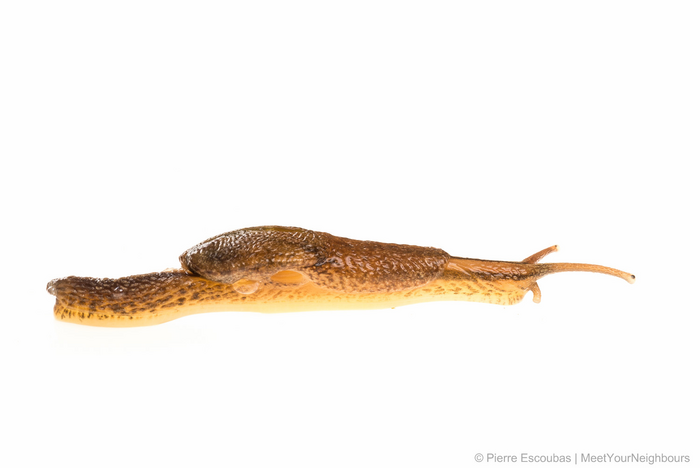
Credit: Pierre Escoubas
Semislugs, or ‘snugs’ as they are affectionately known among mollusc researchers, are like the squatters of the snail world: they do carry a home on their back but it is too small to live in. Still, it offers a sort of protection, while not getting in the way of the worm-like physique of the slug. For reasons unknown, on the island of Borneo, which is shared among the countries of Brunei, Malaysia, and Indonesia, most slugs are of the semislug type. The genus Microparmarion there consists of around 10 semislug species, most of which are found in the cooler forests of the mountains. So, when citizen scientists discovered a Microparmarion in the hot lowland forest of Ulu Temburong National Park, Brunei, as part of their expedition, they were surprised.
For the past years, the scientific travel agency Taxon Expeditions, in collaboration with Universiti Brunei Darussalam (UBD) has been organising biodiversity discovery trips for scientists, students, and laypersons to this forest. On the first trip, in 2018, during a night walk, participant Simon Berenyi, who runs an ethical pest control company in the UK, reached up to a dead leaf suspended over the trail. Everybody—the other participants, even the resident snail expert—had ducked and passed underneath this dead leaf without so much as giving it a glance. But something on its surface caught Simon’s eye. “Oi, is that a slug?” he exclaimed, and picked a slimy, well-camouflaged mollusc off it.
At the time, the team’s zoologists already suspected it was a new species – nothing like it had ever been found in this corner of the island. But that single specimen was not enough to publish its description as a new species. Over the years, successive expeditions to the same area came up with several more specimens of the same species, which made it clear that it was really a species never seen before.
On the 2022 expedition, a team composed of UBD students Nurilya Ezzwan and Izzah Hamdani and citizen scientist Harrison Wu from Virginia, USA, finished the description. Using the portable lab that Taxon Expeditions always carries with them, the team studied the animals’ shell, reproductive organs, and DNA, and prepared a paper for the open-access Biodiversity Data Journal, where it was published this week.
As usual on Taxon Expedition trips, on the last night the team voted on the scientific name for the new species. With an overwhelming majority, the ‘snug’ was named after Mr. Md Salleh Abdullah Bat, the field centre supervisor, who would retire just weeks after the team left. Mr. Salleh himself agrees that it is indeed a very fitting farewell gift.
Research article:
Schilthuizen M, Berenyi S, Ezzwan NSMN, Hamdani NIAA, Wu H, De Antoni L, Vincenzi L, de Gier W, van Peursen ADP, Njunjić I, Delledonne M, Slik F, Grafe U, Cicuzza D (2023) A new semi-slug of the genus Microparmarion from Brunei, discovered, described and DNA-barcoded on citizen-science ‘taxon expeditions’ (Gastropoda, Stylommatophora, Ariophantidae). Biodiversity Data Journal 11: e101579. https://doi.org/10.3897/BDJ.11.e101579
Journal
Biodiversity Data Journal
DOI
10.3897/BDJ.11.e101579
Article Title
A new semi-slug of the genus Microparmarion from Brunei, discovered, described and DNA-barcoded on citizen-science ‘taxon expeditions’ (Gastropoda, Stylommatophora, Ariophantidae)
Article Publication Date
10-Apr-2023