UNIVERSITY PARK, Pa. — In the early 2000s, scientists observed lightning discharge producing X-rays comprising high energy photons — the same type used for medical imaging. Researchers could recreate this phenomenon in the lab, but they could not fully explain how and why lightning produced X-rays. Now, two decades later, a Penn State-led team has discovered a new physical mechanism explaining naturally occurring X-rays associated with lightning activity in the Earth’s atmosphere.
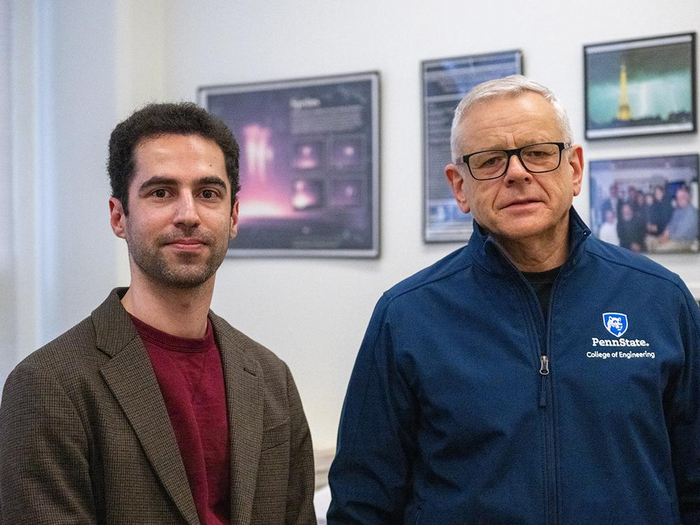
Credit: Jeff Xu/Penn State
UNIVERSITY PARK, Pa. — In the early 2000s, scientists observed lightning discharge producing X-rays comprising high energy photons — the same type used for medical imaging. Researchers could recreate this phenomenon in the lab, but they could not fully explain how and why lightning produced X-rays. Now, two decades later, a Penn State-led team has discovered a new physical mechanism explaining naturally occurring X-rays associated with lightning activity in the Earth’s atmosphere.
They published their results on March 30 in Geophysical Research Letters.
The team’s finding could also shed light on another phenomenon: the small shock sometimes felt when touching a metal doorknob. Called spark discharge, it occurs when a voltage difference is created between a body and a conductor. In a series of lab experiments in the 1960s, scientists discovered that spark discharges produce X-rays — just as lightning does. More than 60 years later, scientists are still conducting lab experiments to better understand the mechanism underpinning this process.
Lightning consists in part of relativistic electrons, which emit spectacular high-energy bursts of X-rays with tens of mega electron-volt energies called terrestrial gamma-ray flashes (TGFs). Researchers have created simulations and models to explain the TGF observations, but there is a mismatch between simulated and actual sizes, according to lead author Victor Pasko, Penn State professor of electrical engineering. Pasko and his team mathematically modeled the TGF phenomenon to better understand how it can occur in observed compact space.
“The simulations are all very big — usually several kilometers across — and the community has difficulty reconciling this right now with actual observations, because when lightning propagates, it’s very compact,” Pasko said, explaining that lightning’s space channel is typically several centimeters in scale, with electric discharge activity producing X-rays expanding around tips of these channels up to 100 meters in extreme cases. “Why is that source so compact? It’s been a puzzle until now. Since we’re working with very small volumes, it may also have implications for the lab experiments with spark discharges underway since the 1960s.”
Pasko said that they developed the explanation for how an electric field amplifies the number of electrons, driving the phenomenon. The electrons scatter on individual atoms, which constitute the air, as they experience acceleration. As the electrons move, most of them go forward as they gain energy and multiply, similar to a snow avalanche, allowing them to produce more electrons. As the electrons avalanche, they produce X-rays, which launch the photons backward and produce new electrons.
“From there, the question we wanted to answer mathematically was, ‘What is the electric field you need to apply in order to just replicate this, to launch just enough X-rays backwards to allow amplification of these select electrons?’” Pasko said.
The mathematical modeling established a threshold for the electric field, according to Pasko, which confirmed the feedback mechanism that amplifies the electron avalanches when X-rays emitted by the electrons travel backward and generate new electrons.
“The model results agree with the observational and experimental evidence indicating that TGFs originate from relatively compact regions of space with spatial extent on the order of 10 to 100 meters,” Pasko said.
In addition to describing high-energy phenomena related to lightning, Pasko said the work may eventually help to design new X-ray sources. The researchers said they plan to examine the mechanism using different materials and gases, as well as different applications of their findings.
The other authors on the paper are Reza Janalizadeh, a postdoctoral scholar in the Penn State Department of Electrical Engineering; Sebastien Celestin of the University of Orleans in Orleans, France; Anne Bourdon, of Ecole Polytechnique in Palaiseau, France; and Jaroslav Jansky of the University of Defense in Brno, Czechia.
The National Science Foundation funded this work.
Journal
Geophysical Research Letters
DOI
10.1029/2022GL102710
Method of Research
Data/statistical analysis
Article Title
Conditions for Inception of Relativistic Runaway Discharges in Air
Article Publication Date
30-Mar-2023