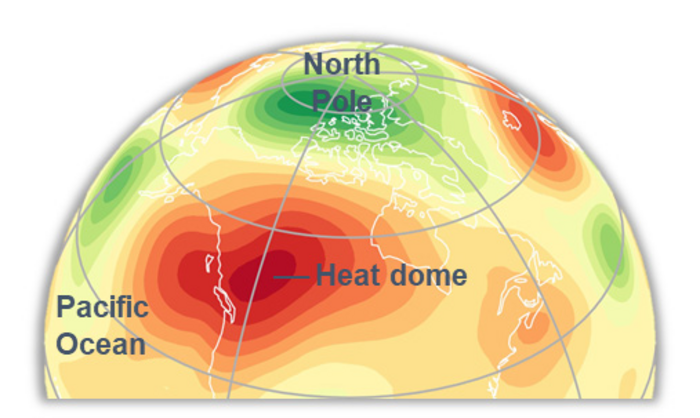
In 2021, North America experienced one of the deadliest heatwaves in history, with extreme temperatures and heat-related illnesses affecting millions of people and leading to widespread power outages and other disruptions. The heatwave was caused by a high-pressure system called “heat dome” which traps hot air like a cap. The “heat dome” was a key dynamic background of the summer 2021 heatwave in Western North America. To what extent the heat dome has contributed to the heatwave and whether the heat dome will continue to affect such harsh heatwaves is of great concern to both the public and the scientific community.
Credit: Xing Zhang
In 2021, North America experienced one of the deadliest heatwaves in history, with extreme temperatures and heat-related illnesses affecting millions of people and leading to widespread power outages and other disruptions. The heatwave was caused by a high-pressure system called “heat dome” which traps hot air like a cap. The “heat dome” was a key dynamic background of the summer 2021 heatwave in Western North America. To what extent the heat dome has contributed to the heatwave and whether the heat dome will continue to affect such harsh heatwaves is of great concern to both the public and the scientific community.
“The impact of heat domes on North American heat extremes is expected to increase due to background warming and soil moisture feedback”, according to a recent study published in Nature Communications on March 27.
This research was led by Prof. Tianjun Zhou from the Institute of Atmospheric Physics at the Chinese Academy of Sciences. The team found that the heat dome-like atmospheric circulations over Western North America contributed over 50% of the magnitude of the observed high temperature. The study revealed that the intensities of 2021-like North American heat extremes have already been impacted by heat domes and will continue to increase due to both the background warming and soil moisture feedback. These findings highlight the urgency and importance of taking action to mitigate the effects of heat domes and address the underlying causes of heatwaves.
“We examined the long-term changes in extreme temperature and heat dome-like atmospheric circulation in the observations. While the temperature index exhibits an accelerated warming trend since 1990, no similar trend is seen in the evolution of a heat dome-like circulation index. This indicates that the hot extreme associated with global warming could increase faster than atmospheric circulation”, said Xing Zhang, the first author of the study, a Ph.D student from the University of the Chinese Academy of Sciences.
“To reveal the underlying physical reasons, we investigated the changes of soil moisture and found strong feedback to heat extremes. The soil moisture-atmosphere feedback partly explains why the intensities of hot extremes associated with similar heat domes increase faster than background global warming”, explained Prof. Tianjun Zhou, the corresponding author of the study.
The scientists extended their study to future climate projections. It is found that the frequency of similar heat events will increase by 40-fold by the end of the 21st century compared to that in 2021 under the RCP8.5 scenario (a business-as-usual scenario).
“To mirror the policy discourse surrounding the Paris Agreement targets of 1.5 °C and ‘well below 2 °C’, we also assessed changes at global warming levels of 1.5 °C, 2 °C and 3 °C. We found that if we limit global warming to 1.5 °C instead of 2 °C (3.0 °C), the 0.5 °C (1.5 °C) less warming would reduce the population exposures to 2021-like heat extreme in Western North America by ~53% (89%) under the RCP8.5-SSP5 scenario. This has important implications for climate mitigation and adaptation activities”, said Dr. Wenxia Zhang, co-author of the study.
Journal
Nature Communications
DOI
10.1038/s41467-023-37309-y
Article Title
Increased impact of heat domes on 2021-like heat extremes in North America under global warming
Article Publication Date
27-Mar-2023