Increasing summer heat and drought are affecting European forests – some years, trees brown prematurely and some even start to die back. Researchers from ETH Zurich and the WSL are showing how exceptional weather conditions over several years are turning forests brown.
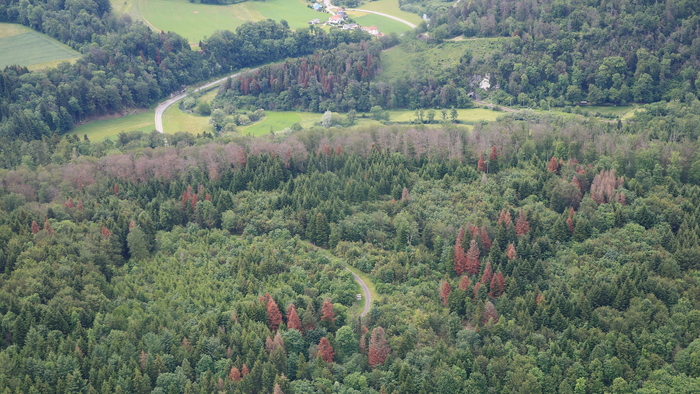
Credit: Valentin Queloz / WSL
Increasing summer heat and drought are affecting European forests – some years, trees brown prematurely and some even start to die back. Researchers from ETH Zurich and the WSL are showing how exceptional weather conditions over several years are turning forests brown.
It was as though autumn had arrived in July. Anyone hiking through the Swiss or German forests in the summer of 2018 could literally see how the hot, dry weather in central Europe was affecting the trees. Spruces and beech tress, in particular, withered prematurely, their leaves and needles turning brown, with entire forest stands under constant stress. In the Mediterranean region, such large-scale phenomena have already occurred several times since 2003.
Researchers from ETH Zurich have now systematically examined all low-greenness events in the temperate and Mediterranean forests of Europe over the past 21 years (2002–2022). The resulting study, which they produced with colleagues from the Swiss Federal Institute for Forest, Snow and Landscape Research (WSL), has just been published in the journal external pageBiogeosciencescall_made.
Browning reached record levels last summer
In their efforts to study forest browning across Europe, the researchers used high-resolution satellite data to identify events of large-scale reduced forest greenness in summer. Reduced greenness is a sign of reduced vitality and stress in forests and is also used as an indicator of forest dieback.
The findings underline previous observations: summer browning has spread throughout Europe. The Central European (temperate) forests have suffered particularly extensive browning in recent years. The Mediterranean region experienced major events already in the early 2000s.
In their analysis, the researchers also quantified the record summer of 2022 and its impact on European forests for the first time: during the hottest summer since records began, Europe experienced its most extensive browning yet, covering 37% of temperate and Mediterranean forest regions – “far more than any other event in the past two decades,” says Mauro Hermann, a doctoral student in atmospheric dynamics under ETH professor Heini Wernli and lead author of the study.
Searching for a common history
This wasn’t actually the goal that the ETH-WSL team was pursuing. “We wanted to understand how the weather affects forests over a large area during several seasons,” explains ETH Professor of Atmospheric Physics Heini Wernli, who led the study. The central role of drought was clear. “However, the connection between forests and weather is far more complex than it might appear at first glance,” explains Wernli.
“Not every dry period – even if it is intense and persistent – causes forests to turn brown immediately,” adds Hermann, referring to the “legacy effect” that has been observable in our forests for a number of years. How well trees survive heat and drought depends not only on the current weather conditions, but also on those of the months or years before.
This was one reason why researchers were especially keen to look into the meteorological history of low-greenness events. They were aiming to identify characteristic weather patterns that preceded multiple of the investigated events.
Specific precursors identified
The researchers did in fact find characteristic weather signals that occurred long before the events, in a kind of precursor to browning with certain specific features for central Europe and the Mediterranean region. “In general, we see that periods with little precipitation occur with unusual frequency over two or three years before the events,” says Hermann.
Increased dry periods with a clear precipitation deficit over at least two years prior to the events are the most conspicuous meteorological precursors in both zones. In the Mediterranean region, frequent dry periods may even go back as far as three years. Other signals include frequent periods of elevated temperatures for at least two years in the temperate zone. Hermann adds, “Prior to low forest greenness in central Europe, we usually observed two dry, hot summers in a row.”
Burden of previous years confirmed
The researchers’ findings are borne out by examples from the 21 years under investigation. The summer of 2003, which was very hot and dry in large parts of Europe, hardly left any large-scale traces on the colour of forests. Since 2018, however, Europe has experienced repeated large-scale drought and high temperatures, leading to several instances of extensive browning.
“One particular finding of the study is that the identified weather signals point to the consequences of previous years’ drought and thus underpin the legacy effect,” Hermann notes. This means that a single hot and dry summer usually does not lead to reduced forest greenness immediately but can contribute to future low-greenness events in a delayed manner.
Precursors, not predictions
Will these precursor signals allow scientists to predict drought stress and forest browning in future? The researchers are cautious: “We have analysed events in retrospect, but we haven’t examined their predictability,” says Hermann. The fact that drought stress also indirectly promotes low forest greenness by fostering bark beetle and fungal infestations as well as forest fires makes forecasting generally difficult.
Thomas Wohlgemuth, head of the Forest Dynamics research unit at WSL and co-author of the study, thinks that forecasting based solely on weather data is unrealistic. The forest ecologist does, however, believe that the newfound understanding of the process will lead to better forest models and assist in prevention by forestry management. “Targeted monitoring of the weather conditions over several seasons could provide valuable information as to whether premature leaf discoloration is likely to occur the following summer,” he says.
Journal
Biogeosciences
DOI
10.5194/bg-20-1155-2023
Article Title
Meteorological history of low-forest-greenness events in Europe in 2002–2022
Article Publication Date
23-Mar-2023