Two-dimensional materials such as graphene have served as a playground for the experimental discovery and theoretical understanding of a wide range of phenomena in physics and materials science. Beyond graphene, there are a large number 2D materials, all with different physical properties. This is promising for potential applications in nanotechnology, where a wide range of functionality can be achieved in devices by using different 2D materials or stacking combinations of different layers.
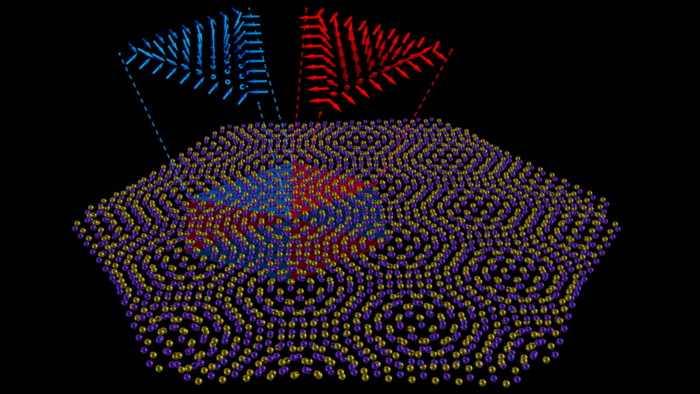
Credit: Daniel Bennett
Cambridge researchers have discovered a new topological phase in a two-dimensional system, which could be used as a new platform for exploring topological physics in nanoscale devices.
Two-dimensional materials such as graphene have served as a playground for the experimental discovery and theoretical understanding of a wide range of phenomena in physics and materials science. Beyond graphene, there are a large number 2D materials, all with different physical properties. This is promising for potential applications in nanotechnology, where a wide range of functionality can be achieved in devices by using different 2D materials or stacking combinations of different layers.
It was recently discovered that in materials such as hexagonal boron nitride (hBN), which are less symmetric than graphene, ferroelectricity occurs when one layer slides over the other and breaks a symmetry. Ferroelectricity is the switching of a material’s electric dipole moment with an electric field, which is a useful property for information processing and memory storage. When 2D materials are twisted with respect to one another, they form a beautiful interference pattern known as a moiré superlattice, which can radically change the physical properties. When hBN and similar materials are twisted the different stacking regions become polarised, leading to a regular network of polar domains, which have also been shown to lead to ferroelectricity.
In this new study reported in Nature Communications, researchers from Cambridge’s Cavendish Laboratory and the University of Liège, Belgium, have discovered that there is more to these polar domains that everyone is studying: they are inherently topological and form objects known as merons and antimerons.
“The polarisation in twisted systems points in the out-of-plane direction, that is to say perpendicular to the layers,” said first author Dr Daniel Bennett, who started this project at the Cavendish Laboratory and is now based at Harvard University, USA.
“What we found is that the symmetry breaking caused by sliding or twisting also results in an in-plane polarisation which is similar in strength to the out-of-plane polarisation. The in-plane polarisation forms a beautiful vector field, and its shape is determined entirely by the symmetry of the layers.”
The discovery of the in-plane polarisation shows that the electrical properties of 2D twisted systems are much more complex than previously thought. More importantly, combining both the in-plane and out-of-plane parts of the polarisation, the team realised that the polarisation in these twisted bilayers is topologically non-trivial.
“In each domain, the polarisation field winds around by half a revolution, forming a topological object known as a meron (half a skyrmion),” said Dr Robert-Jan Slager, whose group at the Cavendish Laboratory was involved in the study. “Throughout the twisted layer, a robust network of merons and antimerons forms.”
“In physics, most things can be understood in terms of energy,” said Bennett. “Nature is lazy and likes to do things in the most efficient way possible, doing so by minimising the energy of a system.”
The phase that a material will adopt is typically the one that has the lowest energy. However topological phases and topological properties are not determined by energetics, but by the various symmetries of a system. The physical properties of a system, such as its electric or magnetic fields, can form complex structures which wind or tie themselves in knots because they are forced to by symmetry.
“The energetic cost of untying these knots is very high, so these structures end up being quite robust,” said Slager. “Being able to create, destroy and control these topological objects is very appealing, for example in the field of topological quantum computing.”
In order to do this, the researchers’ future goals are to develop a better understanding of topological polarisation, as well as develop a proof of concept for a device in which the polar merons/antimerons they discovered can be controlled, or lead to exciting new physical phenomena.
This project was initiated by Bennett during his PhD at Cambridge’s Cavendish Laboratory before he moved to the University of Liège, Belgium, where he continued this research with Prof. Philippe Ghosez and Dr Eric Bousquet, both experts in ferroelectricity.
Journal
Nature Communications
DOI
10.1038/s41467-023-37337-8
Article Title
Polar meron-antimeron networks in strained and twisted bilayers
Article Publication Date
24-Mar-2023