The knowledge of biodiversity in allegedly well-known places is not as complete as one would expect and its detailed study by researchers continues to offer surprises, is what we find out in a new study of the flora of south-central Spain.
Credit: Faro Míguez
The knowledge of biodiversity in allegedly well-known places is not as complete as one would expect and its detailed study by researchers continues to offer surprises, is what we find out in a new study of the flora of south-central Spain.
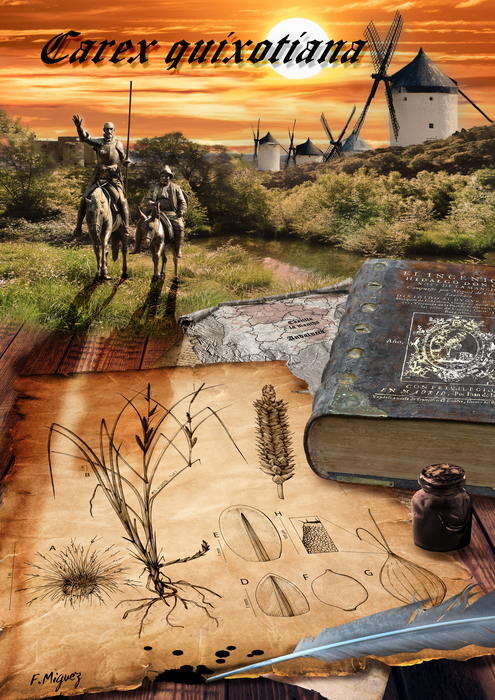
Now, Spanish botanists from Pablo de Olavide University (Seville, Spain) have described a new plant species of the papyrus family (Cyperaceae) restricted to the La Mancha region in south-central Spain. This region is in fact well-known for classic literary fans, who might recognise the name as the main setting in Miguel de Cervantes’ (1547–1616) masterpiece Don Quixote.
The epic novel, which tells the story of the life and journeys of Alonso Quijano, a Spanish hidalgo (nobleman), who becomes the knight-errant Don Quixote de la Mancha, is commonly considered to be one of the greatest literary works ever written, with its number of editions and translations thought to be only surpassed by those of the Bible.
The new species, now scientifically known as Carex quixotiana, belongs to sedges of the genus Carex, a group of herbs included in the papyrus family (Cyperaceae). The classification (taxonomy) of these plants is difficult, as it is a highly diverse and widely distributed genus, whose species are frequently hard to tell apart. In fact, C. quixotiana has itself evaded the eyes of expert botanists for decades, because of its close resemblance to related species.
“Cryptic species are frequent in complex plant groups, such as sedges, and integrative studies encompassing different data sources (e.g. morphology, molecular phylogeny, chromosome number, ecological requirements) are needed to unravel systematic relationships and accurately describe biodiversity patterns,”
says Dr. Martín-Bravo, senior author of the paper.
After a preliminary genetic study pointed to something odd about specimens of what was later to be known as Carex quixotiana, the authors set off on exhaustive field collecting campaigns across La Mancha. As they studied additional populations of the plant in further detail, using morphology, phylogenetics, and chromosome number, the scientists confirmed that they were looking at a species previously unknown to science. Understandably, the distribution range of the newly discovered species, restricted to the mountain ranges surrounding La Mancha (Sierra Madrona and Montes de Toledo), made the authors think about Cervantes’ masterpiece.
So far only known from 16 populations, Carex quixotiana prefers habitats with high water availability, such as small streams, wet meadows and riverside (riparian) forests.
Since little is known about the species’ demographics, including the number of mature individuals in the wild, further investigation is required to determine its conservation status. However, based on what they have learnt so far about the species, the authors of the present study assume that “it is an Iberian endemic with a relatively small number of populations and distribution range, which would benefit from legal protection and inclusion in in-situ/ex-situ conservation programmes.”
In conclusion, the scientists point to their results as yet another proof of how much there is still to learn about Earth’s biodiversity, even when it comes to supposedly well-known organisms, such as flowering plants, and countries, whose flora is presumed to be fully documented. The “Flora Iberica”, for example, which covers Spain and Portugal, has only recently been finalised, the team reminds us.
“In the present biodiversity crisis scenario, it is critical that we do not neglect basic scientific disciplines like taxonomy, since cataloguing biodiversity is a fundamental step towards its preservation and, thus, sustainable management,”
say the researchers.
Research article:
Benítez-Benítez C, Jiménez-Mejías P, Luceño M, Martín-Bravo S (2023) Carex quixotiana (Cyperaceae), a new Iberian endemic from Don Quixote’s land (La Mancha, S Spain). PhytoKeys 221: 161-186. https://doi.org/10.3897/phytokeys.221.99234
Journal
PhytoKeys
DOI
10.3897/phytokeys.221.99234
Article Title
Carex quixotiana (Cyperaceae), a new Iberian endemic from Don Quixote’s land (La Mancha, S Spain)
Article Publication Date
14-Mar-2023