Nuclear physicists have found a new way to see details inside atomic nuclei. They do so by tracking interactions between particles of light and gluons—the gluelike particles that hold together the building blocks of protons and neutrons. The method relies on harnessing a new type of quantum interference between two dissimilar particles. Tracking how these entangled particles emerge from the interactions lets scientists map out the arrangement of gluons.
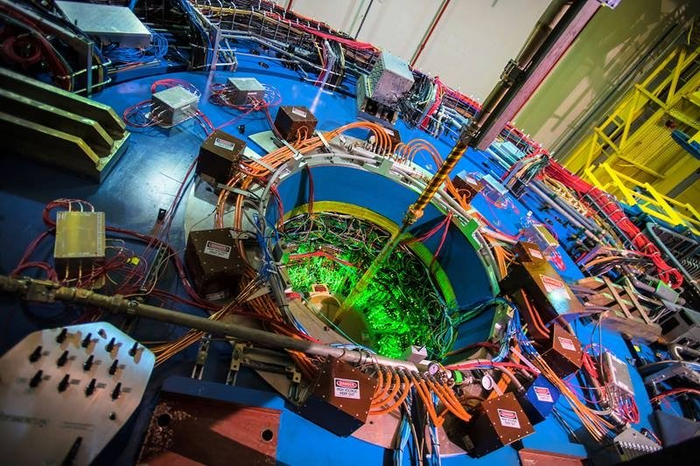
Credit: Image courtesy of Brookhaven National Laboratory
The Science
Nuclear physicists have found a new way to see details inside atomic nuclei. They do so by tracking interactions between particles of light and gluons—the gluelike particles that hold together the building blocks of protons and neutrons. The method relies on harnessing a new type of quantum interference between two dissimilar particles. Tracking how these entangled particles emerge from the interactions lets scientists map out the arrangement of gluons.
The Impact
This technique is similar to how positron emission tomography (PET) scans image the brain and other body parts, but it works at the scale of femtometers—quadrillionths of a meter. It will help scientists understand how gluons build up the structure of protons, neutrons, and the atoms that make up visible matter. The quantum interference measurement is between dissimilar particles that strike meters apart in the STAR detector. This discovery could lead to new ways to harness quantum entanglement. Almost all such attempts to date, including in the field of quantum computing, have explored entanglement between identical particles.
Summary
This research used the Relativistic Heavy Ion Collider (RHIC), a Department of Energy Office of Science user facility that accelerates and collides the nuclei of atoms such as gold. These speeding nuclei are surrounded by a cloud of polarized photons—particles of light. Through a series of quantum fluctuations, the photons surrounding one speeding ion can interact with the gluons in the other. By tracking the velocity and angles at which certain particles emerge from these interactions, the scientists can measure the photon polarization very precisely. This allows them to map out the distribution of gluons both along the polarization direction and perpendicular to it, resulting in a more precise gluon distribution than measured previously.
To make these measurements, the scientists tracked two pions—one with a positive charge, the other with a negative charge. Each is made up of the combined wavefunctions of particles emerging from a decay process that occurs inside each of the two nuclei passing at a “long” distance (for nuclei). Interference patterns between these particles’ wavefunctions indicated that the oppositely charged particles striking RHIC’s STAR detector are entangled, or in sync with one another. This first-ever experimental observation of interference between dissimilar particles makes it possible to measure the photon polarization—and may open new avenues for harnessing quantum entanglement.
Funding
This work was funded by the Department of Energy Office of Science, Nuclear Physics program, the U.S. National Science Foundation, and a range of international agencies listed in the published paper.
Journal
Science Advances
DOI
10.1126/sciadv.abq3903
Article Title
Tomography of ultrarelativistic nuclei with polarized photon-gluon collisions
Article Publication Date
4-Jan-2023