NEW YORK – For a functioning brain to develop from its embryonic beginnings, so much has to happen and go exactly right with exquisite precision, according to a just-so sequence in space and time. It’s like starting with a brick that somehow replicates and differentiates into a hundred types of building materials that also replicate, while simultaneously self-assembling into a handsome skyscraper replete with functioning thermal, plumbing, security and electrical systems.
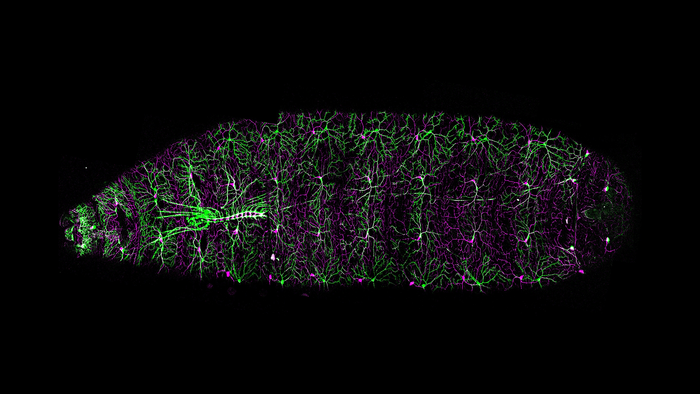
Credit: Samantha Galindo / Grueber lab / Columbia’s Zuckerman Institute / Development
NEW YORK – For a functioning brain to develop from its embryonic beginnings, so much has to happen and go exactly right with exquisite precision, according to a just-so sequence in space and time. It’s like starting with a brick that somehow replicates and differentiates into a hundred types of building materials that also replicate, while simultaneously self-assembling into a handsome skyscraper replete with functioning thermal, plumbing, security and electrical systems.
The accompanying microscope image, from the Zuckerman Institute laboratory of Wesley Grueber, PhD, highlights a single moment in the two-week development drama of a fruit fly larva. Two types of sensory nerve cells, or neurons, in the larva’s body wall have been imaged in action. Here, they’re wiring into the fly’s emerging central nervous system with a precision that ultimately enables the fly to tell the difference between gentle mechanical stimuli, like breezes, and painful ones, like a hard knock or noxious heat.
The diaphanous arborizations are the cells’ stimulus-detecting dendrites in the body wall. The dendrites glowing in magenta denote sensory neurons that detect irritating stimuli. The dendrites glowing in green belong to the type of sensory neurons that pick up gentle stimuli.
The denser millipede-like structure on the left? That’s where the researchers spied something previously unknown. Along with other data, a detailed analysis of this structure reveals how signal-conveying axons of these two types of sensory cells interact as they grow and wire into the fly’s central nervous system. Without these axon-axon interactions, the researchers found, crucial brain wiring gets jumbled, which could, in turn, hobble the fly’s ability to discern and respond to different kinds of sensory information.
“Growing axons that arrive first in a particular location appear to deflect later-arriving axons to set them up in their right places,” says Dr. Grueber. “These kinds of axon-axon interactions are likely used very widely to drive appropriate wiring and next we would like to understand the genes that control these processes.”
To learn more, read the paper “Axon-axon interactions determine modality-specific wiring and subcellular synaptic specificity in a somatosensory circuit,” published today in Development. The full list of authors includes Samantha E. Galindo, Abby J. Wood, Patricia C. Cooney, Luke A. Hammond and Wesley G. Grueber.
Journal
Development
DOI
10.1242/dev.199832
Method of Research
Experimental study
Subject of Research
Animals
Article Title
“Axon–axon interactions determine modality-specific wiring and subcellular synaptic specificity in a somatosensory circuit”
Article Publication Date
15-Mar-2023
COI Statement
The authors declare no competing or financial interests.