The universe is peppered with galaxies, which, on large scales, exhibit a filamentary pattern, referred to as the cosmic web. This heterogeneous distribution of cosmic material is in some ways like blueberries in a muffin where material clusters in certain areas but may be lacking in others.
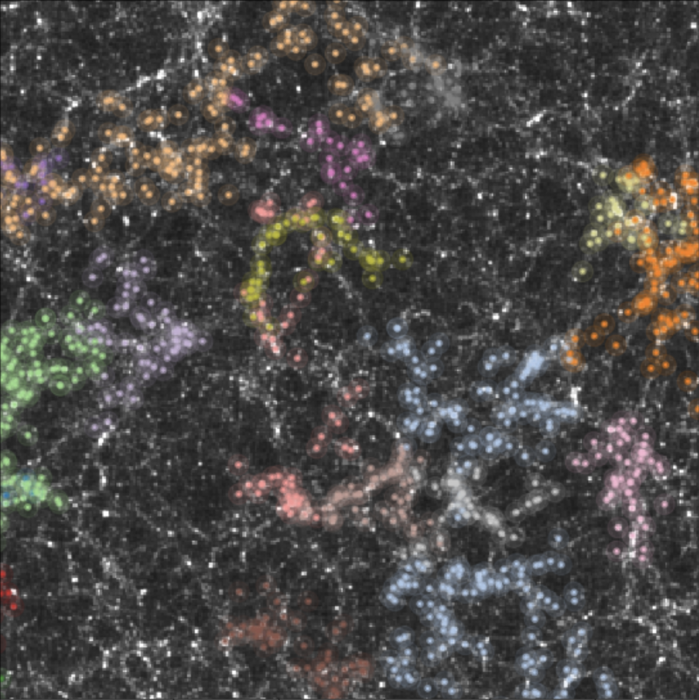
Credit: Philcox & Torquato; The Quijote Simulations
The universe is peppered with galaxies, which, on large scales, exhibit a filamentary pattern, referred to as the cosmic web. This heterogeneous distribution of cosmic material is in some ways like blueberries in a muffin where material clusters in certain areas but may be lacking in others.
Based on a series of simulations, researchers have begun to probe the heterogeneous structure of the universe by treating the distribution of galaxies as a collection of points—like the individual particles of matter that make up a material—rather than as a continuous distribution. This technique has enabled the application of mathematics developed for materials science to quantify the relative disorder of the universe, enabling a better understanding of its fundamental structure.
“What we found was that the distribution of galaxies in the universe is quite different from the physical properties of conventional materials, having its own unique signature,” explained Oliver Philcox, a co-author of the study.
This work, now published in Physical Review X, was conducted by Salvatore Torquato, frequent Member and Visitor at the Institute for Advanced Study and Lewis Bernard Professor of Natural Sciences based in Princeton University’s departments of chemistry and physics; and Oliver Philcox a visiting Ph.D. student at the Institute from September 2020 to August 2022, now a Junior Fellow in the Simons Society of Fellows, hosted at Columbia University.
The pair analyzed public simulation data generated by Princeton University and the Flatiron Institute. Each of the 1,000 simulations consists of a billion dark matter “particles,” whose clusters, formed by gravitational evolution, serve as a proxy for galaxies.
One of the main results of the paper concerns the correlations of pairs of galaxies that are topologically connected to one another by means of the pair-connectedness function. Based on this—and the array of other descriptors that arise in the theory of heterogeneous media—the research team showed that on the largest scales (on the order of several hundred megaparsecs), the universe approaches hyperuniformity, while on smaller scales (up to 10 megaparsecs) it becomes almost antihyperuniform and strongly inhomogeneous.
“The perceived shift between order and disorder depends largely on scale,” stated Torquato. “The pointillist technique of Georges Seurat in the painting A Sunday on La Grande Jatte produces a similar visual effect; the work appears disordered when viewed up-close and highly ordered from afar. In terms of the universe, the degree of order and disorder is more subtle, as with a Rorschach inkblot test that can be interpreted in an infinite number of ways.”
Statistical tools, specifically nearest-neighbor distributions, clustering diagnostics, Poisson distributions, percolation thresholds, and the pair-connectedness function, allowed the researchers to develop a consistent and objective framework for measuring order. Therefore, their findings, while made in a cosmological context, translate to a number of other dynamical, physical systems.
This interdisciplinary work, combining the techniques of cosmology and condensed matter physics, has future implications for both fields. Beyond the distribution of galaxies, many other features of the universe can be explored with these tools, including cosmic voids and the ionized hydrogen bubbles that formed during the reionization phase of the universe. Conversely, the novel phenomena discovered about the universe may also provide insight into various material systems on Earth. The team recognizes that more work will be needed before these techniques can be applied to real data, but this work provides a strong proof-of-concept with significant potential.
- Video credit: NASA/University of Chicago and Adler Planetarium and Astronomy Museum
About the Institute
The Institute for Advanced Study has served the world as one of the leading independent centers for theoretical research and intellectual inquiry since its establishment in 1930, advancing the frontiers of knowledge across the sciences and humanities. From the work of founding IAS faculty such as Albert Einstein and John von Neumann to that of the foremost thinkers of the present, the IAS is dedicated to enabling curiosity-driven exploration and fundamental discovery.
Each year, the Institute welcomes more than 200 of the world’s most promising post-doctoral researchers and scholars who are selected and mentored by a permanent Faculty, each of whom are preeminent leaders in their fields. Among present and past Faculty and Members there have been 35 Nobel Laureates, 44 of the 62 Fields Medalists, and 22 of the 25 Abel Prize Laureates, as well as many MacArthur Fellows and Wolf Prize winners.
Journal
Physical Review X
DOI
10.1103/PhysRevX.13.011038
Article Title
Disordered heterogeneous universe: Galaxy distribution and clustering across length scales
Article Publication Date
14-Mar-2023