Researchers from Tokyo Medical and Dental University (TMDU) find that the side effects caused by treating brain diseases with antisense oligonucleotides are related to altered calcium balance
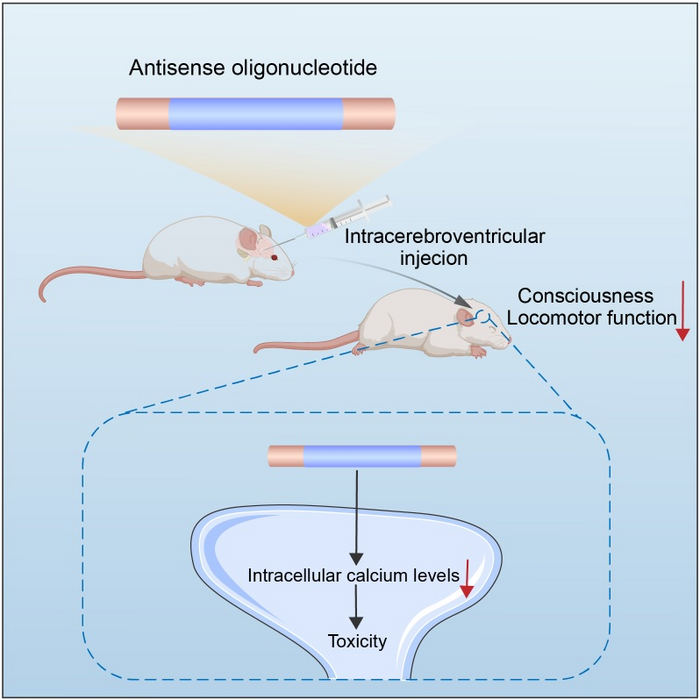
Credit: Department of Neurology and Neurological Science, TMDU
Researchers from Tokyo Medical and Dental University (TMDU) find that the side effects caused by treating brain diseases with antisense oligonucleotides are related to altered calcium balance
Tokyo, Japan – A promising therapy for a range of brain diseases involves antisense oligonucleotides (ASOs)—specialized molecules that can modulate RNA and alter protein production—directly injected into the cerebrospinal fluid, in the space around the brain and spinal cord. Unfortunately, when ASOs are injected like this, they often cause severe side effects. In a recent study published in Molecular Therapy—Nucleic Acids, Japanese researchers have revealed that that such side effects are caused by calcium imbalances in the brain and can be improved by calcium-balance modulators.
Many brain diseases are thought to be caused by specific proteins. ASOs can be created to bind to the RNA that provides a template for a disease-related protein, usually with the aim of making more or less of the protein. To alter protein production in the brain only, ASOs are then injected directly into patients’ cerebrospinal fluid, which flows in and around the whole brain and spinal cord. However, only one such ASO treatment is currently available, to treat spinal muscular atrophy. Many other promising ASOs can induce neurotoxicity (that is, they cause disturbances of consciousness or motor function), which is experienced as unpleasant and sometimes life-threatening side effects. Because the reason for this neurotoxicity is relatively unknown, treating ASO-related neurotoxicity or creating new ASOs with low neurotoxicity is difficult. The researchers from Tokyo Medical and Dental University (TMDU) wanted to address this problem.
“We used three different ASOs that we know are neurotoxic and injected them into the cerebrospinal fluid of mice,” says lead author Chunyan Jia. “The mice showed many abnormal behaviors that indicated acute neurotoxicity, and these behaviors were correlated with changes in calcium levels, as measured in other experiments with neuronal cells.”
Specifically, when the neurotoxic ASOs were used to treat cells, they reduced the levels of free calcium within the cells. Importantly, these reductions were associated with neurotoxicity levels in the mice. The results indicated that calcium levels within cells are important for modulating ASO neurotoxicity, and suggested ways of modifying the calcium balance to reduce neurotoxicity.
“Our findings have important implications for developing effective ASO therapies with fewer harmful side effects,” explains Kotaro Yoshioka, senior author.
“As well as suggesting drugs that may be used alongside ASOs to reduce neurotoxicity, we also reported a relationship between certain nucleotide sequences in ASOs and greater neurotoxicity; this information may be useful when choosing potential ASOs for clinical use.” says Takanori Yokota, director of the research group.
Given that many neurological diseases have no cure or effective treatment, the development of new therapeutic agents is very important. The findings of this study will pave the way for more ASO-based therapies with fewer side effects, and are also expected to improve the ASO development pipeline for very rare brain diseases.
###
The article, “Change of intracellular calcium level causes acute neurotoxicity by antisense oligonucleotides via CSF route,” was published in Molecular Therapy—Nucleic Acids at DOI: 10.1016/j.omtn.2022.12.010
Journal
Molecular Therapy — Nucleic Acids
DOI
10.1016/j.omtn.2022.12.010
Article Title
Change of intracellular calcium level causes acute neurotoxicity by antisense oligonucleotides via CSF route