In the fight against pollution, several regions in the U.S. have banned the use of plastic straws. Alternative materials exist, but most options are either too expensive to scale up, go limp in drinks or taste bad. But now, a team reporting in ACS Omega has developed a new type of bioplastic film from all-natural, degradable materials that can be rolled into a straw that doesn’t get soggy and is stronger than plastic.
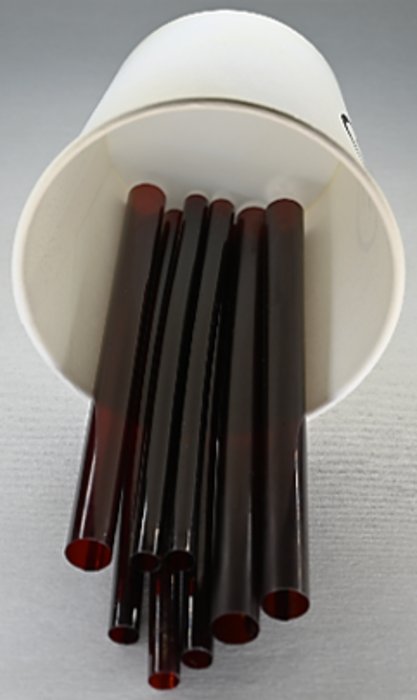
Credit: Adapted from ACS Omega, 2023, DOI: 10.1021/acsomega.2c07797
In the fight against pollution, several regions in the U.S. have banned the use of plastic straws. Alternative materials exist, but most options are either too expensive to scale up, go limp in drinks or taste bad. But now, a team reporting in ACS Omega has developed a new type of bioplastic film from all-natural, degradable materials that can be rolled into a straw that doesn’t get soggy and is stronger than plastic.
As efforts to reduce plastic waste take hold, many researchers and companies have turned to plastic alternatives to fabricate straws that comply with new laws and regulations. But so far, most options either end up breaking down in a drink, like paper straws, or require extra steps and energy to manufacture, like metal or sugarcane straws. But some biopolymers, such as starch and lignin, are readily available as byproducts of other industrial processes and could serve as cheap bioplastic ingredients. Lignin’s natural strength could help overcome starch’s brittleness, especially when combined with a bio-based crosslinker, such as citric acid. So, Dickens Agumba, Duc Hoa Pham and Jaehwan Kim wanted to see if these materials could be combined into a plastic film that was tough, stable in water, yet would still break down when no longer needed.
To create the straws, the researchers blended lignin with either potato starch or polyvinyl alcohol — a more traditional bioplastic material — then added citric acid. They spread the slurry into a thin layer, rolled it into a cylinder and cured it at over 350 F. The bioplastic naturally self-adhered at the seam, but heat treatment set it and made it even stronger. In tests, the cylinders were stronger than those made of polypropylene plastic, yet still flexible. After two months outside, the plastic straws remained unchanged, while the team’s straws degraded significantly. The bioplastic film also offered UV protection, which could be useful for other applications, such as a coating for greenhouse windows. The researchers say that this material could not only reduce the amount of plastic waste in the environment, but also be used to create other, more sustainable bioplastic products from otherwise wasted materials.
The authors acknowledge funding from the National Research Foundation of Korea Creative Research Initiatives Program.
The American Chemical Society (ACS) is a nonprofit organization chartered by the U.S. Congress. ACS’ mission is to advance the broader chemistry enterprise and its practitioners for the benefit of Earth and all its people. The Society is a global leader in promoting excellence in science education and providing access to chemistry-related information and research through its multiple research solutions, peer-reviewed journals, scientific conferences, eBooks and weekly news periodical Chemical & Engineering News. ACS journals are among the most cited, most trusted and most read within the scientific literature; however, ACS itself does not conduct chemical research. As a leader in scientific information solutions, its CAS division partners with global innovators to accelerate breakthroughs by curating, connecting and analyzing the world’s scientific knowledge. ACS’ main offices are in Washington, D.C., and Columbus, Ohio.
To automatically receive news releases from the American Chemical Society, contact [email protected].
Follow us: Twitter | Facebook | LinkedIn | Instagram
Journal
ACS Omega
DOI
10.1021/acsomega.2c07797
Article Title
“Ultrastrong, Hydrostable, and Degradable Straws Derived from Microplastic-Free Thermoset Films for Sustainable Development”
Article Publication Date
16-Feb-2023