Researcher from Tel Aviv University took part in an extensive international study
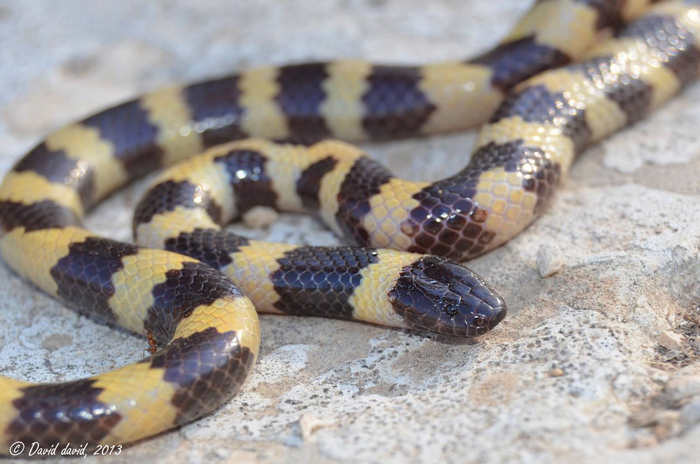
Credit: David David
Researcher from Tel Aviv University took part in an extensive international study
Rare in modern science:
A new snake family was identified – Micrelapidae
- The study found that the Micrelapidae family diverged from the evolutionary tree of snakes about 50 million years ago.
The newly identified family includes only three species, two in Africa and one in Israel.
A rare scientific discovery: Prof. Shai Meiri of TAU’s School of Zoology, Wise Faculty of Life Sciences, and of The Steinhardt Museum of Natural History Museum, took part in an extensive international study that identified a new family of snakes: Micrelapidae According to the researchers, Micrelaps, small snakes usually with black and yellow rings, diverged from the rest of the evolutionary tree of snakes about 50 million years ago. As far as we know the new family includes only three species, one in Israel and neighboring countries, and two in East Africa.
The study was conducted by researchers from Finland, the USA, Belgium, Madagascar, Hong Kong, and Israel. The paper was published in Molecular Phylogenetics and Evolution.
Prof Meiri: “Today we tend to assume that most large groups of animals, such as families, are already known to science, but sometimes we still encounter surprises, and this is what happened with Micrelapid snakes. For years they were considered members of the largest snake family, the Colubridae, but multiple DNA tests conducted over the last decade contradicted this classification. Since then, snake researchers around the world have tried to discover which family these snakes do belong to – to no avail. In this study we joined the scientific effort.”
The researchers used micro-CT technology – high-resolution magnetic imaging, to examine the snake’s morphology, focusing specifically on the skull. In addition, they applied methods of deep genomic sequencing – examining about 4,500 ultra-conserved elements, namely regions in the genome that take millions of years to exhibit any change. Prof: Meiri: “In addition to the DNA of Micrelaps we sampled DNA from various snake groups to which they might have belonged. In this way we discovered in Micrelaps some unique genomic elements, which were not found in any of the other groups.”
According to the researchers their findings indicate that Micrelaps diverged from the rest of the evolutionary tree of snakes about 50 million years ago. Since then, these snakes have evolved independently, as a distinct and separate family. Apparently, this is a very small family, including only three species: two in Kenya and Tanzania in East Africa, and one in Israel and nearby regions (northern Jordan and the Palestinian Authority, southern Syria, and southern Lebanon). This geographic dispersion suggests that these snakes probably originated in Africa, and then, at some point in their history, some of them made their way north through the Great Rift Valley.
Prof. Meiri: “In this study we were able to describe a new snake family – the Micrelapidae. Even through these snakes have been known for decades, they were mistakenly included in other families for many years. Since most animals have already been classified into well-defined families, such a discovery of a new family is quite a rare occurrence in modern science.”
Link to the article:
https://www.sciencedirect.com/science/article/pii/S105579032200313X?via%3Dihub
Journal
Molecular Phylogenetics and Evolution
DOI
10.1016/j.ympev.2022.107700