• HOME
  • NEWS
  • EXPLORE
    • CAREER
      • Companies
      • Jobs
    • EVENTS
    • iGEM
      • News
      • Team
    • PHOTOS
    • VIDEO
    • WIKI
  • BLOG
  • COMMUNITY
    • FACEBOOK
    • INSTAGRAM
    • TWITTER
Tuesday, May 19, 2026
BIOENGINEER.ORG
No Result
View All Result
  • Login
  • HOME
  • NEWS
  • EXPLORE
    • CAREER
      • Companies
      • Jobs
        • Lecturer
        • PhD Studentship
        • Postdoc
        • Research Assistant
    • EVENTS
    • iGEM
      • News
      • Team
    • PHOTOS
    • VIDEO
    • WIKI
  • BLOG
  • COMMUNITY
    • FACEBOOK
    • INSTAGRAM
    • TWITTER
  • HOME
  • NEWS
  • EXPLORE
    • CAREER
      • Companies
      • Jobs
        • Lecturer
        • PhD Studentship
        • Postdoc
        • Research Assistant
    • EVENTS
    • iGEM
      • News
      • Team
    • PHOTOS
    • VIDEO
    • WIKI
  • BLOG
  • COMMUNITY
    • FACEBOOK
    • INSTAGRAM
    • TWITTER
No Result
View All Result
Bioengineer.org
No Result
View All Result
Home NEWS Science News Chemistry

Modulating and characterizing d-band center on Pt-based electrocatalysts under practical conditions

Bioengineer by Bioengineer
March 1, 2023
in Chemistry
Reading Time: 3 mins read
0
General strategy for evaluating the d-band center shift and ethanol oxidation reaction pathway towards Pt-based electrocatalysts
Share on FacebookShare on TwitterShare on LinkedinShare on RedditShare on Telegram

This study is led by Prof. Yanxia Jiang (College of Chemistry and Chemical Engineering, Xiamen University) and Prof. Bin-Wei Zhang (School of Chemistry and Chemical Engineering, Chongqing University). Pt1Au1 alloy supported on the commercial carbon material (Pt1Au1/C) is employed as a typical example to investigate its surface Pt d-band center shift, and as electrocatalyst to study its selectivity towards ethanol oxidation reaction.
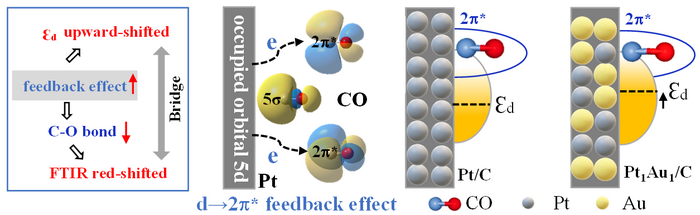
General strategy for evaluating the d-band center shift and ethanol oxidation reaction pathway towards Pt-based electrocatalysts

Credit: ©Science China Press

This study is led by Prof. Yanxia Jiang (College of Chemistry and Chemical Engineering, Xiamen University) and Prof. Bin-Wei Zhang (School of Chemistry and Chemical Engineering, Chongqing University). Pt1Au1 alloy supported on the commercial carbon material (Pt1Au1/C) is employed as a typical example to investigate its surface Pt d-band center shift, and as electrocatalyst to study its selectivity towards ethanol oxidation reaction.

The d-band center position of metal catalysts is an important parameter that is usually employed to describe their activity. Since the electrocatalytic reactions usually happen on the surface of catalysts, it is important to investigate the d-band center of catalysts surface, which can be utilized to tailor their catalytic activity. Therefore, it is urgently required to develop an experimental method that direct characterize the d-band center of the outer catalyst layer involved in the surface reaction process.

“We used the Pt1Au1 alloy as a model catalyst to investigate how Au element modify the surface electronic structure of Pt. An in situ FTIRS CO-probe strategy is developed to evaluate the surface d-band center shift of Pt-based electrocatalysts. The electrochemical in situ FTIRS CO-probe molecular strategy to evaluate the electronic structure of Pt-based catalyst surfaces is highly reliable, and may be branched out to other Pt-based catalysts.” Jiang says.

It is widely accepted that the ethanol oxidation reaction (EOR) involves the dual pathway mechanisms: the C1 pathway and the C2 pathway. The C1 pathway undergoes C-C bond breaking to generate CO intermediate species, then further oxidized to the final product of CO2 (acid media). This process involves 12 electron transfers, which is also known as the complete oxidation pathway. For the C2 pathway, it is mainly incomplete oxidation of ethanol to acetaldehyde or acetic acid, with involving 2 or 4 electron transfers. The commonly preliminary evaluation for the EOR selectivity by using current ratio of the two ethanol oxidation peaks (I1/I2) is unreliable; the method that calculating the integrated area of the characteristic spectra of CO2 and CH3COOH is limited by heavy reliance on in situ Fourier-transform infrared spectroscopy (FTIRS). Therefore, it is urgently required to develop a general and effective classical electrochemical method to praise the EOR selectivity.

“We have systematically discussed how the modified electronic effect and site effect of Pt1Au1/C determined the adsorption configuration of intermediate species and the OH species coverage for EOR, therefore influencing their CO2 selectivity. More significantly, we also develop a universal and effective cyclic voltammetry (CV) peaks differentiation fitting method via secondary derivative peak-seeking and Gaussian fitting to investigate selectivity for Pt-based electrocatalysts.” Jiang says.

See the article:

General strategy for evaluating the d-band center shift and ethanol oxidation reaction pathway towards Pt-based electrocatalysts

https://doi.org/10.1007/s11426-022-1420-2


Journal

Science China Chemistry

DOI

10.1007/s11426-022-1420-2

Share12Tweet8Share2ShareShareShare2

Related Posts

Seeing and Treating Tumors Simultaneously: Harnessing Click Chemistry to End Blind Battles — Chemistry

Seeing and Treating Tumors Simultaneously: Harnessing Click Chemistry to End Blind Battles

May 19, 2026
Enhancing Efficiency and Sustainability in Chemical Reaction Control — Chemistry

Enhancing Efficiency and Sustainability in Chemical Reaction Control

May 19, 2026

New Precision Experiment Challenges Quantum Collapse Theories

May 19, 2026

INSEAD and BCG Unveil “Delivering Energy Transformation”: Driving Competitiveness and Trust Ahead of COP31

May 19, 2026

POPULAR NEWS

  • Research Indicates Potential Connection Between Prenatal Medication Exposure and Elevated Autism Risk

    845 shares
    Share 338 Tweet 211
  • New Study Reveals Plants Can Detect the Sound of Rain

    731 shares
    Share 292 Tweet 182
  • Salmonella Haem Blocks Macrophages, Boosts Infection

    62 shares
    Share 25 Tweet 16
  • Breastmilk Balances E. coli and Beneficial Bacteria in Infant Gut Microbiomes

    58 shares
    Share 23 Tweet 15

About

We bring you the latest biotechnology news from best research centers and universities around the world. Check our website.

Follow us

Recent News

Seeing and Treating Tumors Simultaneously: Harnessing Click Chemistry to End Blind Battles

Decoding the Tumor Microenvironment Chemokine Network: From Immune Evasion to Innovative Multi-Target Therapies

Innovative Technology Transforming Parasports Wins Best Paper Award at CHI

Subscribe to Blog via Email

Enter your email address to subscribe to this blog and receive notifications of new posts by email.

Join 82 other subscribers
  • Contact Us

Bioengineer.org © Copyright 2023 All Rights Reserved.

Welcome Back!

Login to your account below

Forgotten Password?

Retrieve your password

Please enter your username or email address to reset your password.

Log In
No Result
View All Result
  • Homepages
    • Home Page 1
    • Home Page 2
  • News
  • National
  • Business
  • Health
  • Lifestyle
  • Science

Bioengineer.org © Copyright 2023 All Rights Reserved.