Scientists have successfully recorded brain activity from freely moving octopuses, a feat made possible by implanting electrodes and a data logger directly into the creatures.
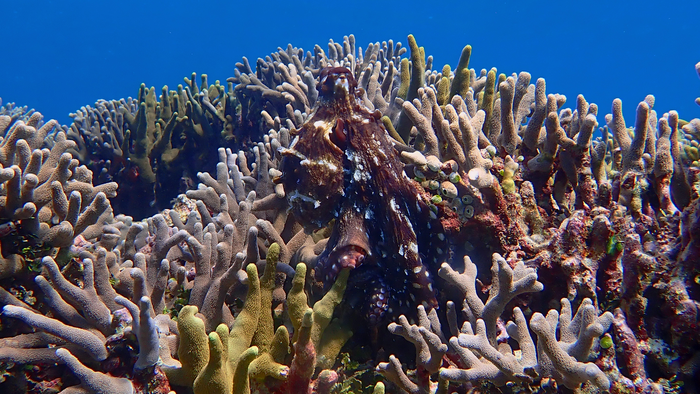
Credit: Keishu Asada
Scientists have successfully recorded brain activity from freely moving octopuses, a feat made possible by implanting electrodes and a data logger directly into the creatures.
The study, published online in Current Biology on February 23, is a critical step forward in figuring out how octopus’ brains control their behavior, and could provide clues to the common principles needed for intelligence and cognition to occur.
“If we want to understand how the brain works, octopuses are the perfect animal to study as a comparison to mammals. They have a large brain, an amazingly unique body, and advanced cognitive abilities that have developed completely differently from those of vertebrates,” said Dr. Tamar Gutnick, first author and former postdoctoral researcher in the Physics and Biology Unit at the Okinawa Institute of Science and Technology (OIST).
But measuring the brainwaves of octopuses has proven a real technical challenge. Unlike vertebrates, octopuses are soft bodied, so they have no skull to anchor the recording equipment onto, to prevent it being removed.
“Octopuses have eight powerful and ultra-flexible arms, which can reach absolutely anywhere on their body,” said Dr. Gutnick. “If we tried to attach wires to them, they would immediately rip if off, so we needed a way of getting the equipment completely out of their reach, by placing it under their skin.”
The researchers settled on small and lightweight data loggers as the solution, which were originally designed to track the brain activity of birds during flight. The team adapted the devices to make them waterproof, but still small enough to easily fit inside the octopuses. The batteries, which needed to work in a low-air environment, allowed up to 12 hours of continuous recording.
The researchers chose Octopus cyanea, more commonly known as the day octopus, as their model animal, due to its larger size. They anesthetized three octopuses and implanted a logger into a cavity in the muscle wall of the mantle. The scientists then implanted the electrodes into an area of the octopus’ brain called the vertical lobe and median superior frontal lobe, which is the most accessible area. This brain region is also believed to be important for visual learning and memory, which are brain processes that Dr. Gutnick is particularly interested in understanding.
Once the surgery was complete, the octopuses were returned to their home tank and monitored by video. After five minutes, the octopuses had recovered and spent the following 12 hours sleeping, eating and moving around their tank, as their brain activity was recorded. The logger and electrodes were then removed from the octopuses, and the data was synchronized to the video.
The researchers identified several distinct patterns of brain activity, some of which were similar in size and shape to those seen in mammals, whilst others were very long lasting, slow oscillations that have not been described before.
The researchers were not yet able to link these brain activity patterns to specific behaviors from the videos. However, this is not completely surprising, Dr. Gutnick explained, as they didn’t require the animals to do specific learning tasks.
“This is an area that’s associated with learning and memory, so in order to explore this circuit, we really need to do repetitive, memory tasks with the octopuses. That’s something we’re hoping to do very soon!”
The researchers also believe that this method of recording brain activity from freely moving octopuses can be used in other octopus species and could help solve questions in many other areas of octopus cognition, including how they learn, socialize and control the movement of their body and arms.
“This is a really pivotal study, but it’s just the first step,” said Prof. Michael Kuba, who led the project at the OIST Physics and Biology Unit and now continues at the University of Naples Federico II. “Octopus are so clever, but right now, we know so little about how their brains work. This technique means we now have the ability to peer into their brain while they are doing specific tasks. That’s really exciting and powerful.”
The study involved an international collaboration between researchers in Japan, Italy, Germany, Ukraine, and Switzerland.
Journal
Current Biology
DOI
10.2139/ssrn.4309084
Method of Research
Experimental study
Subject of Research
Animals
Article Title
Recording Electrical Activity from the Brain of Behaving Octopus
Article Publication Date
23-Feb-2023
COI Statement
TSE-Systems has bought all shares of NewBehavior LLC from H.-P. Lipp who acts occasionally as a consultant for former NewBehavior products