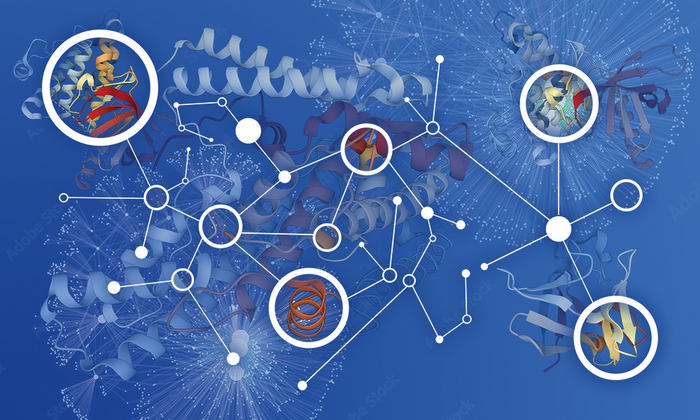
Scientists at Open Targets, EMBL’s European Bioinformatics Institute (EMBL-EBI), and GSK are revealing the shared basis of diseases using a map of interacting human proteins. By helping to understand how biological processes affect human traits and diseases, this work will prioritise new targets for drug discovery and identify drug repurposing opportunities.
Credit: Karen Arnott/EMBL-EBI
Scientists at Open Targets, EMBL’s European Bioinformatics Institute (EMBL-EBI), and GSK are revealing the shared basis of diseases using a map of interacting human proteins. By helping to understand how biological processes affect human traits and diseases, this work will prioritise new targets for drug discovery and identify drug repurposing opportunities.
Proteins are molecules that do most of the work in our cells and are made following blueprints encoded in genes. They are essential for the structure, function, and regulation of the body’s tissues, and are often the target of drugs or therapies.
Genome Wide Association Studies (GWAS) help us establish the genetic basis of disease by linking specific genes to diseases. To determine how those genes contribute to disease, we need to understand the function of the proteins they encode and link specific biological processes to diseases.
In this new study, published in the journal Nature Genetics, researchers created a network of interacting proteins – or an interactome – combining evidence from different sources, including EMBL-EBI’s IntAct database, Reactome, and Signor. Using this interactome, they identified groups of proteins interacting with genes that have been linked through GWAS to over 1,000 human traits from 21 therapeutic areas.
Guilt-by-association
Proteins that interact with each other will likely be involved in the same biological processes. Therefore, if a protein is known to be involved in a disease, knowing which partners it interacts with provides information about the function it has in a cell. Through ‘guilt-by-association’, the interacting proteins can also sometimes be excellent therapeutic targets.
The researchers found 73 clusters of proteins that were linked to more than one trait or disease, a phenomenon known as pleiotropy. Understanding these pleiotropic relationships is invaluable to drug discovery because they indicate opportunities where a therapy for one disease might be effective in another. They can also suggest drug targets to avoid, when targeting them may cause unwanted side effects.
“The interactome identified some known associations, such as cardiovascular diseases and lipoprotein or cholesterol measurements,” said Inigo Barrio Hernandez, postdoctoral fellow at Open Targets and EMBL-EBI. “But we also found some unexpected associations. For example, the interactome highlighted three protein clusters shared by ten respiratory and skin immune-related diseases. This is hugely exciting because we now have some biological support to repurpose existing drugs that are proven to be safe to treat related diseases.”
Finding the cause of diseases
The network expansion is also a useful tool to assess the relative importance of genes at genomic loci identified through GWAS. GWAS compare points of common variation in the human genome between individuals with a specific trait or disease and control individuals. To identify the likely causative genes and proteins linked to the trait in question, prediction methods such as Open Targets’s Locus-to-Gene machine learning score have been developed. This method uses factors such as the distance from the point of common variation to the gene and the structure of the DNA in that location to prioritise the most relevant genes.
In the present study, the researchers showed that the interactome could be used to find the proteins most likely to be involved in causing disease, using Inflammatory Bowel Disease (IBD) as an example. IBD is a complex disease with a genetic basis, but for which the disease biology is not well understood. In collaboration with Open Targets researchers who specialise in IBD, Barrio Hernandez demonstrated that the interactome could be used to prioritise a list of proteins most likely involved in the disease, based on their proximity to other IBD-linked proteins in the interactome.
“This work bridges many fields of biology, including statistical genetics, cell biology, and bioinformatics,” said Pedro Beltrao, Associate Professor at ETH Zurich and former Group Leader at EMBL-EBI. “It brought together groups from across Open Targets and EMBL-EBI, and highlights the value of collaborations across disciplines.”
“This is an exciting showcase of one of our Open Targets collaborative informatics projects that has generated an array of new insights for novel target discovery as well as drug repurposing, and informs our understanding of the connection between rare and common diseases through shared biological processes,” said Ellen McDonagh, Director of Informatics Science at Open Targets. “This is now being developed further to provide tissue and cell-type specific networks to help further prioritise targets for disease treatment.”
Journal
Nature Genetics
DOI
10.1038/s41588-023-01327-9
Article Title
Network expansion of genetic associations defines a pleiotropy map of human cell biology
Article Publication Date
23-Feb-2023