Bee researchers at Heinrich Heine University Düsseldorf (HHU) headed by Professor Dr Martin Beye have identified a new gene in honeybees, which is responsible for the dimorphic eye differentiation between males and females of the species. The researchers have now presented this gene and the evolutionary genetic conclusions they have drawn from it in the scientific journal Nature Communications.
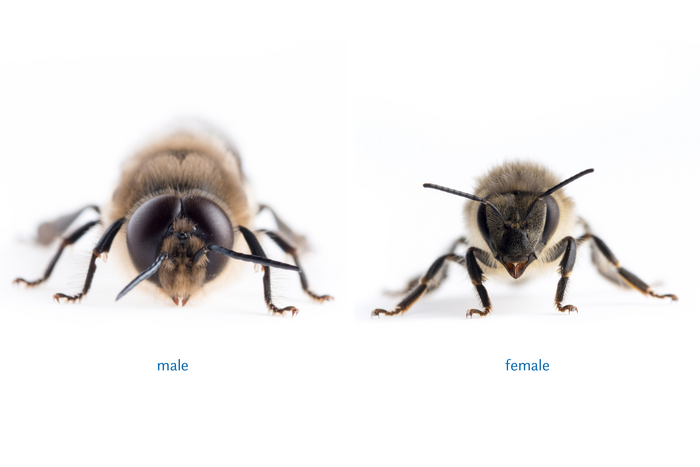
Credit: HHU/Institute of Evolutionary Genetics
Bee researchers at Heinrich Heine University Düsseldorf (HHU) headed by Professor Dr Martin Beye have identified a new gene in honeybees, which is responsible for the dimorphic eye differentiation between males and females of the species. The researchers have now presented this gene and the evolutionary genetic conclusions they have drawn from it in the scientific journal Nature Communications.
Differences between males and females are very common in animal organisms. They are not limited solely to morphological differentiation – i.e. differences in the form and structure of the animals – but also affect physiology and behaviour. This applies equally to invertebrates and vertebrates. This “sexual dimorphism” contributes to the biological diversity of the organisms, with examples including the colourful plumage and tails of male peacocks or the colouration of butterflies.
However, our knowledge about the developmental and evolutionary mechanisms governing this dimorphism is still limited. A developmental regulator gene, the “dsx gene”, has been identified in genetic model organisms. But this gene alone cannot specify sexual dimorphism in other organisms. Furthermore, it was unknown how a sex-specific developmental function emerged during the course of evolution as the advantage in one sex generates a disadvantage in the other sex.
The specialist field of the working group headed by Professor Martin Beye from the Institute of Evolutionary Genetics at HHU is the honeybee (Apis mellifera), which exhibits pronounced dimorphism in the eyes of males and females: Males have extremely large compound eyes, which enable them to locate the queen during mating flights. The females have small compound eyes, which are however sufficient for orientation purposes and finding flowers.
Together with colleagues from Wageningen University in the Netherlands, Professor Beye and his team examined the entire genome of the bee for possible sex-specific developmental regulator genes and identified what they have named the “glubschauge gene”.
This gene regulates the sex-specific eye morphology. The researchers proceeded as follows: Using the CRISPR/Cas9 method, they switched the gene off in females, which resulted in the animals developing the eye form of the males of the species. Conversely, they added the gene to males, resulting in them developing eyes like the females. In so doing, they identified a new developmental gene which has emerged over the course of evolution, also known as a “transcription factor”.
Professor Beye: “Our findings indicate how the diversity of secondary sexual characteristics can be regulated during development. We were able to demonstrate the following principle: Use a separate genetic instruction programme for each characteristic. There is no general instruction for the organism as a whole in the bees.”
The researchers were also interested in the evolutionary history of the “glubschauge gene”: How did this gene come to have its sex-determining function? Professor Beye: “Our findings solve a longstanding mystery in evolutionary biology. No evidence has been found to date of instances where the positive effect in the evolution of a sexual characteristic does not lead to a disadvantage in the other sex. We are now able to show how this can work.”
Using evolutionary sequence analyses, the research team established that this sex-specific function has only emerged during the evolution of hymenoptera. They found that the sex-specific expression newly evolved first, while the developmental function emerged subsequently. Beye: “The initial sex-specific regulation limits the subsequent developmental change to just one sex. So we have demonstrated a molecular path through which sexual dimorphism can evolutionarily originate.”
Journal
Nature Communications
DOI
10.1038/s41467-023-36153-4
Article Title
The function and evolution of a genetic switch controlling sexually dimorphic eye differentiation in honeybees
Article Publication Date
28-Jan-2023