• HOME
  • NEWS
  • EXPLORE
    • CAREER
      • Companies
      • Jobs
    • EVENTS
    • iGEM
      • News
      • Team
    • PHOTOS
    • VIDEO
    • WIKI
  • BLOG
  • COMMUNITY
    • FACEBOOK
    • INSTAGRAM
    • TWITTER
Wednesday, January 14, 2026
BIOENGINEER.ORG
No Result
View All Result
  • Login
  • HOME
  • NEWS
  • EXPLORE
    • CAREER
      • Companies
      • Jobs
        • Lecturer
        • PhD Studentship
        • Postdoc
        • Research Assistant
    • EVENTS
    • iGEM
      • News
      • Team
    • PHOTOS
    • VIDEO
    • WIKI
  • BLOG
  • COMMUNITY
    • FACEBOOK
    • INSTAGRAM
    • TWITTER
  • HOME
  • NEWS
  • EXPLORE
    • CAREER
      • Companies
      • Jobs
        • Lecturer
        • PhD Studentship
        • Postdoc
        • Research Assistant
    • EVENTS
    • iGEM
      • News
      • Team
    • PHOTOS
    • VIDEO
    • WIKI
  • BLOG
  • COMMUNITY
    • FACEBOOK
    • INSTAGRAM
    • TWITTER
No Result
View All Result
Bioengineer.org
No Result
View All Result
Home NEWS Science News Chemistry

Scientists reveal the effect of Cu(I) structure on quantum sieving for hydrogen isotope separation

Bioengineer by Bioengineer
February 9, 2023
in Chemistry
Reading Time: 3 mins read
0
Scientists Reveal the Effect of Cu(I) Structure on Quantum Sieving for Hydrogen Isotope Separation
Share on FacebookShare on TwitterShare on LinkedinShare on RedditShare on Telegram

Recently, a research team led by Prof. CHEN Changlun from Institute of Plasma Physics, Hefei Institutes of Physical Science of Chinese Academy of Sciences, studied Cu(I)Cu(II)-BTC, a kind of hydrogen isotope separation material and proved its crucial role in tuning quantum sieving without a complex structural design, which provided a new strategy for the intelligent design of highly efficient isotope systems.
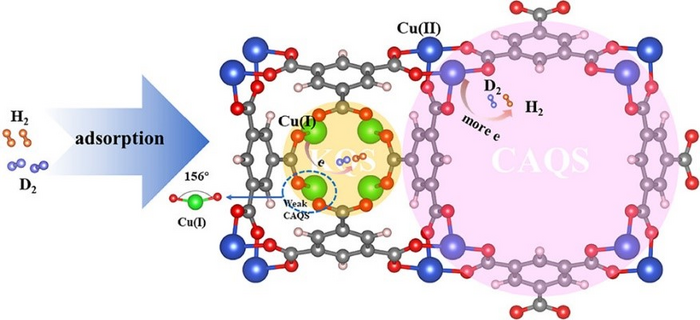
Scientists Reveal the Effect of Cu(I) Structure on Quantum Sieving for Hydrogen Isotope Separation

Credit: HU Xiaoyu

Recently, a research team led by Prof. CHEN Changlun from Institute of Plasma Physics, Hefei Institutes of Physical Science of Chinese Academy of Sciences, studied Cu(I)Cu(II)-BTC, a kind of hydrogen isotope separation material and proved its crucial role in tuning quantum sieving without a complex structural design, which provided a new strategy for the intelligent design of highly efficient isotope systems.

The result was published in ACS Applied Materials & Interfaces.

High pure deuterium (D2) is an important industrial and scientific gas, which has been widely used as an irreplaceable raw material, neutron moderator, isotopic tracer, and in other fields. Despite the huge demand for it, the mole fraction of natural deuterium is only up to 0.0156% of natural hydrogen in the oceans. Moreover, D2 and its isotope (H2 or T2) molecules have almost identical classical dimensions, associated with very similar physicochemical properties, and the separation of hydrogen isotope mixtures in high purity has been considered as one of the greatest difficulties and challenges in modern separation technology.

In this study, HKUST-1 crystals in the presence of hydroquinone were reduced to construct Cu(I)Cu(II)-BTC, featured by dual micropore size distribution and mixed-valence of Cu metal, and had been chosen to study H2/D2 separation in detail.

The study showed that unique Cu(I) and Cu(II) coordination network of Cu(I)Cu(II)-BTC could significantly facilitate D2/H2 isotope separation. Density functional theory (DFT) calculations indicated that the introduction of Cu(I) macrocycles in the framework decreased the pore size and further led to relatively enhanced interaction of H2/D2 molecules on Cu(II) sites. The significantly enhanced selectivity of Cu(I)Cu(II)-BTC at 30 K was mainly attributed to the synergistic effect of kinetic quantum sieving (KQS) and chemical affinity quantum sieving (CAQS).

In addition, a large angle of 156° for the O-Cu(I)-O configuration in Cu(I)Cu(II)-BTC exhibited weak binding strength of hydrogen adsorption since the dz2 orbital and small positive of Cu(I) couldn’t effectively participate in the hydrogen interaction, and didn’t show a strong CAQS effect at above liquid nitrogen temperature.

This research verified the effect of Cu(I) structure in D2/H2 separation. “We believe that this study will provide a new strategy for reasonable design of porous materials with OMSs at highly efficient isotope and gas separation systems,” said HU Xiaoyu, first author of the paper.


Journal

ACS Applied Materials & Interfaces

DOI

10.1021/acsami.2c18221

Article Title

Highly Effective H2/D2 Separation within the Stable Cu(I)Cu(II)-BTC: The Effect of Cu(I) Structure on Quantum Sieving

Article Publication Date

9-Jan-2023

Share12Tweet8Share2ShareShareShare2

Related Posts

blank

Thermal [2+2] Cycloaddition Builds Gem-Difluoro Bicycloalkanes

January 13, 2026
blank

Cobalt-Catalyzed Thioester Coupling via Siloxycarbene

January 12, 2026

Advancing Alkene Chemistry: Homologative Difunctionalization Breakthrough

January 8, 2026

Biocompatible Ligand Enables Safe In-Cell Protein Arylation

January 8, 2026

POPULAR NEWS

  • Enhancing Spiritual Care Education in Nursing Programs

    155 shares
    Share 62 Tweet 39
  • PTSD, Depression, Anxiety in Childhood Cancer Survivors, Parents

    147 shares
    Share 59 Tweet 37
  • Robotic Ureteral Reconstruction: A Novel Approach

    74 shares
    Share 30 Tweet 19
  • Study Reveals Lipid Accumulation in ME/CFS Cells

    53 shares
    Share 21 Tweet 13

About

We bring you the latest biotechnology news from best research centers and universities around the world. Check our website.

Follow us

Recent News

Multi-Omics Reveal Personalized Prognosis in Thyroid Cancer

SOHLH2-RAD54L Axis Drives Radioresistance in Lung Cancer

First Direct Detection of Migdal Effect

Subscribe to Blog via Email

Enter your email address to subscribe to this blog and receive notifications of new posts by email.

Join 71 other subscribers
  • Contact Us

Bioengineer.org © Copyright 2023 All Rights Reserved.

Welcome Back!

Login to your account below

Forgotten Password?

Retrieve your password

Please enter your username or email address to reset your password.

Log In
No Result
View All Result
  • Homepages
    • Home Page 1
    • Home Page 2
  • News
  • National
  • Business
  • Health
  • Lifestyle
  • Science

Bioengineer.org © Copyright 2023 All Rights Reserved.