A team of scientists at Los Alamos National Laboratory is applying machine-learning algorithms to subsurface imaging that will impact a variety of applications, including energy exploration, carbon capture and sequestration and estimating pathways of subsurface contaminant transport, according to new research published in IEEE Signal Processing Magazine.
Credit: Los Alamos National Laboratory
A team of scientists at Los Alamos National Laboratory is applying machine-learning algorithms to subsurface imaging that will impact a variety of applications, including energy exploration, carbon capture and sequestration and estimating pathways of subsurface contaminant transport, according to new research published in IEEE Signal Processing Magazine.
“The subsurface is extremely complex and full of uncertainty, and knowledge of its physical properties is vital for a variety of applications,” said Youzuo Lin of Los Alamos’ Energy and Earth System Science group and lead author of the paper. “This paper is the first systematic survey on physics-guided machine-learning techniques for computational wave imaging.”
The authors reviewed more than a 100 research articles, organizing them within a structured framework that highlights the most significant recent innovations in this area. These insights will be of value not only for subsurface imaging, but also for other computational wave imaging problems such as medical ultrasound imaging and acoustic sensing for materials science.
The process of obtaining subsurface data from surface measurements is called seismic inversion. Subsurface geophysical properties influence the transmission of seismic waves through the subsurface. Traditional physics models can be used to predict surface measurements for any given subsurface physical configuration.
Seismic inversion is the other way around: given actual surface measurements, researchers infer the subsurface configuration that would give rise to those measurements. Like most inverse problems, seismic imaging can be unreliable, meaning many different subsurface configurations can result in the same surface measurements.
“While we cannot directly observe the Earth beneath our feet, knowing what’s there is crucial for a variety of subsurface applications,” Lin said. “But since it is nearly impossible to get a comprehensive view of the subsurface, we rely on these limited geophysical measurements.”
Current optimization algorithms for the inverse problem are typically very computationally expensive because they require many evaluations. Recent advances in algorithms and computing provide an opportunity for significant progress in solving computational imaging and inversion problems. Additionally, efficient solutions to previously infeasible problems have been obtained using data-driven approaches.
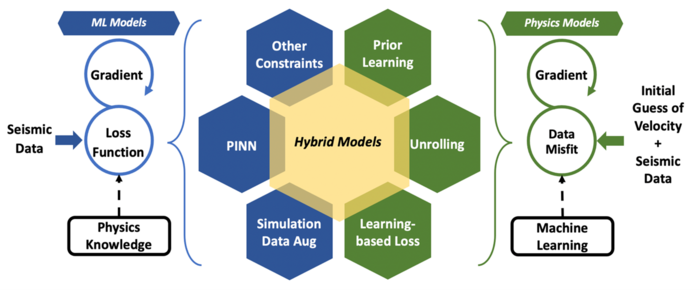
The performance of machine learning-based methods stems from their ability to make use of massive amounts of high-quality training data without the need for hand-designed features. However, seismic inversion is not a data-rich field. A relatively small amount of field data exists due to the high cost of acquisition, and, as a result of its commercial value, very little is publicly available. To alleviate the data scarcity issue and improve model generalization, there has been growing interest in combining physics knowledge with machine learning for solving seismic inversion problems.
“Over the last decade, researchers have done increasingly amazing things, turning ever larger datasets into ever more intelligent services,” said James Theiler of the Space Data Science and Systems group at Los Alamos and coauthor on the paper. “We want to exploit that technology, but in a field where actual data is not so plentiful.”
DOI
10.1109/MSP.2022.3217658
Method of Research
Data/statistical analysis
Subject of Research
Not applicable
Article Title
Physics-Guided Data-Driven Seismic Inversion: Recent progress and future opportunities in full-waveform inversion
Article Publication Date
2-Jan-2023