Physicists using advanced muon spin spectroscopy at Paul Scherrer Institute PSI make the missing link between their recent breakthrough in a kagome metal and unconventional superconductivity. The team uncovered an unconventional superconductivity that can be tuned with pressure, giving exciting potential for engineering quantum materials.
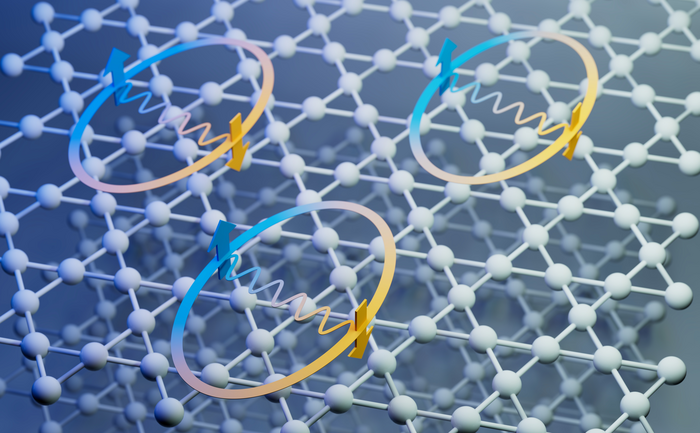
Credit: Paul Scherrer Institute / Mahir Dzambegovic
Physicists using advanced muon spin spectroscopy at Paul Scherrer Institute PSI make the missing link between their recent breakthrough in a kagome metal and unconventional superconductivity. The team uncovered an unconventional superconductivity that can be tuned with pressure, giving exciting potential for engineering quantum materials.
A year ago, a group of physicists led by PSI detected evidence of an unusual collective electron behaviour in a kagome metal, known as time-reversal symmetry-breaking charge order – a discovery that was published in Nature. Although this type of behaviour can hint towards the highly desirable trait of unconventional superconductivity, actual evidence that the material exhibited unconventional superconductivity was lacking. Now, in a new study published in Nature communications, the team have provided key evidence to make the link between the unusual charge order they observed and unconventional superconductivity.
The material in question is a ‘kagome’ metal made from potassium, vanadium and antimony (KV3Sb5). Here, the atoms are arranged in a two-dimensional lattice of corner-sharing triangles; the same pattern as in traditional Japanese ‘kagome’ baskets. It is this intricate arrangement of atoms that gives rise to exotic and sought after quantum phenomena.
“Many people have made interesting theoretical predictions in kagome metals such as these, but it was previously very difficult to prove them experimentally. But now we have the platform to experimentally realise such exotic physics,” says Zurab Guguchia from the Lab of Muon Spin Spectroscopy at PSI, who led the team.
Unconventional charge order, unconventional superconductivity?
Materials superconduct when the electrons pair up into so-called Cooper pairs, enabling current to flow without resistance. In unconventional superconductors, the electrons pair up in any sort of unusual conformation in contrast with conventional electron pairing found in traditional superconductors.
“We knew that KV3Sb5 was superconducting. Our question was, what is the nature of this superconductivity: is it unconventional like the charge order, or completely unconnected?” explains Guguchia.
Muon spin spectroscopy reveals that the underlying mechanism is the same
To answer this question, the team once again turned to the advanced muon spin spectroscopy facility at PSI, which uses spin-polarised muons implanted into a material to measure the local magnetic properties. Here, they probed KV3Sb5 and another, similar kagome metal, RbV3Sb5, where the potassium atoms are replaced with rubidium.
The first step was to confirm the rubidium kagome metal exhibited the same unusual charge order as its potassium brother. It did. As detected KV3Sb5, also in RbV3Sb5 they discovered charge-order that breaks so-called time-reversal symmetry (a type of symmetry that means that the laws of physics are the same whether you look at a system going forward or backward in time).
The researchers could then investigate the nature of the electron pairing responsible for the superconductivity in both materials. They found a superconducting pairing state that broke time-reversal symmetry, naturally connecting it to the time-reversal symmetry breaking charge order they had previously discovered. This indicated that the same microscopic mechanisms that underpin the unconventional charge order might also be responsible for the unconventional superconductivity.
This was a surprise: in both materials unconventional superconductivity set in at a temperature much lower than the temperature at which charge ordering began. “It’s exactly because both processes compete for the same electrons. So, if we weaken the charge ordering, we can drive the system towards optimal unconventional superconductivity,” explains Guguchia.
Putting on the pressure lets superconductivity reign
Key to making this discovery, were experiments with pressure, which enable the team to study the interplay between the charge order and unconventional superconductivity. By applying pressure, the team could push the material into a state where the unconventional superconductivity reigns. Furthermore, they uncovered that pressure also induces a change in the microscopic characteristics of the superconductivity, nudging it from a so-called ‘nodal’ superconducting gap structure at low pressure to ‘nodeless’ at high pressure.
The ability to tune superconductivity and its microscopic characteristics is a highly desirable property for engineering quantum materials. This is particularly the case for layered materials such as these kagome metals, where in the future layers could be combined to create heterostructures with designed quantum features. “So especially now that we show the unconventional superconductivity is easily tunable by hydrostatic pressure, there’s a lot of potential,” says Guguchia.
Text: Paul Scherrer Institute / Miriam Arrell
Journal
Nature Communications
DOI
10.1038/s41467-022-35718-z
Subject of Research
Not applicable
Article Title
Tunable unconventional kagome superconductivity in charge ordered RbV3Sb5 and KV3Sb5
Article Publication Date
11-Jan-2023