Bin Chen, associate professor of physics and researcher at NJIT’s Center for Solar-Terrestrial Research (CSTR), has been awarded the 2023 Karen Harvey Prize from the Solar Physics Division of the American Astronomical Society (AAS) for “significantly advancing” our understanding of the fundamental physics driving the largest explosions in our solar system — solar flares.
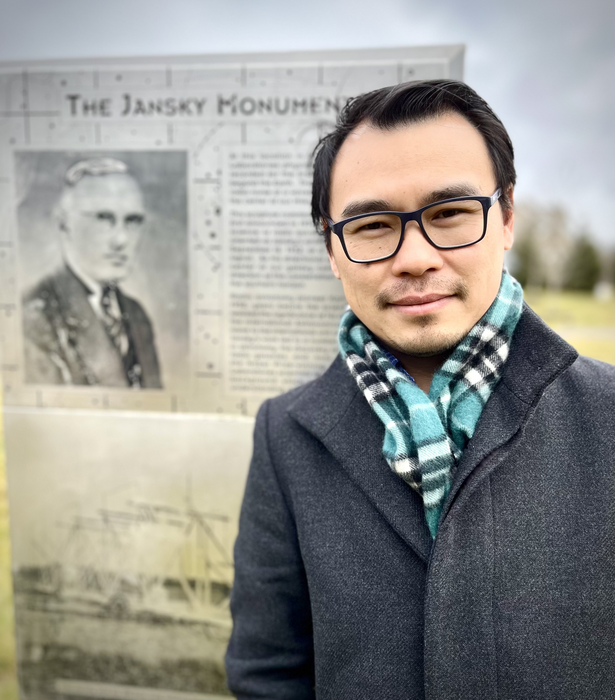
Credit: Bin Chen/NJIT
Bin Chen, associate professor of physics and researcher at NJIT’s Center for Solar-Terrestrial Research (CSTR), has been awarded the 2023 Karen Harvey Prize from the Solar Physics Division of the American Astronomical Society (AAS) for “significantly advancing” our understanding of the fundamental physics driving the largest explosions in our solar system — solar flares.
The Karen Harvey Prize, established by AAS’s Solar Physics Division in 2002 in memory of solar physicist Karen L. Harvey (1942-2002), is awarded each year in recognition of a significant contribution to the study of the Sun early in a person’s professional career.
An award ceremony will be held at the 2023 annual meeting of the Solar Physics Division of the American Astronomical Society, scheduled for the week of August 14 in Minneapolis, MN. Along with receiving the award, Chen will deliver a plenary Harvey Prize Lecture at the meeting.
“I feel extremely honored to receive this prestigious prize,” said Chen. “At the same time, I am very pleased that the effort we have put into this line of work is recognized at such a high level. These achievements would not be possible without the support from many of my wonderful colleagues and students at NJIT and elsewhere, and I am deeply grateful for that.”
“Already in his career, Bin Chen’s contribution to our understanding of these significant solar events has been remarkable, and his leadership and mentorship in the field has been exemplary,” said Atam P. Dhawan, NJIT Interim Provost and Senior Executive Vice President. “Bin’s collaborative efforts with NJIT research colleagues represent some of the world’s leading investigations of the Sun and explosive space weather phenomena, and we couldn’t be more delighted that his incredible scientific contributions are being recognized with the Karen Harvey Prize.”
Since arriving to NJIT in 2016, Chen has led breakthrough research and development of new radio observing techniques used for unraveling the complex physical processes at the heart of solar flares — intense eruptions that are triggered by the breaking and reconnecting of magnetic field lines along the Sun’s surface.
Chen’s research has recently incorporated unique microwave observations of solar flare events captured by NJIT’s Expanded Owens Valley Solar Array (EOVSA) radio telescope, which have offered an unprecedented glimpse into the “central engine” of these eruptions where dramatic bursts of energy are stored and released, accelerating energetic particles to near-light speed.
Insights from Chen’s work have implications for understanding the fundamental physical processes underlying these ubiquitous explosive events across the universe, and for improving space weather predictions and assessing how such events may impact Earth.
The Harvey Prize Committee cited Chen for “significantly advancing the study of magnetic reconnection and particle acceleration in solar flares,” as well as his “innovative methods to analyze solar flare observations … leading to new insights in several areas of flare physics such as the termination shocks and measurements of magnetic fields and particles in reconnection current sheets.”
In addition to his research contributions, the Prize Committee also recognized Chen for “exceptional leadership” as a mentor and collaborative team builder in the solar and space research community, and noted his instrumental role in developing the next generation of solar radio telescopes.
At NJIT, Chen serves as the Director of the Applied Physics Graduate Program and co-leads the university’s solar radio group, which operates EOVSA — a world-class radio telescope array dedicated to solar physics research, located at Owens Valley Radio Observatory near Big Pine, California.
Among his other early career honors and distinctions, Chen received the NASA/UCAR Jack Eddy Fellowship in 2013 and the National Science Foundation (NSF)’s CAREER Award in 2017.
He is currently serving as panel member of the National Academies of Sciences, Engineering, and Medicine’s Decadal Survey for Solar and Space Physics (Heliophysics) 2024-2033, and has previously served as a committee member of the Solar Physics Division of the American Astronomical Society (2019–2021). Chen’s research receives funding from NSF and NASA.
A full list of AAS’s 2023 award and prize recipients can be found here.