• HOME
  • NEWS
  • EXPLORE
    • CAREER
      • Companies
      • Jobs
    • EVENTS
    • iGEM
      • News
      • Team
    • PHOTOS
    • VIDEO
    • WIKI
  • BLOG
  • COMMUNITY
    • FACEBOOK
    • INSTAGRAM
    • TWITTER
Saturday, February 7, 2026
BIOENGINEER.ORG
No Result
View All Result
  • Login
  • HOME
  • NEWS
  • EXPLORE
    • CAREER
      • Companies
      • Jobs
        • Lecturer
        • PhD Studentship
        • Postdoc
        • Research Assistant
    • EVENTS
    • iGEM
      • News
      • Team
    • PHOTOS
    • VIDEO
    • WIKI
  • BLOG
  • COMMUNITY
    • FACEBOOK
    • INSTAGRAM
    • TWITTER
  • HOME
  • NEWS
  • EXPLORE
    • CAREER
      • Companies
      • Jobs
        • Lecturer
        • PhD Studentship
        • Postdoc
        • Research Assistant
    • EVENTS
    • iGEM
      • News
      • Team
    • PHOTOS
    • VIDEO
    • WIKI
  • BLOG
  • COMMUNITY
    • FACEBOOK
    • INSTAGRAM
    • TWITTER
No Result
View All Result
Bioengineer.org
No Result
View All Result
Home NEWS Science News Biology

An Old Yellow Enzyme helps algae combat photooxidative stress

Bioengineer by Bioengineer
January 18, 2023
in Biology
Reading Time: 2 mins read
0
Anja Hemschemeier
Share on FacebookShare on TwitterShare on LinkedinShare on RedditShare on Telegram

OYEs in microalgae use energy from photosynthesis
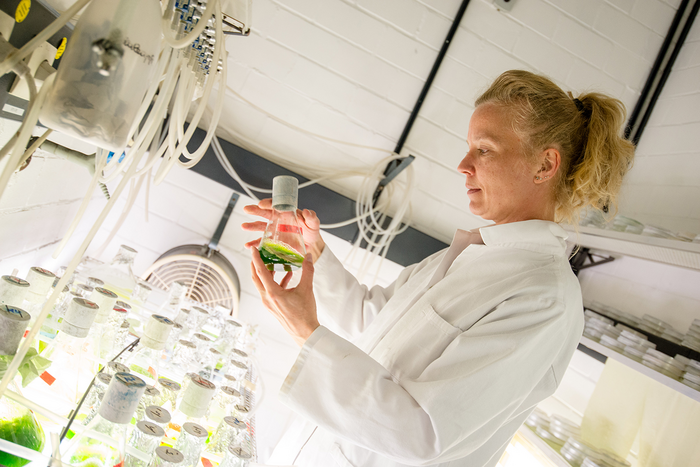
Anja Hemschemeier

Credit: © RUB, Marquard

OYEs in microalgae use energy from photosynthesis

“Our research group is among the first to investigate OYEs in algae,” says Dr Stefanie Böhmer, lead author of the study. “Initially, we set out to determine whether these biocatalysts are also suitable for industrial processes. We were particularly interested in whether microalgae can use the energy of photosynthesis to drive the respective chemical reactions. This could help establish more environmentally friendly productions.” The researchers could indeed demonstrate this: a chemical molecule added to living algae cells was only converted at high rates in the light. “This result also indicated that the so-called en-reductases of the algae that are responsible for this conversion are linked to photosynthesis,” says Böhmer. Therefore, the researchers from the Photobiotechnology working group investigated how an algal strain in which an OYE biocatalyst is defective adapts to strong light.

Excess light energy must be dissipated

In cooperation with researchers from the University of Leipzig, the Bochum research team could indeed show that this algal strain is hardly able to dissipate excess light energy. “Photosynthetic organisms such as algae and plants must always maintain a balance between absorbed light energy and its conversion into chemical energy,” explains Anja Hemschemeier, who led the study. “Otherwise, oxidative cell damage will occur if the light is too strong. Therefore, these organisms have sophisticated protective mechanisms in place to dissipate excess light energy, for example as heat.”

In the microalgal strain lacking an OYE, the researchers detected hardly any of these protective mechanisms at all, and the strain accordingly exhibited oxidative damage. “We suspect that a certain molecule, which is normally converted by this biocatalyst in the algal cells, is essential for the photosynthetic balance,” says Hemschemeier.

The research team now plans to get to the bottom of this. “Photosynthetic organisms provide the basis for our life. It’s very important to understand how they adapt to stress, and we believe we’ve found another piece of the jigsaw here,” concludes Hemschemeier.


Journal

Plant Direct

DOI

10.1002/pld3.480

Method of Research

Experimental study

Subject of Research

Not applicable

Article Title

Chlamydomonas reinhardtii mutants deficient for Old Yellow Enzyme 3 exhibit increased photooxidative stress

Article Publication Date

15-Jan-2023

Share12Tweet8Share2ShareShareShare2

Related Posts

Florida Cane Toad: Complex Spread and Selective Evolution

Florida Cane Toad: Complex Spread and Selective Evolution

February 7, 2026
New Study Uncovers Mechanism Behind Burn Pit Particulate Matter–Induced Lung Inflammation

New Study Uncovers Mechanism Behind Burn Pit Particulate Matter–Induced Lung Inflammation

February 6, 2026

DeepBlastoid: Advancing Automated and Efficient Evaluation of Human Blastoids with Deep Learning

February 6, 2026

Navigating the Gut: The Role of Formic Acid in the Microbiome

February 6, 2026

POPULAR NEWS

  • Robotic Ureteral Reconstruction: A Novel Approach

    Robotic Ureteral Reconstruction: A Novel Approach

    82 shares
    Share 33 Tweet 21
  • Digital Privacy: Health Data Control in Incarceration

    63 shares
    Share 25 Tweet 16
  • Study Reveals Lipid Accumulation in ME/CFS Cells

    57 shares
    Share 23 Tweet 14
  • Breakthrough in RNA Research Accelerates Medical Innovations Timeline

    53 shares
    Share 21 Tweet 13

About

We bring you the latest biotechnology news from best research centers and universities around the world. Check our website.

Follow us

Recent News

Evaluating Pediatric Emergency Care Quality in Ethiopia

TPMT Expression Predictions Linked to Azathioprine Side Effects

Improving Dementia Care with Enhanced Activity Kits

Subscribe to Blog via Email

Enter your email address to subscribe to this blog and receive notifications of new posts by email.

Join 73 other subscribers
  • Contact Us

Bioengineer.org © Copyright 2023 All Rights Reserved.

Welcome Back!

Login to your account below

Forgotten Password?

Retrieve your password

Please enter your username or email address to reset your password.

Log In
No Result
View All Result
  • Homepages
    • Home Page 1
    • Home Page 2
  • News
  • National
  • Business
  • Health
  • Lifestyle
  • Science

Bioengineer.org © Copyright 2023 All Rights Reserved.