A team of scientists has uncovered the physical principles—a series of forces and hydrodynamic flows—that help ensure the proper functioning of life’s blueprint. Its discovery provides new insights into the genome while potentially offering a new means to spot genomic aberrations linked to developmental disorders and human diseases.
Credit: Image by Achal Mahajan, UC San Diego
A team of scientists has uncovered the physical principles—a series of forces and hydrodynamic flows—that help ensure the proper functioning of life’s blueprint. Its discovery provides new insights into the genome while potentially offering a new means to spot genomic aberrations linked to developmental disorders and human diseases.
“The way in which the genome is organized and packed inside the nucleus directly affects its biological function, yet the physical principles behind this organization are far from understood,” explains Alexandra Zidovska, an associate professor in New York University’s Department of Physics and an author of the paper, which appears in the journal Physical Review X (PRX). “Our results provide fundamental insights into the biophysical origins of the organization of the genome inside the cell nucleus.”
“Such knowledge is crucial for understanding the genome’s function,” adds David Saintillan, a professor at the University of California San Diego’s Department of Mechanical and Aerospace Engineering and an author of the paper.
“Our findings show the key role of physics in the genome’s organization and hence its function,” observes Michael Shelley, a professor at NYU’s Courant Institute of Mathematical Sciences, a researcher at the Flatiron Institute, and an author of the paper.
The team, which also included Wen Yan, formerly of the Flatiron Institute’s Center for Computational Biology, and Achal Mahajan, a UC San Diego doctoral student at the time of the work, focused on the role of the nucleoplasm—the fluid in which the genome is immersed—and the forces that drive its organization.
Specifically, the scientists examined the forces applied on chromosomal material, or chromatin, by enzymes at work in a cell’s nucleus. Here, these forces initiate processes, such as transcription, and act in ways that affect the spatial arrangement of the chromatin.
This organization affects biological function. But despite the crucial role of this process in conveying genetic information, the physics underlying it are opaque.
In pursuing a greater understanding of this dynamic, the scientists focused on the genome’s compartmentalization into its primary parts, euchromatin and heterochromatin. Euchromatin contains predominantly actively transcribing genes, which drive expression; heterochromatin contains genes that are silenced—and therefore not expressed in the cell.
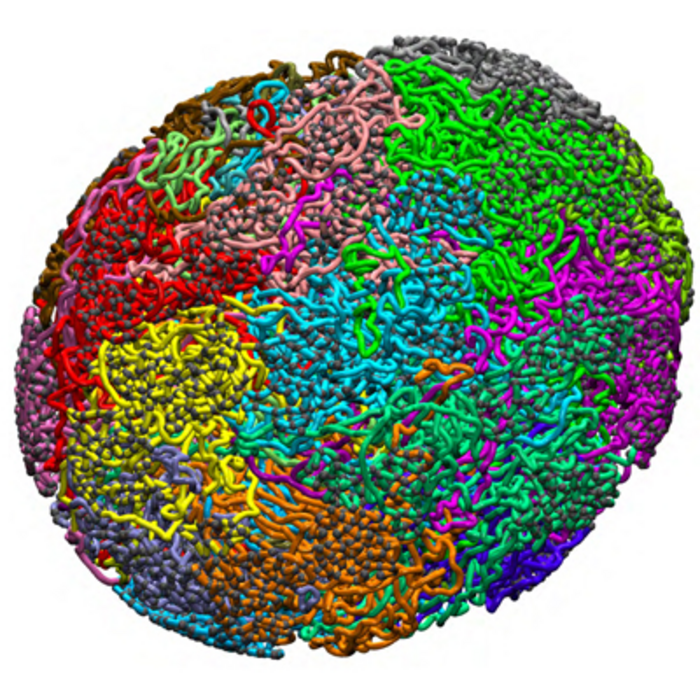
To capture this, they created a computer modeling system that replicated this process through a series of simulations. In their model nucleus, 23 chromatin fibers—the number of chromosomes in the human genome—were modeled as floppy chains and stuffed into a fluid-filled sphere. Each chain was divided up into active regions, or euchromatin, and passive heterochromatic regions.
They found that when active forces act on the chromatin fiber, they generate flows in the fluid around them, which in turn affect the motion and positioning of the surrounding chromatin. These forces push on the euchromatic parts and drive flows that cause a major spatial rearrangement of the genome, notably leading to the formation of heterochromatin compartments.
“The euchromatic, or active, parts push the heterochromatic, or inactive, parts out of their way and bunch them together,” explains Zidovska. “This is how the cell effectively stores inactive genes.
“This is crucial for our health—if this process goes awry, the organism doesn’t form properly and potentially leads to developmental disorders and other afflictions, such as the development of cancer cells.”
An image and a video, along with captions and credits, depicting this process may be accessed from Google Drive.
This research was supported by grants from the National Science Foundation (CMMI-1762506, DMS-2153432, CMMI-1762566, DMS-2153520, DMR-2004469, CAREER PHY-1554880 and PHY-2210541).
# # #
Journal
Physical Review X
Method of Research
Computational simulation/modeling
Subject of Research
Not applicable
Article Title
Euchromatin Activity Enhances Segregation and Compaction of Heterochromatin in the Cell Nucleus
Article Publication Date
23-Dec-2022