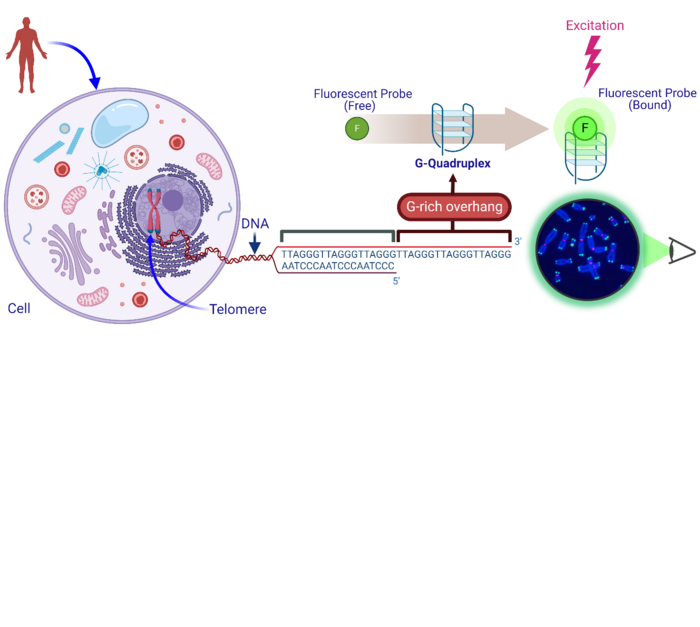
DNA, the genetic material compacted in chromosomes, stores information to regulate all the cell processes in the body. Two decades ago, in addition to the widely known Watson-Crick double helix model of DNA, scientists postulated an alternative conformation that controls different biological functions. This conformation was named G-Quadruplex as it contains a high guanine-rich sequence of DNA strands arranging four Guanine structures in a planar conformation stack on each other. This stable structure is responsible for crucial biological processes, including regulation of genes, cell division, aging, cell death, etc. Irregularities in gene regulation cause globally crucial human health issues like cancer. Due to the frequency of localization of guanidine-rich DNA sequences, computational calculations have predicted that the human genome contains approximately 376,000 potential putative G-quadruplex forming sequences, mainly at the end of the chromosome called telomeres. Around 20,000 sites are associated with oncogenes in which the gene regulates cancer development and progression. The biological role of the G-quadruplex in cancer prognosis and pathogenesis has not been fully understood by molecular biologists due to a lack of adequate visualization or tracking methods for studying molecules in a complex biological matrix. Therefore, developing G-quadruplex-selective probes is an essential but challenging task for molecular therapeutic, diagnostic, imaging, and sensing applications.
Credit: Dr. Michael Heagy.
DNA, the genetic material compacted in chromosomes, stores information to regulate all the cell processes in the body. Two decades ago, in addition to the widely known Watson-Crick double helix model of DNA, scientists postulated an alternative conformation that controls different biological functions. This conformation was named G-Quadruplex as it contains a high guanine-rich sequence of DNA strands arranging four Guanine structures in a planar conformation stack on each other. This stable structure is responsible for crucial biological processes, including regulation of genes, cell division, aging, cell death, etc. Irregularities in gene regulation cause globally crucial human health issues like cancer. Due to the frequency of localization of guanidine-rich DNA sequences, computational calculations have predicted that the human genome contains approximately 376,000 potential putative G-quadruplex forming sequences, mainly at the end of the chromosome called telomeres. Around 20,000 sites are associated with oncogenes in which the gene regulates cancer development and progression. The biological role of the G-quadruplex in cancer prognosis and pathogenesis has not been fully understood by molecular biologists due to a lack of adequate visualization or tracking methods for studying molecules in a complex biological matrix. Therefore, developing G-quadruplex-selective probes is an essential but challenging task for molecular therapeutic, diagnostic, imaging, and sensing applications.
The G-Quadruplex structures can exist in various conformations or forms called topologies. The relatively overwhelming amount of double standard DNA, its dynamic nature, and polymorphism make it even more challenging to detect in a real-time environment. Initially, researchers adapted conventional methods such as platinum crosslinking, FRET, I-radio probing, covalent ligation, click reaction, sedimentation, and small molecule probes. Among them, fluorescence-active small molecule investigation is the more direct, emerging, and real-time visualization method. Over the past two and a half decades, researchers have developed fluorescence-active small molecular probes for G-Quadruplex detection. They evaluated their selectivity of recognition over duplex DNA in mechanical parameters such as binding affinity, absorbance, and fluorescence enhancement or quenching and fluorescence lifetime change upon binding with G-quadruplexes. The research involved evaluating various fluorescence cores with different side chains or binders, increasing the selectivity towards the G-Quadruplex over the duplex DNA. The structure-activity relationship study of the probes has helped the discovery of superior probes with ideal characteristics.
In this review, Michael Heagy and Susantha K. Ganegamage present a comprehensive study of probes developed over the last two and a half decades. The researchers have classified and summarized several classes of probes, including carbocyanine, porphyrins, ethidium, carbazoles, acridines, tripodal or tetrapodal probes, pyrimidine carboxamides, triangulenium, anthraquinones, polyaromatic hydrocarbons, BODIPY dyes, berberines, acetones and their derivatives for the variation of selectivity, photophysical, and biological properties concerning the structural modifications. “The intent of this exhaustive review is to provide helpful guidance and insights for designing novel fluorescent DNA probes with optimal characteristics,” says Professor Heagy who heads the Department of Chemistry and Materials Science, at the Rochester Institute of Technology. The review is published in Current Organic Chemistry.
To access the research, please visit: https://www.eurekaselect.com/article/125423
Journal
Current Organic Chemistry
DOI
10.2174/1385272826666220811102939
Article Title
Illuminating the G-Quadruplex: A Review on Fluorescent Probes for Detecting Polymorphic G-Quartet DNA Structures
Article Publication Date
12-Sep-2022