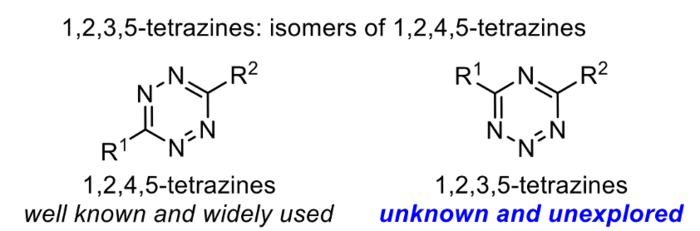
LA JOLLA, CA—Chemists at Scripps Research have devised the first general method for synthesizing a family of compounds called 1,2,3,5-tetrazines, which hold great promise for making pharmaceuticals, biological probes and other chemical products.
Credit: Scripps Research
LA JOLLA, CA—Chemists at Scripps Research have devised the first general method for synthesizing a family of compounds called 1,2,3,5-tetrazines, which hold great promise for making pharmaceuticals, biological probes and other chemical products.
The researchers had synthesized the first compound in this previously unknown family in 2019, but the new method, reported on December 3, 2022 in the Journal of Organic Chemistry, is now general and more efficient.
“For the first time, the chemistry community can access these promising compounds and explore their interesting properties,” says study senior author Dale Boger, PhD, the Richard and Alice Cramer Professor of Chemistry at Scripps Research.
The study’s first author was Zhi-Chen Wu, PhD, a graduate student in the Boger lab during the study, now a medicinal chemist at Amgen.
Methods enabling the synthesis of new compounds always offer the prospect of novel medicines and other products with unusual, valuable features. The 1,2,3,5-tetrazines have been seen as particularly promising, given the success of closely related 1,2,4,5-tetrazines. The latter compounds, discovered in 1959, have unique patterns of reactivity and are widely used for making pharmaceuticals, new materials and chemical probes that label biological molecules. The 1,24,5-tetrazines are best known for their uses in “click chemistry” reactions, so-called for their ease of use and efficient, focused reactivity with target molecules. (Click chemistry’s widespread utility was recognized with this year’s Nobel Prize in Chemistry.)
“The 1,2,4,5-tetrazines have become unbelievably valuable for chemistry in the 60+ years since their discovery,” Boger says.
Despite being an isomer of 1,2,4,5-tetrazines—meaning having the same chemical formula, but with a different arrangement of atoms—1,2,3,5-tetrazines have been much more elusive. Yet when Wu and Boger achieved the first 1,2,3,5-tetrazine synthesis in 2019, they found ample evidence of its promise. One observation was that the compound can very efficiently and swiftly react with compounds called amidines via “ligation reactions” (a type of reaction that joins two fragments together). The chemists noted that such ligations could be the basis for new molecular probes and labeling techniques for biology, as well as for assembling pharmaceuticals and other chemical products. The researchers also found evidence that the 1,2,3,5-tetrazine’s reactivity differed from that of 1,2,4,5-tetrazines, in a way that could allow the two tetrazine classes to be used simultaneously in certain contexts without generating crossover reactivity.
That first synthesis of a 1,2,3,5-tetrazine was relatively laborious and could be used for making only the one compound. The new method, by contrast, offers a general route to making myriad versions of these compounds—efficiently, in just five reaction steps from inexpensive commercially available starting compounds.
The researchers and their colleagues at Scripps Research will now be synthesizing additional new 1,2,3,5-tetrazines to explore their properties in click chemistry and other applications.
“I think this is the start of a new chapter that could prove to be as timely, durable, and important as the one for 1,2,4,5-tetrazines,” Boger says.
“1,2,3,5-Tetrazines: A General Synthesis, Cycloaddition Scope, and Fundamental Reactivity Patterns” was co-authored by Zhi-Chen Wu and Dale L. Boger.
The work was supported in part by the National Institutes of Health (CA042056).
About Scripps Research
Scripps Research is an independent, nonprofit biomedical institute ranked the most influential in the world for its impact on innovation by Nature Index. We are advancing human health through profound discoveries that address pressing medical concerns around the globe. Our drug discovery and development division, Calibr, works hand-in-hand with scientists across disciplines to bring new medicines to patients as quickly and efficiently as possible, while teams at Scripps Research Translational Institute harness genomics, digital medicine and cutting-edge informatics to understand individual health and render more effective healthcare. Scripps Research also trains the next generation of leading scientists at our Skaggs Graduate School, consistently named among the top 10 US programs for chemistry and biological sciences. Learn more at www.scripps.edu.
Journal
The Journal of Organic Chemistry