Our palms tell us a lot about our emotional state, tending to get wet when people are excited or nervous. This reaction is used to measure emotional stress and help people with mental health issues, but the devices to do it now are bulky, unreliable and can perpetuate social stigma by sticking very visible sensors on prominent parts of the body.
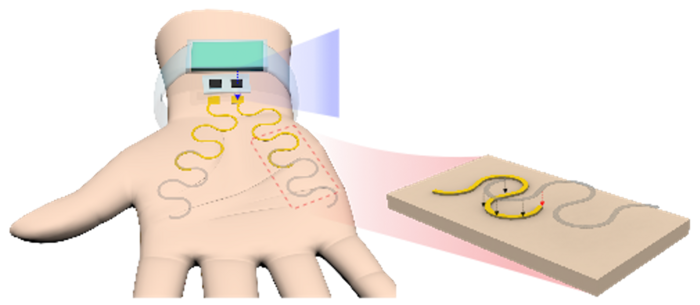
Credit: The University of Texas at Austin
Our palms tell us a lot about our emotional state, tending to get wet when people are excited or nervous. This reaction is used to measure emotional stress and help people with mental health issues, but the devices to do it now are bulky, unreliable and can perpetuate social stigma by sticking very visible sensors on prominent parts of the body.
Researchers at The University of Texas at Austin and Texas A&M University have applied emerging electronic tattoo (e-tattoo) technology to this type of monitoring, known as electrodermal activity or EDA sensing. In a new paper published recently in Nature Communications, the researchers created a graphene-based e-tattoo that attaches to the palm, is nearly invisible and connects to a smart watch.
“It’s so unobstructive that people sometimes forget they had them on, and it also reduces the social stigma of wearing these devices in such prominent places on the body,” said Nanshu Lu, professor in the Department of Aerospace Engineering and Engineering Mechanics and leader of the project.
Lu and her collaborators have been advancing wearable e-tattoo technology for many years. Graphene has been a favorite material because of how thin it is and how well it measures electrical potential from human body, leading to very accurate readings.
But, such ultra-thin materials can’t handle much, if any strain. So that makes applying them to parts of the body that include a lot of movement, such as the palm/wrist, challenging.
The secret sauce of this discovery is how the e-tattoo on the palm is able to successfully transfer data to a rigid circuit – in this case a commercially available smart watch, in out-of-lab, ambulatory settings. They used a serpentine ribbon that has two layers of graphene and gold partially overlapped. By snaking the ribbon back and forth, it can handle the strain that comes with movements of the hand for everyday activities like holding the steering wheel while driving, opening doors, running etc.
Current palm monitoring tech uses bulky electrodes that fall off and are very visible, or EDA sensors applied to other parts of the body, which gives a less accurate reading.
Other researchers have tried similar methods using nanometer-thick straight-line ribbons to connect the tattoo to a reader, but they couldn’t handle the strain of constant movement.
Lu said the researchers were inspired by virtual reality (VR), gaming and the incoming metaverse for this research. VR is used in some cases to treat mental illness; however, the human-aware capability in VR remains lacking in many ways.
“You want to know whether people are responding to this treatment,” Lu said. “Is it helping them? Right now, that’s hard to tell.”
Other members of the team include Hongwoo Jang and Eunbin Kim from the Texas Materials Institute; Sangjun Kim and Kyoung-Ho Ha from the Walker Department of Mechanical Engineering; Xiangxing Yang from the Chandra Family Department of Electrical and Computer Engineering; and Kaan Sel and Roozbeh Jafari from Texas A&M’s Department of Electrical and Computer Engineering.
Journal
Nature Communications
DOI
10.1038/s41467-022-34406-2
Article Title
Graphene e-tattoos for unobstructive ambulatory electrodermal activity sensing on the palm enabled by heterogeneous serpentine ribbons