Motion is everywhere in living systems and is necessary for mechanical functions in artificial systems, such as robots and machines. Functional mechanical structures that can change volume and shape in response to external stimuli (such as light, heat, electricity, humidity, and chemistry) have a wide range of application prospects in the field of biomechanics and bionic robots. They have attracted immense research interest, particularly at micro-/nanoscales.
Credit: Tang, Jia, et al.
Motion is everywhere in living systems and is necessary for mechanical functions in artificial systems, such as robots and machines. Functional mechanical structures that can change volume and shape in response to external stimuli (such as light, heat, electricity, humidity, and chemistry) have a wide range of application prospects in the field of biomechanics and bionic robots. They have attracted immense research interest, particularly at micro-/nanoscales.
Many proposals for actuators rely on light as an energy source. Optical force is commonly used to manipulate microobjects, due to its unique advantages of precision, immediacy, and capacity for miniaturization. The fundamental principle involved in optical manipulation is that photons carry momentum that can transfer to objects during scattering and absorbing processes, and accordingly enable their motion. But optical force produced by momentum transfer is at a level of the piconewton, which is much smaller than the adhesive force on a solid interface, making it difficult to work in nonliquid environments.
Light-induced elastic waves present a solution. Induced by temperature rising through optical absorption in microobjects, they convey sufficient mechanical displacement to enable microobjects to crawl on solid interfaces. The idea has been successfully exemplified with gold microplates in microfiber-based systems. Such pioneering results encourage new perspectives for light-driven micromotors on solid interfaces, yet there remain questions to be explored. For instance, the actuation principle is theoretically applicable for any microobject that can generate elastic waves by absorbing light, but it has not yet been extended to other absorptive, elastic materials. Also, potential issues associated with thermal effects (such as thermal damage and melting) remain to be addressed.
As reported in Advanced Photonics Nexus, researchers from Hangzhou Institute for Advanced Study, University of the Chinese Academy of Sciences, and Westlake University approached these outstanding issues by studying the motion of two-dimensional topological insulator antimony telluride plates on microfibers to which laser pulses are delivered. Antimony telluride, Sb2Te3, is a unique quantum material hosting topologically protected boundary surface states that lead to several fascinating electric and optical properties, such as spin-momentum locking of electrons and ultrabroadband plasmon excitations. The researchers harnessed these properties to efficiently absorb light for generating elastic waves. Since Sb2Te3 has a rather low thermal conductivity (~1 W/m/K, close to glass and two orders of magnitude smaller than gold), it can also mitigate heat diffusion and intensify thermal effects.
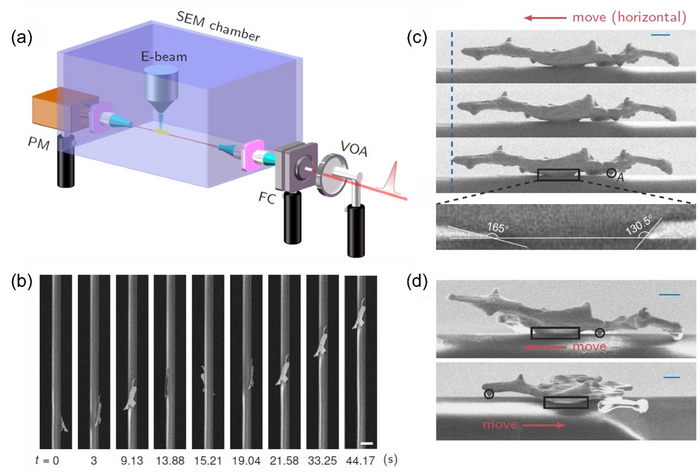
Experimentally, the team implemented a microfiber-based actuation system in a scanning electron microscope (SEM) chamber, where light-induced actuation can be precisely characterized. Their successful observations of continuous spiral motion of Sb2Te3 plates supplement previous results with gold plates, contributing new evidence to support the actuation principle based on light-induced elastic waves.
The team investigated the thermal effects on actuation in their system by intentionally increasing the laser power. They observed a new type of liquid-like motion that shows features completely different from the elastic-wave-based spiral motion. They note that this phenomenon is caused by the formation of the microbumps induced by the Marangoni effect, which is a common thermal effect. The asymmetric deformation of the thermal induced liquid-like state provides the driving force.
Many unique applications can be immediately envisioned with a light-enabled actuator in a nonliquid environment. For instance, mobile photonic modulation/switching by delivering microobjects to targeted positions to control the light flow can be realized by integrating this technique into an on-chip waveguide network. Besides, multimode micro robots operating in vacuum system can be realized by carefully designing the driving light and the geometry of the actuator.
Read the Gold Open Access article by W. Tang et al., “Light-induced vacuum micromotors based on an antimony telluride microplate,” Adv. Photon. Nexus 1(2), 026005 (2022), doi 10.1117/1.APN.1.2.026005.
Journal
Advanced Photonics Nexus
DOI
10.1117/1.APN.1.2.026005
Method of Research
Observational study
Subject of Research
Not applicable
Article Title
Light-induced vacuum micromotors based on an antimony telluride microplate
Article Publication Date
16-Nov-2022