Nanodiamond materials have great potential as catalysts. Inexpensive nanoparticles made of carbon provide very large surfaces compared to their volume. However, to catalytically accelerate chemical reactions in an aqueous medium, electrons from the catalyst need to go into solvation and this requires in pure diamond materials high-energy UV light for excitation. On the other hand, the extremely small sizes of the nanoparticles allow new molecular states on the surfaces of nanodiamonds that also absorb visible light.
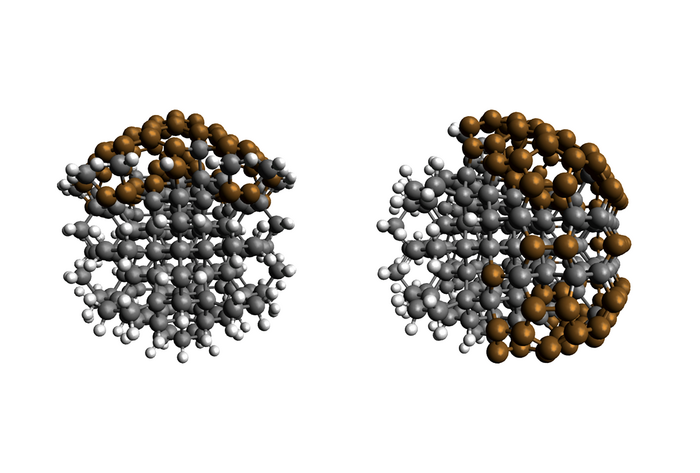
Credit: T. Kirschbaum / HZB
Nanodiamond materials have great potential as catalysts. Inexpensive nanoparticles made of carbon provide very large surfaces compared to their volume. However, to catalytically accelerate chemical reactions in an aqueous medium, electrons from the catalyst need to go into solvation and this requires in pure diamond materials high-energy UV light for excitation. On the other hand, the extremely small sizes of the nanoparticles allow new molecular states on the surfaces of nanodiamonds that also absorb visible light.
Different surfaces
As part of the DIACAT project, a team at HZB has now investigated different variants of nanodiamond materials during excitation with light and analysed the processes with extremely high time resolution. Nanodiamond samples with different surface chemistries were produced by the group of Dr. Jean-Charles Arnault, CEA, France and Prof. Anke Krueger, now at the University of Stuttgart. The nanoparticles differed in their surfaces, which contained different amounts of hydrogen or oxygen atoms.
Hydrogen helps – and fullerene-like carbon too
“The hydrogen on the surfaces makes electron emission much easier,” explains Dr Tristan Petit, nanodiamond expert at HZB. “Among the many variants, we discovered that a certain combination of hydrogen as well as fullerene-like carbon on the surfaces of the nanoparticles is ideal,” he says.
Ultrafast laser excitations
In the Laserlab at HZB they studied aqueous nanodiamond dispersions with different surface terminations such as hydrogen, -OH or -COOH after exciting them with ultrafast laser pulses. “We were able to experimentally measure exactly how the absorption profile behaves with different excitation wavelengths in the UV range at 225 nm and with blue light in the visible range at 400 nm”, explains Dr Christoph Merschjann, HZB.
Picoseconds after the excitation
“We wanted to find out what happens in the first crucial picoseconds after excitation with light, because that is the time when an electron leaves the surface and goes into the water,” says Merschjann. The theory team led by Dr Annika Bande contributed modelling with density functional theory to interpret the spectra. The data showed, as expected, that UV light brings electrons into solution in all samples, but for those samples that had fullerene-like carbon on their surfaces, this was also achieved with visible light.
Blue light can work
“In this work we show – to the best of our knowledge for the first time – that the emission of solvated electrons from nanodiamonds in water is possible with visible light!”, Petit summarises the results. This is a decisive step towards opening up nanodiamond materials as photocatalysts. These inexpensive and metal-free materials could be a key to further processing CO2 into valuable hydrocarbons with sunlight in the future, or even to convert N2 into ammonia.
Note: DIACAT has received funding from the European Union’s Horizon 2020 Research and Innovation Programme under Grant Agreement no 665085.
Journal
Nanoscale
DOI
10.1039/D2NR03919B
Method of Research
Experimental study
Subject of Research
Not applicable
Article Title
Early dynamics of the emission of solvated electrons from nanodiamonds in water
Article Publication Date
1-Nov-2022
COI Statement
none