• HOME
  • NEWS
  • EXPLORE
    • CAREER
      • Companies
      • Jobs
    • EVENTS
    • iGEM
      • News
      • Team
    • PHOTOS
    • VIDEO
    • WIKI
  • BLOG
  • COMMUNITY
    • FACEBOOK
    • INSTAGRAM
    • TWITTER
Saturday, February 7, 2026
BIOENGINEER.ORG
No Result
View All Result
  • Login
  • HOME
  • NEWS
  • EXPLORE
    • CAREER
      • Companies
      • Jobs
        • Lecturer
        • PhD Studentship
        • Postdoc
        • Research Assistant
    • EVENTS
    • iGEM
      • News
      • Team
    • PHOTOS
    • VIDEO
    • WIKI
  • BLOG
  • COMMUNITY
    • FACEBOOK
    • INSTAGRAM
    • TWITTER
  • HOME
  • NEWS
  • EXPLORE
    • CAREER
      • Companies
      • Jobs
        • Lecturer
        • PhD Studentship
        • Postdoc
        • Research Assistant
    • EVENTS
    • iGEM
      • News
      • Team
    • PHOTOS
    • VIDEO
    • WIKI
  • BLOG
  • COMMUNITY
    • FACEBOOK
    • INSTAGRAM
    • TWITTER
No Result
View All Result
Bioengineer.org
No Result
View All Result
Home NEWS Science News Health

Physicians with beliefs about long-term harms of benzodiazepine are less likely to prescribe it

Bioengineer by Bioengineer
November 29, 2022
in Health
Reading Time: 2 mins read
0
Visual Abstract
Share on FacebookShare on TwitterShare on LinkedinShare on RedditShare on Telegram

Despite the continuing growth of benzodiazepine (BZD)-related overdoses, BZD prescription rates have held constant. Much is unknown about how a doctor’s own beliefs about BZD use and potential harm to patients might influence their willingness to prescribe the drug. Using a Medicare database, researchers identified primary care providers who had prescribed a BZD in 2017 and surveyed a random sample of 100 doctors on their attitudes around BZD prescribing. Approximately 62% of clinician respondents reported that they disagreed or strongly disagreed with the statement, “If a patient has been prescribed a benzodiazepine for years, the potential harms from continuing the benzodiazepine are low,” while 18.0% agreed or strongly agreed with the statement. When clinicians believed that the potential harms from continuing BZDs were low for patients on long-term treatment, they were more likely to prescribe a BZD to patients for whom they cared.  
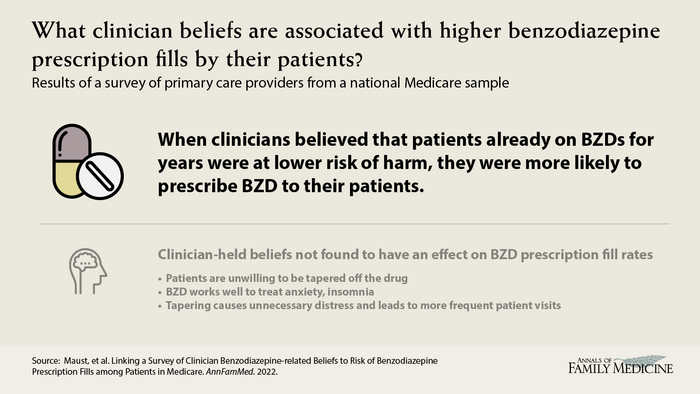
Visual Abstract

Credit: The Annals of Family Medicine

Despite the continuing growth of benzodiazepine (BZD)-related overdoses, BZD prescription rates have held constant. Much is unknown about how a doctor’s own beliefs about BZD use and potential harm to patients might influence their willingness to prescribe the drug. Using a Medicare database, researchers identified primary care providers who had prescribed a BZD in 2017 and surveyed a random sample of 100 doctors on their attitudes around BZD prescribing. Approximately 62% of clinician respondents reported that they disagreed or strongly disagreed with the statement, “If a patient has been prescribed a benzodiazepine for years, the potential harms from continuing the benzodiazepine are low,” while 18.0% agreed or strongly agreed with the statement. When clinicians believed that the potential harms from continuing BZDs were low for patients on long-term treatment, they were more likely to prescribe a BZD to patients for whom they cared.  

Linking a Survey of Clinician Benzodiazepine-related Beliefs to Risk of Benzodiazepine Prescription Fills Among Patients in Medicare
Donovan T. Maust, M.D., MS, et al
Department of Psychiatry and Institute for Healthcare Policy and Innovation, University of Michigan, and Center for Clinical Management Research, VA Ann Arbor Healthcare System, Ann Arbor, Michigan


Pre-embargo article link
Permanent link


Journal

The Annals of Family Medicine

Article Title

Linking a survey of clinician benzodiazepine-related beliefs to risk of benzodiazepine prescription fills among patients in Medicare

Article Publication Date

20-Nov-2022

Share12Tweet8Share2ShareShareShare2

Related Posts

Urinary Clusterin: Tracking Kidney Disease and Treatment Response

February 7, 2026

Personalized Guide to Understanding and Reducing Chemicals

February 7, 2026

Inflammasome Protein ASC Drives Pancreatic Cancer Metabolism

February 7, 2026

Phage-Antibiotic Combo Beats Resistant Peritoneal Infection

February 7, 2026

POPULAR NEWS

  • Robotic Ureteral Reconstruction: A Novel Approach

    Robotic Ureteral Reconstruction: A Novel Approach

    82 shares
    Share 33 Tweet 21
  • Digital Privacy: Health Data Control in Incarceration

    63 shares
    Share 25 Tweet 16
  • Study Reveals Lipid Accumulation in ME/CFS Cells

    57 shares
    Share 23 Tweet 14
  • Breakthrough in RNA Research Accelerates Medical Innovations Timeline

    53 shares
    Share 21 Tweet 13

About

We bring you the latest biotechnology news from best research centers and universities around the world. Check our website.

Follow us

Recent News

Urinary Clusterin: Tracking Kidney Disease and Treatment Response

Personalized Guide to Understanding and Reducing Chemicals

Inflammasome Protein ASC Drives Pancreatic Cancer Metabolism

Subscribe to Blog via Email

Enter your email address to subscribe to this blog and receive notifications of new posts by email.

Join 73 other subscribers
  • Contact Us

Bioengineer.org © Copyright 2023 All Rights Reserved.

Welcome Back!

Login to your account below

Forgotten Password?

Retrieve your password

Please enter your username or email address to reset your password.

Log In
No Result
View All Result
  • Homepages
    • Home Page 1
    • Home Page 2
  • News
  • National
  • Business
  • Health
  • Lifestyle
  • Science

Bioengineer.org © Copyright 2023 All Rights Reserved.